
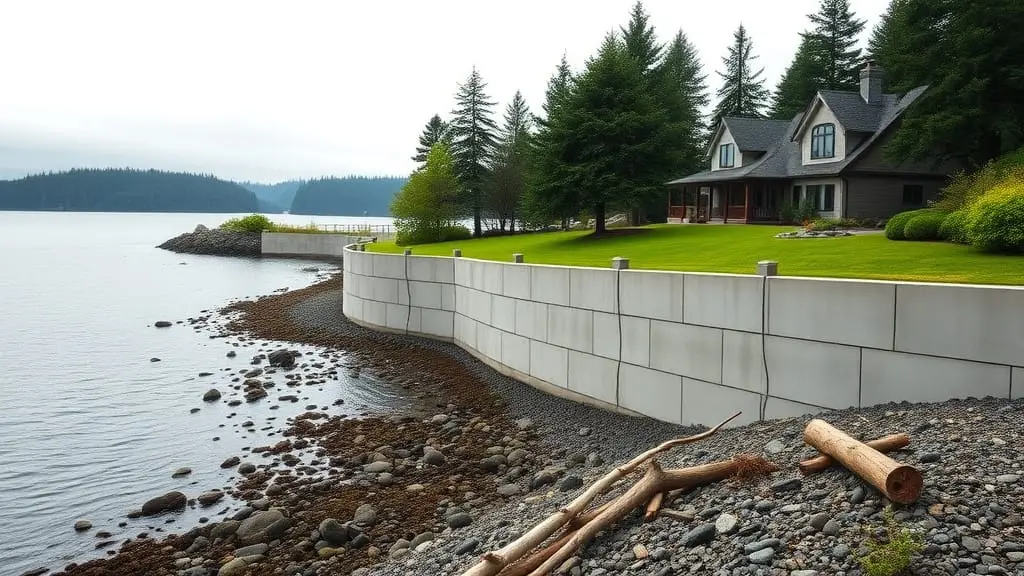
Marine Concrete Construction: Sea Walls & Bulkheads for Whatcom County Waterfront Properties
Bellingham Bay, Birch Bay, Drayton Harbor, and the shorelines of Lake Whatcom and Lake Samish represent some of the most desirable—and challenging—properties in Whatcom County. Waterfront living offers unmatched beauty and recreation, but protecting these properties from erosion, wave action, and tidal forces requires specialized concrete construction that most inland contractors simply don't understand. Over the past 15 years, we've constructed and repaired dozens of sea walls, bulkheads, and shoreline protection systems from Blaine to Semiahmoo to the Edgemoor waterfront, and we've learned exactly what it takes to build marine structures that withstand our unique Pacific Northwest coastal conditions.
Understanding Bellingham's Marine Environment
The Salish Sea environment creates challenges dramatically different from freshwater or inland construction. Bellingham Bay experiences 8-12 foot tidal ranges, exposing structures to wet-dry cycles twice daily. Saltwater is aggressively corrosive, attacking concrete and steel reinforcement through chloride penetration. Winter storm waves can exceed 4 feet in exposed locations, delivering tremendous impact forces. And the biological activity—barnacles, algae, marine vegetation—creates ongoing maintenance demands.
Properties along Birch Bay and Drayton Harbor near Blaine face additional exposure from northwesterly storm winds funneling down the Strait of Georgia. We've repaired storm-damaged bulkheads in Birch Bay where 15 years of winter wind-driven waves progressively undermined structures until catastrophic failure occurred. The same erosion threatens undeveloped shoreline properties—one significant storm can remove 5-10 feet of beach, threatening homes, septic systems, and wells.
Lake Whatcom and Lake Samish present different challenges. While freshwater is less corrosive than saltwater, these lakes have strict watershed protection regulations due to their role as Bellingham's drinking water source. Any construction requires permits ensuring no contamination of water resources, and timing restrictions often apply to protect fish spawning seasons. The Lake Whatcom Management Program has specific requirements for shoreline work that we navigate regularly.
Regulatory Requirements: Navigating Complex Permitting
Marine construction in Washington State involves multiple regulatory layers that can frustrate unprepared homeowners and contractors. All work below the ordinary high water mark requires permits from:
- Washington Department of Fish and Wildlife (WDFW): Hydraulic Project Approval (HPA) ensuring work doesn't harm fish habitat. Timing restrictions typically prohibit in-water work during salmon spawning and migration periods (varies by location but generally mid-July through mid-February allowed).
- Washington Department of Ecology: Section 401 Water Quality Certification ensuring work won't pollute waters. This is particularly rigorous for Lake Whatcom watershed projects.
- U.S. Army Corps of Engineers: Section 404 permit under Clean Water Act for work affecting waters of the United States. Nationwide permits may apply for some bulkhead repairs, while individual permits are required for new construction or major modifications.
- City of Bellingham or Whatcom County: Shoreline substantial development permits under the Shoreline Management Act. Properties within shoreline jurisdiction (generally 200 feet landward from ordinary high water) face design standards, setback requirements, and environmental review.
Permit processes often take 4-6 months and cost $5,000-15,000 depending on project scope and environmental sensitivity. We coordinate all permitting as part of our service, working with marine environmental consultants when needed to prepare required documentation. While permits add time and cost, they're legally required and protect salmon habitat, water quality, and your legal interests—unpermitted marine work creates serious liability and can require expensive removal and restoration.
Sea Wall and Bulkhead Construction Methods
Poured Concrete Sea Walls
Poured-in-place concrete sea walls provide maximum durability and customization for waterfront protection. We excavate to stable bearing material (often bedrock or dense glacial till on Bellingham Bay properties), construct steel-reinforced concrete walls with marine-grade concrete mixes, and backfill with free-draining gravel. Proper drainage behind sea walls is critical—just like retaining walls, hydrostatic pressure will cause failure if water cannot escape.
Marine concrete mixes differ significantly from standard concrete. We specify minimum 4,000 PSI compressive strength with low water-cement ratios (0.40 or less), high cement content, and pozzolanic admixtures (fly ash or slag) that densify the matrix and resist chloride penetration. Many specifications require air entrainment for freeze-thaw resistance even in the marine environment. Steel reinforcement uses epoxy-coated rebar with increased cover (3-4 inches rather than standard 2 inches) to delay corrosion.
Last year, we constructed a 65-foot concrete sea wall on Bellingham Bay near Squalicum Harbor, replacing a failing timber bulkhead that had allowed 15 feet of beach erosion over 20 years. The engineered wall extends 4 feet below mean low water, includes integrated tie-back anchors extending 15 feet into the bank, and was designed for 50-year storm wave loads. Construction occurred during the July-September in-water work window, with environmental monitoring ensuring no sediment discharge to the bay. The wall has now protected the property through two winter storm seasons with no movement or damage.
Poured sea walls cost $400-800 per linear foot depending on height, depth, access, and site conditions. While expensive, they typically provide 50+ years of service with minimal maintenance—far superior to timber bulkheads requiring replacement every 20-25 years.
Concrete Sheet Pile Walls
For deep water or soft bottom conditions where conventional foundations are impractical, concrete sheet piles offer solutions. These precast interlocking concrete panels are driven into the sea bottom using vibratory or impact hammers, creating a continuous wall. Sheet piles work well for docks, piers, and deep-water bulkheads. While less common than poured walls, we've used concrete sheet piles for several Bellingham Bay projects where bottom conditions made conventional construction difficult.
Rip Rap and Revetment Systems
For properties with adequate setback from the water, rip rap (large stone) revetments provide erosion protection with lower cost and environmental impact than vertical walls. We place filter fabric on the existing slope, then install 1-3 ton boulders in engineered configurations that dissipate wave energy while allowing some water movement through the structure. Rip rap works well for Lake Whatcom shorelines where regulations discourage hard armoring, or for Bellingham Bay properties with room for sloped protection.
Properly designed rip rap costs $150-300 per linear foot and can last indefinitely with occasional maintenance to replace displaced stones. It provides better fish and wildlife habitat than vertical walls, sometimes simplifying permitting. We completed a rip rap project on Lake Whatcom last year where the property owner preferred natural appearance and regulatory requirements discouraged vertical bulkheads—the result protects the shoreline while maintaining natural character.
Bulkhead Repair and Replacement
Many Whatcom County waterfront properties have aging timber bulkheads approaching the end of their 20-25 year service life. Common failure modes include rotted piles allowing wall tilting, failed tie-back anchors allowing forward movement, and deteriorated planks allowing soil loss behind the wall. We evaluate failing bulkheads and recommend repair versus replacement based on remaining structural capacity.
When Repair Makes Sense
Bulkheads less than 15 years old with isolated damage—several rotted piles, failed section of wale (horizontal support), or limited plank deterioration—can often be repaired. We replace failed components, install additional tie-backs if needed, and address drainage problems. Repairs typically cost 30-50% of replacement and can extend service life another 10-15 years.
When Replacement is Necessary
Bulkheads over 20 years old with widespread rot, significant tilt or settlement, or multiple previous repairs usually require full replacement. Attempting incremental repairs often proves futile—the structure has reached the end of its design life. We typically recommend concrete replacement for permanent solution, though treated timber is still an option if cost constraints exist. Modern timber bulkheads use larger piles, closer spacing, and more robust tie-back systems than older construction, typically providing better performance than original walls.
Erosion Control for Unprotected Shorelines
Not all waterfront properties have existing bulkheads, and some owners don't want hard armoring. For these situations, we design soft shore protection using vegetation, bio-engineering techniques, and strategic rock placement that controls erosion while maintaining natural character. These approaches work particularly well on Lake Whatcom and Lake Samish where regulations promote natural shoreline functions.
Soft shore protection often combines native vegetation (salal, kinnikinnick, beach grasses) with strategic rock toe protection at the waterline and bioengineering techniques like live stakes or fascines that stabilize slopes. While less protective than concrete or rip rap, these systems cost less, face fewer regulatory hurdles, and maintain habitat values. They work best for low-to-moderate energy shorelines with adequate setback from structures.
Storm Damage Repair and Emergency Response
Coastal storms can damage even well-constructed marine structures. We provide emergency response for storm-damaged bulkheads and sea walls throughout Whatcom County. If your bulkhead fails during a winter storm, temporary protection may involve sandbags, sheet piles, or other emergency measures to prevent additional erosion while permanent repairs are designed and permitted.
Emergency repairs sometimes qualify for after-the-fact permits with expedited review, though this varies by jurisdiction and damage extent. We work with regulatory agencies to secure necessary approvals while protecting your property from additional damage.
Cost Considerations for Marine Construction
Marine construction costs significantly more than comparable inland work due to specialized materials, tidal timing constraints, environmental requirements, and permitting complexity. Typical costs for Whatcom County:
- Concrete sea walls (new construction): $400-800 per linear foot
- Timber bulkhead replacement: $300-500 per linear foot
- Rip rap revetments: $150-300 per linear foot
- Bulkhead repairs: $150-300 per linear foot for partial replacement
- Permitting and engineering: $5,000-15,000 depending on project complexity
Access significantly affects costs. Properties accessible by land with equipment access incur lower costs than remote locations requiring barge access or hand work. Tidal restrictions may require staging work across multiple low tide cycles, increasing labor costs. Rock for rip rap must be barged to sites without land access, adding expense.
Timing and Seasonal Considerations
In-water work windows are strictly regulated to protect fish. For most Whatcom County marine waters, work is allowed July 16 through February 15, though this varies by specific location and species present. Lake Whatcom typically allows work August through February. Planning construction during allowable windows is critical—we schedule projects well in advance to secure materials, equipment, and crews during the limited season.
Weather adds uncertainty to marine construction. Winter storm seasons (November-February) create dangerous working conditions and potential damage to incomplete work, so most projects target July-October completion. We monitor tides and weather forecasts carefully, adjusting schedules to work during optimal conditions.
Long-Term Maintenance
Marine structures require more maintenance than inland concrete due to the harsh environment. We recommend:
- Annual inspection: Check for cracks, spalling, displacement, or undermining after winter storm seasons
- Drainage maintenance: Ensure weep holes and drain systems remain clear
- Vegetation control: Remove trees and large plants growing on or near structures—roots can cause damage
- Storm debris removal: Clear logs, kelp, and debris that accumulate during storms to prevent impact damage
Concrete marine structures typically require minor repairs every 10-15 years and major maintenance every 25-30 years. This is still far superior to timber bulkheads requiring replacement every 20-25 years. We provide ongoing maintenance services for structures we've built, catching small problems before they become major repairs.
Protecting Your Waterfront Investment
Whether you're dealing with a failing timber bulkhead on your Edgemoor home, planning new construction for a Birch Bay property, or need erosion control on Lake Whatcom shoreline, marine concrete work requires specialized expertise that few contractors possess. We combine marine construction experience, understanding of Whatcom County's regulatory environment, and knowledge of our local marine conditions to deliver structures that protect your property for decades while complying with environmental requirements that protect our shared marine resources.
Ready to get started? Contact us today for a free estimate — we serve all of Bellingham and Whatcom County.
Why Choose Bellingham Concrete Contractors?


