Concrete Resurfacing: Restoring Bellingham's Aging Driveways & Patios
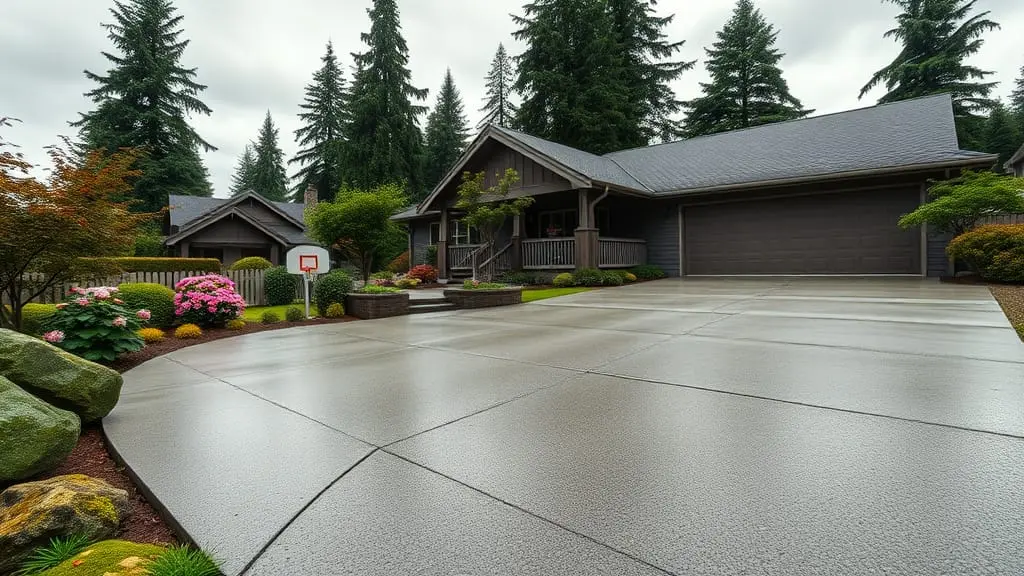
Bellingham's housing stock tells a story through its concrete. Thousands of homes in the Roosevelt, York, Birchwood, and Sehome neighborhoods feature original driveways and patios from the 1960s-80s that are showing their age—surface scaling, network cracking, staining, and deterioration that makes them look tired and reduces property appeal. The good news? Most of this concrete doesn't need complete replacement. Concrete resurfacing offers a cost-effective solution that restores appearance and extends service life another 15-20 years at roughly half the cost of replacement. We've resurfaced hundreds of driveways and patios across Whatcom County, transforming weathered concrete into beautiful surfaces that look brand new.
Why Bellingham Concrete Needs Resurfacing
Our Pacific Northwest climate is uniquely hard on concrete surfaces. While our freeze-thaw cycles aren't as severe as eastern Washington or the Midwest, they still cause damage—particularly when combined with our 40+ inches of annual rain. Water penetrates surface microcracks, freezes during occasional winter cold snaps, expands, and progressively scales and spalls the surface. This damage accelerates on horizontal surfaces (driveways, patios, walkways) exposed to weather.
Moss and algae growth present another challenge specific to our marine climate. Shaded driveways in the Lettered Streets or Fairhaven develop persistent moss that retains moisture, accelerates surface deterioration, and creates slippery conditions. Even power washing provides only temporary relief—moss returns within months without addressing the underlying moisture retention.
Age alone degrades concrete. The calcium hydroxide in concrete reacts with atmospheric carbon dioxide over decades, slowly weakening the surface layer through carbonation. UV exposure breaks down surface cement paste. De-icing salts tracked from roads penetrate concrete and attack from within. By age 30-40 years, even structurally sound concrete often shows significant surface degradation—precisely the situation in many Bellingham neighborhoods developed during the 1960s-80s building boom.
What is Concrete Resurfacing?
Resurfacing applies a thin (1/4 to 1/2 inch) layer of polymer-modified cement overlay to existing concrete, creating a new wearing surface bonded to the old. Modern overlay materials combine Portland cement with polymer resins, creating products that bond tenaciously to existing concrete while resisting cracking, weathering, and wear far better than standard concrete. The result looks like new concrete—because essentially it is—while costing 40-60% less than removal and replacement.
The process works only when underlying concrete remains structurally sound. If your driveway has major cracks with vertical displacement, widespread settlement, or crumbling concrete, resurfacing won't solve the underlying problems—replacement becomes necessary. But for surfaces with cosmetic deterioration—scaling, staining, minor cracking, surface spalling—resurfacing provides excellent results.
The Resurfacing Process: How We Restore Concrete
Surface Preparation
Success depends entirely on proper surface preparation. We begin by thoroughly cleaning the existing concrete using pressure washing (minimum 3,000 PSI) to remove dirt, moss, algae, oil, and loose material. For oil-stained areas common on driveways, we apply degreasers and scrub mechanically. Any existing sealers must be removed since they prevent bonding—we use mechanical grinders or chemical strippers as needed.
Next, we profile the surface using mechanical scarification, grinding, or shot blasting. This creates a rough texture that dramatically improves overlay bonding. The goal is removing weak surface concrete and exposing sound substrate with open pores that accept bonding agents. We also fill or route cracks wider than 1/8 inch, install backer rods and flexible sealants in control joints, and address any minor settlement or drainage issues.
For a typical Bellingham driveway, preparation takes 1-2 full days and generates significant dust and noise. We contain dust with water suppression when possible and schedule work to minimize neighbor disruption. Preparation is messy and tedious—but it's the foundation for long-term success.
Bonding and Overlay Application
Once prepared, we apply primer/bonding agent to the entire surface. These specialized products—typically epoxy or polymer-based—penetrate existing concrete and provide chemical bond between old and new. Primer application timing is critical: overlay must be applied while primer is still tacky (usually 1-4 hours depending on temperature and product).
We mix overlay material according to manufacturer specifications, achieving a pourable but thick consistency. Material is spread using squeegees and trowels, working quickly since most products have 20-30 minute working time before they become too stiff to manipulate. For broom finish, we apply medium-to-coarse broom texture once the overlay reaches proper stiffness. For smooth or decorative finishes, we use specialized trowels and tools to achieve desired appearance.
Thickness matters: too thin and the overlay lacks durability, too thick and it's prone to delamination. We typically apply 1/4 inch for foot traffic areas (patios, walkways) and 3/8-1/2 inch for vehicular traffic (driveways). Multiple thin coats sometimes work better than one thick application, particularly for surfaces with minor irregularities we're filling and smoothing.
Curing and Sealing
Proper curing is critical in Bellingham's climate. We apply curing compound immediately after finishing to prevent rapid moisture loss that causes surface cracking. In hot weather (rare but possible in July-August), we use protective coverings or water fog to maintain moisture. Most overlays achieve sufficient cure for light foot traffic in 24-48 hours and vehicle traffic in 5-7 days, though full strength develops over 28 days.
After proper cure, we seal the surface using penetrating or film-forming sealers. Sealers protect against moisture penetration, staining, and UV degradation while enhancing appearance. For driveways, we typically use high-solids acrylic or polyurethane sealers that provide excellent protection and subtle sheen. Patios might receive decorative sealers that enhance color or create a glossy appearance depending on client preference.
Decorative Options: Beyond Gray
While standard gray overlay restores function, decorative options transform surfaces into true design features. Modern overlay systems support numerous finishes:
Integral Color
Color can be mixed throughout overlay material, creating tans, browns, reds, charcoals, or custom shades. Integral color is permanent—it can't wear off since it permeates the material. We've completed colored overlays throughout Bellingham using earth tones that complement Pacific Northwest landscaping and architecture. A charcoal overlay on a Fairhaven driveway last year created dramatic curb appeal transformation, making the 1970s home feel updated and fresh.
Stamped Overlays
Stamped texture can be applied to overlays just like fresh concrete, creating the appearance of stone, brick, or tile. This combines resurfacing's cost advantages with decorative concrete's aesthetic appeal. Last summer, we resurfaced and stamped a 400-square-foot Sehome patio using random stone pattern with tan and brown coloring—the homeowners now have a surface that looks like expensive flagstone at less than half the cost.
Spray Textures
Specialized spray-applied overlays create subtle textures and can incorporate multiple colors for variegated appearance. These systems work well for pool decks, patios, and other decorative applications. While less common in our climate than warmer regions, we've used spray textures for several covered patio projects where the protected environment suits the product.
Staining and Scoring
After overlay cures, acid or water-based stains can create mottled, variegated coloring that mimics natural stone. Combined with saw-cut scoring to create faux grout lines, stained and scored overlays deliver tile or stone appearance. We completed a stunning entryway last year in the Columbia neighborhood using this technique—the result looks like expensive slate tile but cost about $8 per square foot installed.
Cost Comparison: Resurfacing vs. Replacement
Economics strongly favor resurfacing when underlying concrete is sound. Typical costs in Whatcom County:
- Standard concrete replacement: $8-12 per square foot (includes demolition, disposal, base prep, and new concrete)
- Standard gray overlay: $4-6 per square foot
- Decorative colored overlay: $6-8 per square foot
- Stamped overlay: $8-12 per square foot
For a typical 400-square-foot driveway, replacement costs $3,200-4,800 while basic resurfacing costs $1,600-2,400—a savings of $1,600-2,400. Even decorative stamped overlay at $3,200-4,800 matches replacement cost while avoiding demolition disruption and disposal environmental impact.
Resurfacing also completes faster. Replacement requires demolition (1 day), base prep and forming (1 day), concrete placement and finishing (1 day), and 5-7 day cure before vehicle traffic—total timeline of 8-10 days. Resurfacing typically completes in 3-5 days with less disruption and no heavy equipment tearing up landscaping or creating demolition debris.
Best Candidates for Resurfacing in Bellingham
Resurfacing works beautifully for concrete showing:
- Surface scaling and spalling: Top layer flaking or peeling but underlying concrete sound
- Minor cracking: Hairline to 1/4-inch cracks without vertical displacement
- Staining: Oil, rust, or organic stains that pressure washing won't remove
- Discoloration and weathering: Faded appearance, moss growth, or general aged appearance
- Rough or pitted surface: Uneven texture that's become uncomfortable or unsightly
Neighborhoods with housing stock from the 1960s-80s—Roosevelt, York, Birchwood, parts of Sehome and the Lettered Streets—have thousands of driveways perfect for resurfacing. These homes often have structurally sound original concrete that simply looks tired. Rather than complete replacement, a quality overlay restores appearance and performance at half the cost.
When Replacement Makes More Sense
Resurfacing can't fix structural problems. If your concrete shows these issues, replacement is likely necessary:
- Major settlement: Sections that have settled more than 1 inch creating trip hazards
- Severe cracking: Cracks wider than 1/2 inch, numerous interconnected cracks creating a "cracked egg" appearance, or cracks with vertical displacement
- Spalling through the slab: Deterioration that extends through the full concrete thickness
- Structural failure: Areas where concrete is crumbling, breaking apart, or has lost integrity
- Inadequate base: Settlement caused by poor or failed base materials—resurfacing won't prevent continued settlement
We provide honest assessment. When replacement is truly needed, we'll tell you—even though it costs us the resurfacing job. Our reputation depends on recommending the right solution, not just selling work.
Timing Your Resurfacing Project
Resurfacing requires dry weather and moderate temperatures. Most overlay products require 40°F minimum temperature and 24-48 hours without rain after application. In Bellingham, this makes April-October the practical window, with July-September offering most reliable conditions. We can work during dry windows in October-November, but weather unpredictability makes scheduling challenging.
Surface must be completely dry before overlay application—a challenge in our damp climate even during summer. We sometimes use blowers and heaters to accelerate drying, particularly in shaded areas or after unexpected rain. Planning resurfacing during our driest months ensures best conditions and minimizes weather-related delays.
Maintenance for Longevity
Resurfaced concrete requires minimal maintenance but benefits from attention:
- Resealing every 2-3 years: Maintains moisture protection and appearance, costs $1.50-2.50 per square foot
- Regular cleaning: Annual pressure washing removes organic growth and debris
- Prompt stain treatment: Address oil drips or other stains quickly before they penetrate deeply
- Monitor cracks: Fill minor cracks as they develop to prevent water infiltration
With proper maintenance, quality overlays last 15-20 years in Bellingham's climate—about 75% the lifespan of new concrete at half the cost. When the overlay eventually wears out, the underlying concrete often remains sound, allowing another resurfacing rather than full replacement.
Environmental Benefits
Resurfacing offers significant environmental advantages over replacement. Demolition generates 2-3 tons of concrete waste for a typical driveway, requiring trucking to disposal sites and landfill space. Concrete production is carbon-intensive—cement manufacturing generates roughly 8% of global CO2 emissions. Resurfacing eliminates demolition waste and uses 85-90% less material than replacement, dramatically reducing environmental impact.
For environmentally conscious Bellingham homeowners—a significant portion of our client base—resurfacing aligns with values of reducing waste and minimizing carbon footprint while still achieving excellent results.
Transforming Bellingham's Aging Concrete
Whether your 1970s driveway in the Roosevelt neighborhood needs surface restoration, your Birchwood patio shows decades of weather damage, or your York walkway has developed that tired, worn appearance, concrete resurfacing offers an economical, environmentally responsible solution that delivers dramatic visual improvement without full replacement disruption and cost. We bring decades of resurfacing experience to every project, ensuring proper preparation, quality materials, and installation techniques that deliver long-lasting results in Bellingham's challenging climate.
Ready to get started? Contact us today for a free estimate — we serve all of Bellingham and Whatcom County.
Why Choose Bellingham Concrete Contractors?


