
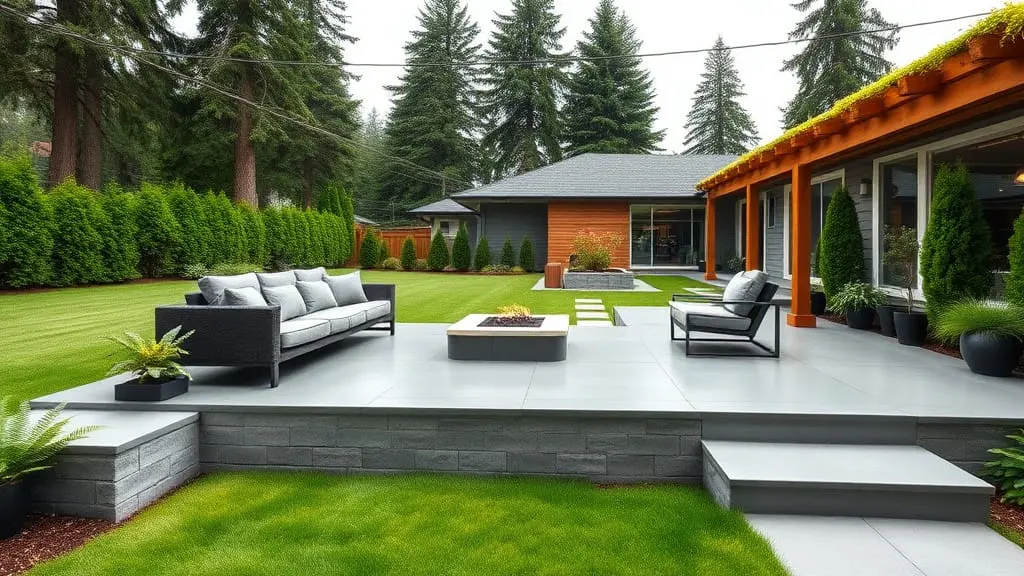
Most people assume outdoor living in Bellingham means four months of patio use and eight months of staring at it through the window. That assumption costs homeowners thousands of dollars in wasted potential. With intentional design choices, a concrete patio in our Pacific Northwest climate can be a functional outdoor room from January through December. The secret is not fighting the weather but designing for it.
Bellingham's climate is actually more moderate than most people realize. Our winter temperatures typically range from 35-45 degrees, rarely dropping into the teens. We get 37 inches of rainfall annually, but much of it arrives as steady drizzle rather than heavy downpours. The real challenge is not extreme weather but persistent dampness, limited daylight from November through February, and the psychological barrier of stepping outside when the sky is gray. A well-designed patio addresses all three.
Rain Protection Strategies That Actually Work
Rain is the single biggest obstacle to year-round patio use in Bellingham. A concrete patio without overhead cover sits unused for roughly 150 rainy days per year. Adding rain protection instantly doubles or triples your annual patio hours.
Permanent Roof Extensions
The most effective rain protection is a solid roof extending over part or all of the patio. This can be a direct extension of the home's existing roofline, a pergola with a solid polycarbonate or metal roof, or a freestanding structure. In neighborhoods like Fairhaven, Edgemoor, and the Lettered Streets where architectural character matters, we work with local builders to design covered structures that complement the home's style.
A covered area does not need to span the entire patio. Many of our most successful year-round patios in South Hill and Sehome use a hybrid approach: a 10-by-12-foot covered section near the house for dining and cooking, transitioning to an open section further out for summer use and fire pit gatherings. The covered section gets used twelve months a year while the open area adds capacity during dry weather.
Budget for a covered patio structure ranges from $5,000-$8,000 for a basic aluminum pergola with polycarbonate panels to $15,000-$30,000 for a custom-framed roof extension that matches the home. This investment typically pays for itself in increased property value and dramatically expanded livable space.
Retractable Options
Retractable awnings and shade sails offer flexible rain protection that can be extended during drizzle and retracted on sunny days. Modern retractable awnings with wind sensors and motorized operation cost $3,000-$7,000 installed and provide reliable coverage for patios up to 20 feet wide. They work well in Cordata and Barkley Village where HOA guidelines may restrict permanent structures.
Heating Solutions for Bellingham's Cool Seasons
Temperature management extends patio season by months. With the right heating approach, outdoor dining and entertaining is comfortable from early March through late November, and even winter gatherings become feasible.
Overhead Radiant Heaters
Electric infrared heaters mounted under a covered patio roof are the most efficient option for Bellingham's climate. Unlike propane patio heaters that warm the air (which promptly blows away), radiant heaters warm people and surfaces directly. A pair of 3,000-watt infrared heaters can keep a 12-by-14-foot covered patio area comfortable when temperatures are in the high 30s.
Installation cost runs $800-$2,000 for a two-heater setup including electrical work. Operating cost in Bellingham, where Puget Sound Energy rates average around 10-12 cents per kilowatt-hour, is roughly $0.60-$0.75 per hour for both heaters. That is less than the cost of a single propane tank refill for a traditional patio heater.
Built-In Fire Features
A concrete fire pit or fireplace integrated into the patio provides both heat and ambiance. Gas fire pits are more practical for Bellingham's year-round use because they ignite instantly, produce no smoke (important in our stagnant winter air), and require no dry firewood storage. A built-in 36-inch gas fire pit radiates enough heat to keep a 10-foot radius comfortable on most Bellingham evenings.
We integrate fire pit bases and gas line conduits directly into the patio concrete pour, which saves $500-$1,000 compared to retrofitting. For properties in Sudden Valley and Silver Beach near Lake Whatcom, where fire restrictions are periodically enforced during dry summers, a gas feature with a shutoff valve ensures compliance while still providing heat during the cooler months when restrictions are lifted.
Heated Concrete Surfaces
Hydronic or electric radiant heating embedded in the concrete slab itself is a premium option that keeps the patio surface warm and dry. The heated surface melts light frost and snow on contact, prevents ice formation, and radiates gentle warmth underfoot. This approach is particularly valuable on covered patios where foot comfort matters, such as outdoor kitchen areas where you stand for extended periods.
Radiant slab heating adds $12-$20 per square foot to the patio cost. For a 200-square-foot covered outdoor kitchen area, that is $2,400-$4,000 in additional material and installation cost. While not inexpensive, homeowners in Edgemoor and Samish who have invested in heated patio surfaces consistently report it as one of the best upgrades they have made.
Drainage Engineering for Year-Round Performance
A patio that floods during October storms or develops ice patches in December is not a year-round outdoor space. Proper drainage engineering is the foundation of all-season performance in Bellingham's 37-inch rainfall climate.
Surface Drainage Design
Every patio we install in Whatcom County slopes at a minimum 2 percent away from the home, with 3-4 percent preferred for covered patios where roof runoff concentrates at the drip edge. On properties with challenging drainage like those on Alabama Hill and South Hill where slope creates runoff velocity, we install channel drains at the patio perimeter to capture sheet flow before it erodes landscaping or pools against foundation walls.
Subsurface Water Management
The glacial till soil throughout Bellingham holds water at or near the surface during the wet season. For year-round patios, especially those with heated surfaces or covered areas where the ground does not receive direct rainfall, we install a French drain system beneath and around the slab perimeter. This 4-inch perforated pipe in a gravel bed intercepts groundwater before it can saturate the soil beneath the slab and cause frost heaving.
Properties in Happy Valley, Columbia, and the lower areas of Geneva near Whatcom Creek are particularly prone to high winter water tables. On these sites, subsurface drainage is not optional for a slab that needs to perform through all four seasons without movement or cracking.
Lighting Design for Dark Pacific Northwest Months
From November through February, Bellingham gets as few as 8.5 hours of daylight, with sunset arriving before 4:30 PM in December. Without thoughtful lighting, your patio is effectively invisible for most of the hours you are home during the week. Year-round lighting design treats the patio as an evening room that needs to be both functional and inviting after dark.
Layered Lighting Approach
- Ambient overhead lighting: Warm-toned LED string lights or pendant fixtures under a covered structure provide general illumination without harsh glare. Color temperature of 2700K mimics candlelight and feels warm on cool evenings
- Task lighting: Focused lights above cooking and dining areas ensure safety and functionality. Recessed can lights in a patio cover or adjustable spotlights on a ledger board work well
- Accent and perimeter lighting: LED strip lights embedded in seat walls, step risers, and planter edges define the patio boundaries and create depth. These low-level lights provide enough illumination to navigate safely without washing out the ambiance
- Landscape uplighting: Spotlights aimed at surrounding trees and architectural features extend the perceived space beyond the patio edge, making the outdoor area feel larger at night than during the day
We integrate electrical conduit and junction boxes into every patio pour, even when clients are not ready to install lighting immediately. The cost during construction is $200-$400 for future-proofing, compared to $1,500-$3,000 for cutting into finished concrete later.
Weather-Resistant Finishes and Surfaces
Year-round use means your patio surface endures more foot traffic, more moisture exposure, and more thermal cycling than a seasonal-use patio. Finish selection matters significantly for both durability and safety.
Slip Resistance in Wet Conditions
A smooth-troweled concrete finish becomes dangerously slippery when wet, and in Bellingham, it is wet often. For year-round patios, we recommend broom finish as the minimum texture, with exposed aggregate or stamped concrete patterns providing even better traction. Adding a non-slip aggregate to the concrete sealer further improves grip without changing the appearance.
Sealer Selection for Maximum Durability
Year-round patios in our climate need a penetrating sealer rather than a film-forming sealer. Film-forming sealers sit on the surface and can peel or turn white when trapped moisture tries to escape, a common failure in Bellingham's humid conditions. Penetrating sealers absorb into the concrete, providing water resistance from within while allowing the slab to breathe. These sealers cost $0.15-$0.30 per square foot per application and need renewal every 2-3 years in our climate.
Outdoor Kitchen Integration
An outdoor kitchen transforms a patio from a sitting area into a genuine living space. In the Pacific Northwest, outdoor kitchens are increasingly popular because they extend the home's entertaining capacity without the cost of an interior renovation.
Concrete Countertops and Built-In Features
Concrete countertops are ideal for Bellingham outdoor kitchens because they are durable, weather-resistant, and can be poured to any shape or size. A typical outdoor kitchen counter with integrated grill opening, sink cutout, and serving area runs $3,000-$6,000 for the concrete work. Combined with a covered overhead structure, this creates a cooking station usable ten or more months per year.
Essential outdoor kitchen features for Bellingham's climate include adequate counter drainage so rainwater does not pool on surfaces, sealed concrete that resists staining from food and grease, and electrical outlets rated for wet locations. Properties in Ferndale, Lynden, and Blaine with larger lots often accommodate full outdoor kitchens with dedicated concrete pads, built-in seating for eight or more, and permanent roofing structures.
Seasonal Maintenance Calendar
Year-round patio use requires year-round maintenance. Here is a simple schedule for Bellingham homeowners:
- Spring (March-April): Power wash to remove winter moss and algae buildup. Inspect sealer condition and reapply if water no longer beads on the surface. Check drainage paths for debris blockage
- Summer (May-August): Clean cooking areas after each use. Apply UV-resistant sealer if due. Inspect expansion joints and fill any gaps with flexible sealant
- Fall (September-October): Clear leaves and organic debris that trap moisture and stain concrete. Verify drainage channels are clear before the wet season. Test heating systems before cold weather arrives
- Winter (November-February): Keep surface clear of standing water and ice. Use calcium chloride sparingly for ice melt and avoid rock salt which can damage concrete. Brush away heavy snow rather than letting it compact
The Year-Round Patio Investment
A patio designed for twelve-month use in Bellingham typically costs 30-50 percent more than a basic summer-only installation when you factor in covered structures, heating, lighting, and enhanced drainage. For a 300-square-foot patio, that might mean $12,000-$20,000 total compared to $4,500-$7,500 for an uncovered basic slab. But the math favors the year-round design. You gain roughly 200 additional days of outdoor living per year, and the covered, heated space adds measurable resale value to your home.
In a region where indoor square footage costs $300-$500 per foot to build, creating 300 square feet of year-round outdoor living space for $40-$65 per foot is an exceptional value, particularly in neighborhoods like Fairhaven, Edgemoor, and South Hill where outdoor living is a key selling point.
Ready to get started? Contact us today for a free estimate — we serve all of Bellingham and Whatcom County.