
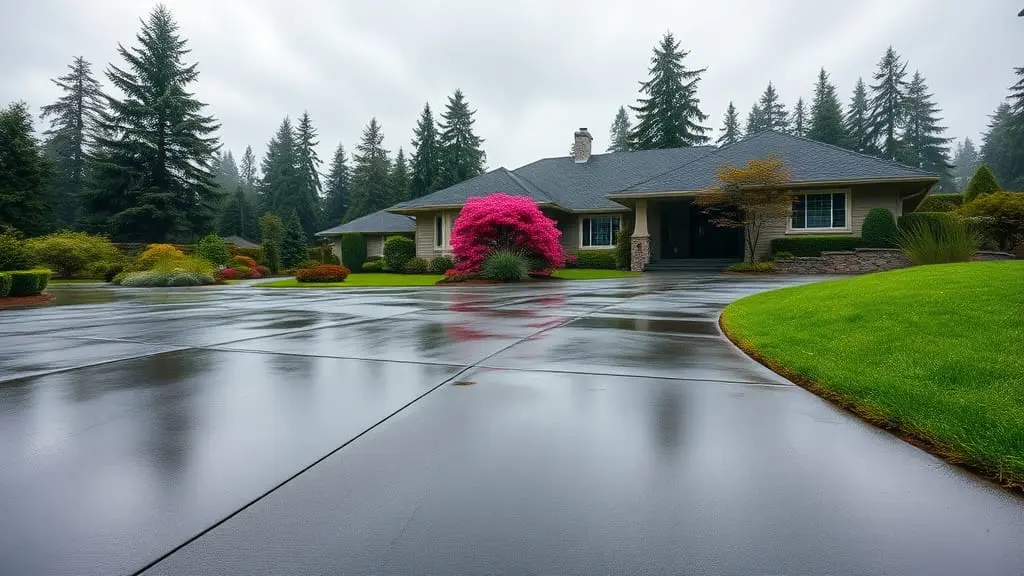
Every concrete surface will eventually develop some form of cracking. It is an inherent characteristic of the material, not a defect. However, there is an enormous difference between controlled, nearly invisible cracks that are engineered into the design and uncontrolled structural cracks that compromise the integrity of your driveway, patio, or foundation. In the Pacific Northwest, and specifically in Bellingham's demanding marine climate, the forces acting on concrete are more aggressive than in most regions of the country.
As concrete contractors who have poured and maintained thousands of projects across Whatcom County, we have studied how our local conditions interact with concrete to cause cracking, and we have refined our techniques over decades to minimize it. Understanding why cracks form gives you the knowledge to make informed decisions about prevention, repair, and when to call for professional assessment.
The Science of Concrete Cracking
Concrete is extremely strong in compression (it can bear enormous weight) but weak in tension (it resists pulling forces poorly). When internal or external forces create tension that exceeds the concrete's tensile strength, a crack forms. Every type of concrete crack traces back to this fundamental principle.
How Concrete Cures and Why That Matters
Concrete does not dry. It cures through a chemical reaction called hydration, where water reacts with Portland cement to form calcium silicate hydrate crystals that bind the aggregate together. This reaction generates heat and causes the concrete to shrink as it hardens. The shrinkage is unavoidable, but the cracking it can cause is controllable.
In Bellingham, the curing environment significantly affects crack risk. Our cool, humid conditions between October and April slow the hydration reaction, which actually produces stronger concrete over time. But the temperature and moisture differentials between a slab's surface and its interior create stress that can cause early cracking if not managed properly. A pour on a sunny July afternoon in Cordata or Barkley Village, where open lots get full sun exposure, faces the opposite problem: rapid surface drying that pulls moisture away from the top layer faster than it can be replaced from below.
Types of Concrete Cracks Common in Bellingham
Plastic Shrinkage Cracks
These form within the first few hours after pouring, before the concrete has hardened. They appear as short, random cracks on the surface, typically 1-2 feet long, and occur when the surface dries faster than the interior. In Bellingham, plastic shrinkage cracks are most common during summer pours when wind and direct sun accelerate surface evaporation.
Neighborhoods with more wind exposure, like the hilltop properties on Alabama Hill and South Hill, are particularly susceptible. We have seen brand-new patios develop plastic shrinkage cracks within hours because the concrete was poured during a dry east wind event. Prevention involves proper curing practices: applying curing compound immediately after finishing, using evaporation retardants during the pour, and erecting wind breaks on exposed sites.
Drying Shrinkage Cracks
As concrete cures over weeks and months, it continues to lose moisture and shrink. A typical concrete slab shrinks approximately 1/16 inch per 10 feet of length. Over a 20-foot driveway, that amounts to 1/8 inch of total shrinkage. This shrinkage is restrained by the subgrade, the edges, and any embedded reinforcement, creating internal tension that results in cracking.
Control joints (also called contraction joints) are the primary defense against drying shrinkage cracks. These are the grooves you see cut or tooled into concrete surfaces, dividing them into panels. The joints create intentional weak points where the concrete cracks in a straight, controlled line rather than randomly across the surface. We cut control joints to a depth of 1/4 the slab thickness, at intervals no greater than 2-3 times the slab thickness in feet. For a standard 4-inch residential slab, that means joints every 8-12 feet.
In Bellingham, we lean toward tighter joint spacing than the maximum allows, typically 8-10 feet, because our climate's moisture cycling puts additional stress on slabs. Driveways in Sunnyland, Geneva, and Columbia that were poured with 15-foot joint spacing routinely develop uncontrolled cracks between the joints.
Settlement Cracks
Settlement cracks occur when the ground beneath the concrete compacts unevenly, causing one section of the slab to drop relative to its neighbors. These are concerning because they indicate a subgrade problem, not a concrete problem.
Bellingham's glacial till soil is a frequent contributor. This dense, variable soil contains pockets of clay, sand, and organic material that compact differently under load. Properties throughout Sehome, the Lettered Streets, and Fairhaven sit on decades-old fill material not engineered to modern standards. We have repaired foundation settlement in York and Columbia where slabs dropped over an inch due to poorly compacted fill. Tree root decomposition is another common cause. When a large Douglas fir or cedar is removed, the root system decays over several years, creating voids. We advise homeowners in Edgemoor and Silver Beach to wait at least two years after major tree removal before pouring concrete, or to excavate and replace the root zone with compacted structural fill.
Freeze-Thaw Damage
Freeze-thaw cracking is the most uniquely destructive force acting on concrete in Bellingham. Unlike the dramatic deep freezes of the Midwest, our damage comes from dozens of moderate freeze-thaw cycles per winter, each doing small but cumulative damage.
The mechanism is straightforward. Water enters concrete pores during rain. Overnight temperatures drop to 28-32 degrees. The water freezes and expands by 9%, creating hydraulic pressure inside the concrete. The concrete thaws the next day, more water enters the now-slightly-enlarged pores, and the cycle repeats. Over 30-50 cycles per winter, this process causes surface scaling (thin layers of concrete flaking off), pop-outs (small craters where aggregate near the surface breaks free), and eventually structural cracking.
Air-entrained concrete is the primary defense against freeze-thaw damage. Air entrainment involves adding a chemical admixture during mixing that creates billions of microscopic air bubbles uniformly distributed through the concrete. These bubbles act as pressure relief valves, giving the expanding ice room to grow without fracturing the concrete matrix. The target air content for freeze-thaw resistant concrete in our climate is 5-7% by volume.
Every exterior concrete mix we pour in Whatcom County includes air entrainment. It is non-negotiable. Homeowners who purchase concrete from batch plants for DIY projects should specifically request air-entrained concrete and verify the air content at delivery. We have seen numerous DIY slab installations in Ferndale and Lynden fail within three winters because non-air-entrained concrete was used.
Reinforcement Strategies for Crack Prevention
Reinforcement does not prevent cracks from forming. Instead, it holds the concrete together after cracks develop, keeping them tight and preventing them from widening into structural failures. The right reinforcement strategy depends on the application and local conditions.
Rebar (Steel Reinforcing Bar)
Rebar is the standard for structural concrete applications. For residential flatwork in Bellingham, we typically use #4 rebar (1/2-inch diameter) placed in a grid pattern on 18-24 inch centers. The rebar sits on chairs approximately 2 inches from the bottom of the slab, positioning it in the tension zone where cracks initiate.
For driveways, garage slabs, and any concrete that will support vehicle traffic, rebar is essential. The repeated loading from vehicles creates flexural stress that can cause rapid crack propagation in unreinforced concrete. We specify rebar for all driveway installations throughout Whatcom County, regardless of soil conditions.
Welded Wire Reinforcement (WWR)
Welded wire mesh (commonly 6x6 W1.4/W1.4) provides distributed reinforcement for residential slabs like patios, walkways, and light-duty applications. It is less expensive than rebar and faster to install. In Bellingham, we use WWR for most patio and walkway projects where vehicle loading is not a factor.
Fiber Reinforcement
Synthetic and steel fibers mixed directly into the concrete provide three-dimensional reinforcement that reduces plastic shrinkage cracking and improves impact resistance. Not a substitute for rebar in structural applications, but an excellent supplement. We add polypropylene fiber at 1.5 pounds per cubic yard to virtually every residential pour in Bellingham. The cost is minimal ($8-$12 per cubic yard) and it significantly reduces early-age cracking. For stamped concrete in Fairhaven and the Lettered Streets where appearance is paramount, fiber reinforcement prevents the fine surface cracks that detract from decorative finishes.
Proper Curing in Bellingham's Climate
Curing is the process of maintaining adequate moisture and temperature in freshly poured concrete for the hydration reaction to continue. Inadequate curing is responsible for more concrete failures than any other single factor.
Curing Challenges in Our Climate
Bellingham presents a paradox for concrete curing. During our wet season (October through April), there is plenty of ambient moisture but temperatures can be too low for optimal curing. During our dry season (May through September), temperatures are ideal but surface drying can be too rapid.
- Wet season pours: We protect fresh concrete from rain with temporary shelters for the first 4-6 hours until initial set occurs. After that, the rain actually helps keep the surface moist. Our bigger concern is temperature. Concrete should not be poured when ambient temperatures are below 40 degrees Fahrenheit, or when they are predicted to drop below 40 within 24 hours of the pour. We monitor weather closely and schedule accordingly. Hot water can be used in the mix when temperatures are marginal.
- Dry season pours: We apply liquid curing compound immediately after finishing. This membrane seals in moisture and prevents the surface from drying faster than the interior. On particularly hot or windy days in exposed areas like Cordata and Barkley Village, we supplement with wet burlap or curing blankets.
Minimum Curing Duration
We maintain curing protection for a minimum of 7 days on all exterior concrete in Whatcom County. The American Concrete Institute recommends 7 days for standard concrete, but in our climate we often extend to 10-14 days for flatwork that will face winter exposure within its first year. The longer the curing period, the stronger and more durable the finished product.
When Cracks Are Cosmetic vs. Structural
Not all cracks require professional intervention. Understanding the difference saves unnecessary expense and prevents ignoring cracks that do need attention.
Cosmetic Cracks (Monitor but No Immediate Action Needed)
- Hairline cracks less than 1/16 inch wide: These are normal drying shrinkage cracks and pose no structural concern. They can be sealed to prevent water infiltration but do not affect the slab's integrity.
- Cracks that follow control joints: This is exactly what control joints are designed to do. A crack running along the bottom of a control joint means the joint is working as intended.
- Spider web or map cracking (crazing): Fine, shallow cracks covering the surface in a pattern resembling a spider web. These are caused by surface drying during finishing and affect only the top 1/16 inch of the slab. Cosmetic only.
Structural Cracks (Professional Assessment Recommended)
- Cracks wider than 1/4 inch: These indicate significant stress or settlement and should be evaluated promptly.
- Cracks with vertical displacement: If one side of the crack is higher than the other, the subgrade has failed and the slab is settling unevenly.
- Cracks that are actively widening: Mark the ends of the crack and measure its width monthly. If it is growing, the underlying cause needs to be addressed.
- Cracks in foundation walls: Horizontal cracks in basement or crawlspace walls can indicate dangerous lateral soil pressure, especially in Bellingham's saturated glacial till during winter months. These require immediate professional evaluation.
- Multiple parallel cracks in a driveway: Often indicates inadequate thickness, missing reinforcement, or subgrade failure. The slab may need resurfacing or replacement.
Cost of Crack Prevention vs. Repair
Investing in proper crack prevention during initial construction is dramatically less expensive than repairing or replacing cracked concrete later. Here is a cost comparison for a typical 600-square-foot Bellingham driveway:
- Air-entrained concrete (vs. standard): Additional $0-$3 per cubic yard, approximately $10-$20 total
- Fiber reinforcement: $8-$12 per cubic yard, approximately $50-$75 total
- Proper control joint spacing: No additional cost (it is a matter of technique)
- Rebar reinforcement: $1.50-$2.50 per square foot, approximately $900-$1,500 total
- Curing compound application: $0.10-$0.20 per square foot, approximately $60-$120 total
- Total prevention investment: $1,020-$1,715
Compare that to repair costs:
- Crack filling and sealing: $300-$800 (temporary, recurring)
- Slab jacking for settlement: $1,500-$4,000
- Partial replacement: $2,000-$5,000
- Full driveway replacement: $6,000-$12,000
Prevention costs less than 15% of the price of replacement and delivers decades of service. In Bellingham's climate, cutting corners on concrete construction is a false economy that we see punished by nature within just a few winters.
Whether you are planning a new pour or assessing cracks in existing concrete, understanding the forces at work beneath the surface empowers you to make smart, cost-effective decisions. Our team brings decades of Pacific Northwest concrete experience to every project, from the hilltops of South Hill to the waterfront properties of Birch Bay and Blaine.
Ready to get started? Contact us today for a free estimate — we serve all of Bellingham and Whatcom County.