
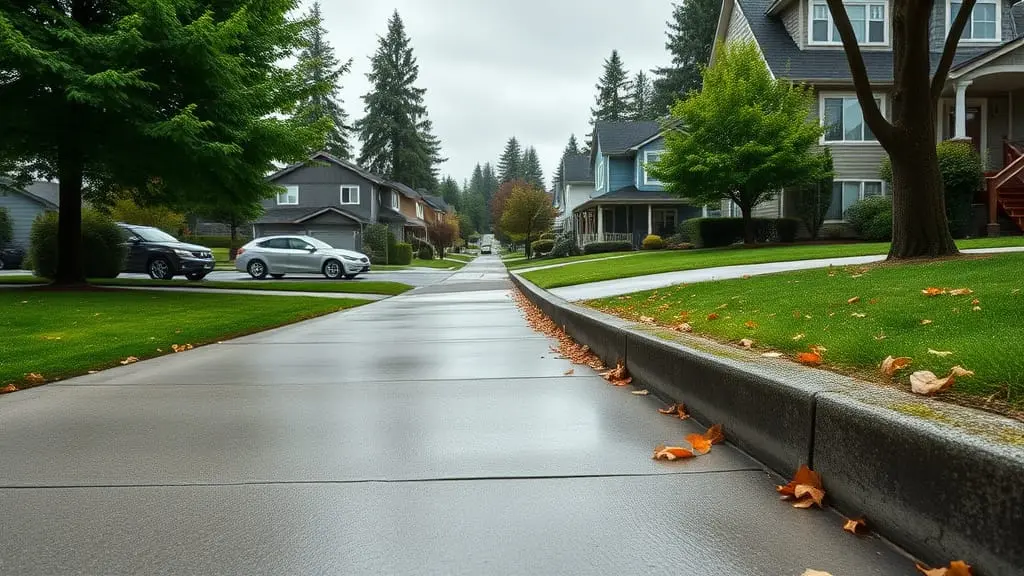
Walk through any established Bellingham neighborhood and you will see the evidence: buckled sidewalk panels, jagged cracks radiating outward, and uneven surfaces that turn a simple stroll into a tripping hazard. The culprit is almost always tree roots. Bellingham's urban forest is one of the city's defining features, but it comes with a concrete consequence that homeowners in the Lettered Streets, Sehome, South Hill, and Fairhaven know all too well.
As sidewalk and curb contractors serving Whatcom County for over two decades, we have repaired and replaced thousands of linear feet of root-damaged concrete. The problem is not going away. Bellingham's tree canopy continues to mature, and the conflict between underground root systems and rigid concrete surfaces intensifies with every passing year. Understanding why this happens, what your options are, and how to prevent future damage can save you thousands of dollars and protect both your property and your trees.
Why Bellingham's Trees Are Especially Destructive to Concrete
Not every city has our level of tree-root damage. Three factors unique to Bellingham and Whatcom County make the problem particularly severe here.
Species With Aggressive Root Systems
The Pacific Northwest is home to some of the most vigorous root-producing tree species in North America. The three worst offenders for concrete damage in Bellingham are:
- Douglas fir (Pseudotsuga menziesii): The iconic PNW conifer sends lateral roots spreading 20-30 feet from the trunk. These roots stay within the top 12-18 inches of soil, putting them directly in the path of sidewalk slabs. Mature specimens in Sehome and the Lettered Streets have root systems that extend well beneath streets and into neighboring properties.
- Western red cedar (Thuja plicata): Cedars have dense, shallow root mats that spread widely. Their fibrous roots fill every available inch of topsoil and are notorious for infiltrating gaps beneath concrete slabs, where moisture collects and nutrients are available.
- Big leaf maple (Acer macrophyllum): These deciduous trees are common throughout South Hill, Alabama Hill, and Happy Valley. Their roots are aggressive enough to crack 4-inch concrete slabs and can lift entire sidewalk panels several inches above grade.
Other species that cause problems locally include red alder, black cottonwood, and ornamental cherry trees planted in neighborhoods like York and Samish.
Bellingham's Soil and Climate Encourage Shallow Root Growth
The glacial till soil underlying most of Bellingham is dense and poorly draining. Tree roots cannot penetrate deep into this compacted layer, so they spread laterally through the softer topsoil instead, staying in the top 18 inches, which is exactly the depth zone where sidewalk bases sit. Our marine climate compounds the issue. With 37 inches of annual rainfall concentrated between October and April, the upper soil layer stays moist for months. The gap between a concrete slab and the compacted base beneath it creates a perfect microenvironment for roots: slightly warmer, consistently moist, and sheltered.
Aging Infrastructure Meets Mature Trees
Many of Bellingham's sidewalks were poured 50 to 80 years ago, when the street trees planted alongside them were saplings. A Big leaf maple with a 4-inch trunk in 1960 now has a 24-inch trunk with a root system spanning the entire front yard. The sidewalks were never designed to accommodate roots of that magnitude. Neighborhoods like the Lettered Streets, Sunnyland, Columbia, and Geneva have some of the worst damage because their infrastructure and trees have aged together for decades.
Assessing the Damage: Repair vs. Replace
Not every root-damaged sidewalk needs full replacement. The decision depends on the severity of displacement, the structural integrity of the remaining concrete, and the likelihood of recurring damage.
When Repair Is Sufficient
Repairs are viable when the damage is modest and the root causing the problem can be managed without harming the tree. Common repair scenarios include:
- Minor lifting (under 1 inch): Panels lifted less than one inch can sometimes be ground down with a concrete grinder to restore a level surface. This costs $3-$8 per square foot and takes just a few hours. It is a good short-term solution for Fairhaven homeowners who want to address a tripping hazard quickly.
- Hairline cracks without displacement: Cracks that have not caused the panel to shift can be filled with flexible polyurethane caulk designed for concrete joints. Cost: $200-$500 per panel depending on severity.
- Localized root pruning: If a single root is causing the problem and the arborist confirms it can be safely cut without destabilizing the tree, removing the offending root and releveling the panel may be enough. Root pruning combined with slab grinding typically costs $500-$1,200 per panel.
When Full Replacement Is Necessary
Replacement becomes the only practical option when the damage is severe or the underlying conditions guarantee the problem will recur. Indicators that you need concrete removal and replacement include:
- Lifting exceeding 1.5 inches: Panels displaced this far cannot be ground level without making the concrete dangerously thin.
- Multiple cracked panels: When three or more adjacent panels are cracked and displaced, patching individual sections creates an uneven patchwork that looks worse than the original damage.
- Root mass beneath the slab: If excavation reveals a dense mat of roots rather than one or two individual roots, the problem will return quickly unless the entire slab section is replaced with root mitigation measures in place.
- Concrete age over 40 years: Older concrete in Bellingham often has aggregate exposure, scaling from decades of freeze-thaw cycles, and reduced structural integrity. Repair investment in deteriorating concrete yields poor returns.
Full sidewalk replacement in the Bellingham market typically costs $8-$14 per square foot installed, which includes demolition of the existing concrete, base preparation, forming, pouring, and finishing. A standard 4-foot-wide, 40-foot-long sidewalk section runs $1,280-$2,240. Adding root barriers (discussed below) adds $8-$15 per linear foot to the total.
Root Barrier Solutions
If you are replacing a sidewalk in a root-damage zone, installing a root barrier is one of the smartest investments you can make. Root barriers are physical or chemical systems that redirect tree roots downward and away from the concrete surface.
Types of Root Barriers We Install
- Linear root barriers: Sheets of high-density polyethylene (HDPE) or fiberglass installed vertically along the edge of the sidewalk, typically 18-24 inches deep. These physically block lateral root growth toward the slab. Cost: $8-$12 per linear foot installed.
- Ribbed root barriers: Specialized panels with vertical ribs that not only block roots but redirect them downward. These are the most effective option for aggressive species like Big leaf maple and are what we recommend for most Bellingham installations. Cost: $12-$18 per linear foot.
- Deeproot Silva Cell systems: For commercial projects or high-value streetscapes, suspended pavement systems create underground soil volumes that give roots room to grow without contacting concrete. These are expensive ($50-$80 per square foot) but are increasingly used in municipal projects. The City of Bellingham has incorporated them in some downtown and Barkley Village streetscape improvements.
Root Barrier Installation Best Practices for Our Climate
In Bellingham's wet climate, root barrier installation requires attention to drainage. A barrier that blocks water flow can create pooling on one side, which accelerates soil erosion and undermines the sidewalk base. We always install barriers with weep holes or gravel channels at the base to allow water passage while still deflecting roots. This is especially critical on properties in Edgemoor and Silver Beach where slope and drainage patterns are already a concern.
Bellingham's Tree Protection Ordinances
Before you start cutting roots or removing trees to protect your concrete, understand that Bellingham has municipal tree protection regulations that can affect your project.
The City of Bellingham's municipal code includes protections for significant trees, generally defined as trees with a trunk diameter of 6 inches or more measured at 4.5 feet above ground. On residential property, you typically have the right to prune roots on your own land, but there are important restrictions:
- Street trees: Trees in the public right-of-way between the sidewalk and the street are city property. You cannot prune roots, trim branches, or remove these trees without city approval. Contact the City of Bellingham's Public Works department for permits.
- Significant tree removal: Removing a tree over 6 inches in diameter may require a tree removal permit, even on your own property. The city can deny removal if the tree is healthy and the damage can be mitigated by other means.
- Critical root zone protection: Arborists define the critical root zone as an area extending outward from the trunk at a radius equal to 1 foot for every inch of trunk diameter. Root pruning within this zone can destabilize or kill the tree. Most certified arborists in Whatcom County will not recommend cutting roots within half the critical root zone radius.
- Heritage trees: Certain exceptional specimens may have additional protection. Check with the city's planning department before any work near large or notable trees.
We coordinate with local ISA-certified arborists on every project involving root pruning near significant trees. This protects our clients from code violations and ensures the tree's health is preserved whenever possible.
Prevention Strategies for New Sidewalk Installations
If you are installing a new sidewalk or walkway on a Bellingham property with existing trees, proactive planning can prevent root damage entirely.
Routing and Setback
The simplest prevention is adequate distance. We recommend a minimum 6-foot setback between the sidewalk edge and any tree trunk for small ornamental species, and 10-12 feet for large species like Douglas fir and Big leaf maple. On narrow lots common in the Lettered Streets and Sunnyland, this is not always possible, which is when root barriers become essential.
Thicker Slabs and Reinforcement
Standard residential sidewalks are 4 inches thick. In root-prone areas, we pour 5-inch or 6-inch slabs with fiber mesh or welded wire reinforcement. The added thickness and tensile strength make the slab far more resistant to root pressure. The cost increase is modest, typically $1-$3 per square foot, and can delay or prevent root damage for a decade or more.
Compacted Gravel Base
A properly compacted 4-6 inch gravel base beneath the slab serves dual purposes. It provides stable structural support and creates an environment that roots find less hospitable than native soil. Roots prefer soft, moist, nutrient-rich soil. Crushed angular gravel compacted to 95% density offers none of those qualities, discouraging root growth beneath the slab.
Species Selection for New Plantings
If you are planting new trees near concrete, species selection matters. Trees with less aggressive root systems include Pacific dogwood, vine maple, Japanese maple varieties (popular in Fairhaven and Edgemoor), and shore pine. Avoid planting willows, poplars, or silver maples near concrete surfaces, as these are among the most destructive to hardscaping.
Cost Summary for Root Damage Repair and Prevention
Here is a breakdown of typical costs for root-damage projects in the 2025 Bellingham and Whatcom County market:
- Slab grinding (minor leveling): $3-$8 per square foot
- Crack filling and sealing: $200-$500 per panel
- Root pruning with slab releveling: $500-$1,200 per panel
- Full sidewalk replacement: $8-$14 per square foot
- Linear root barriers (HDPE): $8-$12 per linear foot
- Ribbed root barriers: $12-$18 per linear foot
- Arborist consultation: $200-$400 per visit
- City permit for street tree work: $50-$150
A typical project in Bellingham involving the replacement of two sidewalk panels with ribbed root barriers and arborist coordination runs $2,500-$4,500. Larger projects involving full frontage replacement with root mitigation can reach $6,000-$12,000 depending on the scope and complexity of the root system.
When to Take Action
Do not wait until someone trips and falls. Liability for sidewalk injuries on your property frontage rests with the property owner in most cases, and a personal injury claim far exceeds the cost of timely repair. If your sidewalk panels are displaced more than half an inch, it is time to get a professional assessment.
The best time to schedule root-damage repair or replacement work in Bellingham is during the dry season, from late May through September, when soil conditions allow proper excavation and concrete curing is more predictable. We book up quickly during these months, so planning ahead is essential.
We serve homeowners dealing with root damage throughout Bellingham's tree-lined neighborhoods, from the mature canopies of Sehome and the Lettered Streets to the established plantings in Ferndale and Lynden. Our team works with local arborists to find solutions that protect both your concrete and your trees.
Ready to get started? Contact us today for a free estimate — we serve all of Bellingham and Whatcom County.