
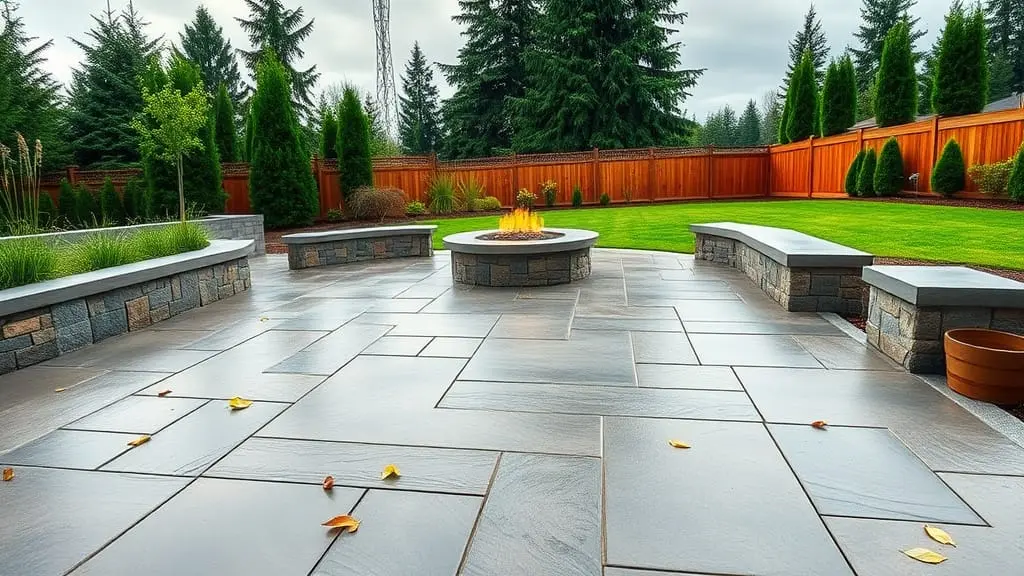
The Pacific Northwest has a visual identity unlike anywhere else in the country. Towering Douglas firs, sword ferns carpeting forest floors, moss-covered boulders, and the muted gray-green palette of our marine climate create a landscape that demands materials and textures in harmony with it. A bright white stamped concrete patio with a geometric tile pattern would look completely out of place in a Fairhaven backyard, just as a tropical flagstone in coral tones would clash with the cedars and hemlocks surrounding a Sudden Valley home.
Choosing stamped concrete patterns that look natural in Bellingham is not just about aesthetics. The right pattern and color combination ages gracefully in our wet climate, hides the inevitable moss and weathering that come with 37 inches of annual rainfall, and requires less maintenance to keep looking intentional. After installing hundreds of stamped concrete projects throughout Whatcom County, we have identified the patterns and color combinations that consistently look best in our Pacific Northwest setting.
Natural Stone Patterns That Belong in the PNW
Ashlar Slate
Ashlar slate is the most popular stamped concrete pattern in the Bellingham market, and for good reason. The pattern replicates the look of hand-cut natural slate in a running ashlar layout with varied stone sizes. The clean lines and natural texture complement both contemporary homes in Cordata and Barkley Village and craftsman-style residences in Sehome and the Lettered Streets.
What makes ashlar slate particularly effective in our climate is the subtle surface texture. Natural slate has a slight riven quality, with gentle ridges and variations that look even better when damp. Unlike smoother patterns that can appear washed-out on rainy days, the slate texture catches and scatters light on wet surfaces, maintaining visual depth and interest through our long rainy season. The grout lines between stamps also disguise any minor moss growth that occurs between sealant applications.
Cost for an ashlar slate stamped patio in Bellingham runs $15-$22 per square foot, depending on color complexity and whether accent colors are used in the grout lines.
Random Flagstone
Random flagstone stamps replicate the irregular, organic shapes of naturally split stone. This pattern is the best choice for patios that will be surrounded by naturalistic landscaping, which describes the majority of Bellingham backyards. The irregular edges and varied stone sizes create a surface that looks like it was laid by hand from locally quarried stone.
We have installed random flagstone patios in wooded settings throughout Edgemoor, Silver Beach, and Sudden Valley where the stamped concrete blends so seamlessly with the surrounding landscape that visitors often assume it is real stone. The key is selecting colors that match the stone types actually found in our region. Whatcom County's native stone tends toward cool grays, blue-grays, and mossy greens rather than the warm sandstone tones common in stamped concrete catalogs from national manufacturers.
Random flagstone is also forgiving of the slight imperfections that can occur during the stamping process. The intentionally irregular pattern means minor variations in stamp depth or color application look natural rather than like mistakes. This makes it an excellent choice for larger patio areas and walkways where maintaining perfect stamp alignment over 400 or more square feet becomes challenging.
European Cobblestone
Cobblestone stamps create the appearance of traditional hand-set stone in either running bond or fan patterns. This option works beautifully for driveway aprons, walkway borders, and transition areas between different concrete surfaces. In Bellingham's historic neighborhoods like Fairhaven and the Lettered Streets, cobblestone stamping complements the early-1900s architectural character without the maintenance headaches of actual cobblestones, which can shift and settle in our wet soil.
The fan cobblestone pattern in particular suits properties with curved walkways and rounded patio edges. The radiating fan shape follows curves naturally, whereas rectangular patterns can look forced on non-linear surfaces. We have used fan cobblestone on several Boulevard Park and Sunnyland properties where curved front walkways lead from the driveway to the front door.
Wood Plank Patterns for PNW Character
Concrete stamped to look like wood planks might seem counterintuitive, but in the Pacific Northwest it makes exceptional sense. Wood decking is a constant battle against moss, rot, and structural deterioration in our wet climate. Wood plank stamped concrete provides the warm, natural appearance of timber without any of the maintenance burden.
Board-Form and Wood Grain Stamps
Modern wood plank stamps are remarkably realistic. The patterns include grain lines, knots, saw marks, and natural variation between boards. When colored appropriately in weathered cedar, reclaimed barn wood, or driftwood gray tones, these stamps are nearly indistinguishable from real wood at conversational distance.
This pattern is especially popular for pool deck areas, outdoor entertaining spaces, and patios where homeowners want the warmth of wood without the perpetual maintenance battle. In neighborhoods like Samish and Geneva where mature tree canopy creates heavy shade and moisture, real wood decking typically requires replacement every 10-15 years. A wood plank stamped concrete patio lasts 25 or more years with periodic resealing.
Cost for wood plank stamped concrete in Bellingham ranges from $16-$24 per square foot. The premium over basic slate patterns reflects the additional coloring work required to create realistic wood grain variation.
Color Choices That Complement the PNW Palette
Pattern selection is only half the equation. Color choice determines whether stamped concrete looks natural in our landscape or stands out awkwardly against the surrounding greenery. Bellingham's visual environment is dominated by deep greens, cool grays, brown bark tones, and the silvery weathered wood of Pacific Northwest architecture.
Colors That Work in Whatcom County
- Slate gray with charcoal release: The most versatile combination for our region. The cool gray base blends with our overcast skies and native stone while the charcoal release agent deepens grout lines and texture to create natural-looking shadow and dimension
- Sandstone with walnut release: A warm neutral that complements cedar-sided homes common throughout South Hill, Happy Valley, and Ferndale. The walnut release prevents the sandstone from reading too warm or yellowed in our cool-toned light
- Pewter with dark gray release: A slightly warmer gray that works exceptionally well with modern architecture and fiber cement siding. Popular in newer developments in Cordata and Barkley Village
- Forest brown with dark walnut release: A rich earth tone that harmonizes with bark mulch, native soil, and the brown tones in Douglas fir and Western red cedar bark. Best for wooded settings in Edgemoor, Silver Beach, and Sudden Valley
- Weathered gray with slate release: Mimics the silvery patina of naturally aged wood, perfect for complementing driftwood-gray siding and aged cedar shingle homes found throughout older Bellingham neighborhoods
Colors to Avoid in Our Climate
- Bright terra cotta and coral: These warm Mediterranean tones clash with our cool, green landscape and look increasingly unnatural as algae growth mutes the surface over time
- Pure white or cream: Shows every stain, moss spot, and dirt mark in a climate where surfaces stay damp for months. Maintenance becomes a constant battle
- Vivid red brick tones: While appropriate in some regions, the bright red-orange of traditional brick stamping looks artificial against Bellingham's muted natural palette
- Very dark charcoal or black: Absorbs heat on sunny summer days, and in shaded PNW yards, creates a dark, heavy appearance that makes outdoor spaces feel smaller and less inviting
Two-Tone and Accent Color Techniques
The most natural-looking stamped concrete installations in Bellingham use a two-tone or three-tone color approach. Natural stone is never one uniform color. It contains veins, deposits, and weathering patterns that create subtle variation across the surface.
Integral Color Plus Release Agent
The standard approach uses an integral color mixed into the concrete batch as the base tone, with a contrasting release agent applied before stamping. The release agent settles into the stamp's texture lines, creating depth and shadow that make the pattern read as three-dimensional. This two-color approach is included in standard stamped concrete pricing.
Hand-Applied Accent Staining
For premium installations, our finishers can hand-apply acid stain or water-based stain to individual stones after the concrete has cured. This creates variation where some stones are slightly darker or warmer than others, replicating the natural variation you see in a real stone patio. This technique adds $3-$6 per square foot but produces results that are virtually indistinguishable from natural stone, even on close inspection.
We have used this technique on high-end patios in Edgemoor and Fairhaven where the stamped concrete needed to match the quality level of surrounding landscaping and architecture. The multi-tone treatment also ages more gracefully than single-color stamping because the intentional variation masks the subtle color changes that occur as concrete weathers over years of PNW exposure.
Pattern and Color Trends in Bellingham
Concrete design trends in the Bellingham market consistently favor natural and understated over bold and dramatic. Here is what we are seeing the most demand for in recent projects across Whatcom County:
- Large-format ashlar patterns with 18-to-24-inch stone sizes are replacing the smaller 12-inch patterns that dominated a decade ago. Larger stones create a more contemporary feel and reduce the visual busyness of the surface
- Seamless texture stamps that create a stone-like surface without visible grout lines are gaining popularity for modern homes. These produce a monolithic appearance with natural texture but no defined stone shapes
- Exposed aggregate borders combined with stamped interior fields create visual interest at patio edges while keeping the main surface smooth and comfortable for furniture
- Matte sealers are preferred over high-gloss finishes. A wet-look sealer makes stamped concrete look like a decorative product rather than natural stone. Low-sheen sealers maintain the natural appearance while still protecting the surface
Longevity of Stamped Concrete in Bellingham's Climate
A properly installed and maintained stamped concrete patio in Whatcom County lasts 25-30 years or longer. The critical maintenance task is resealing every 2-3 years. In our wet climate, the sealer is what prevents water penetration that leads to freeze-thaw damage and color fading. Homeowners who maintain their resealing schedule consistently see their stamped concrete patios looking excellent after 15 or more years.
Pattern choice affects long-term appearance more than most homeowners realize. Patterns with deep texture lines, such as random flagstone and cobblestone, hide wear better than shallow patterns like smooth ashlar. In high-traffic areas like walkways and front entry paths, deeper textures maintain their visual impact even as the surface gradually wears over decades of use.
When you are ready to explore stamped concrete options for your Bellingham property, we bring physical stamp samples and color charts to your home so you can see how different combinations look against your house exterior and landscaping. Viewing options in your actual setting, under our PNW sky and surrounded by your existing landscape, produces far better decisions than choosing from a catalog or showroom display under artificial lighting.
Ready to get started? Contact us today for a free estimate — we serve all of Bellingham and Whatcom County.