
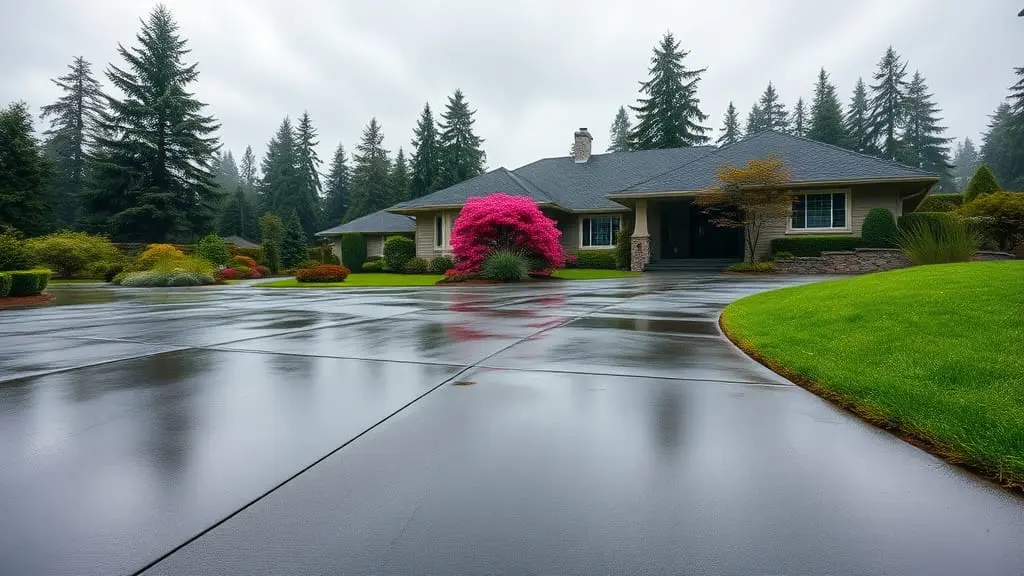
Stamped concrete is one of the most popular decorative hardscaping choices across Whatcom County—and for good reason. It delivers the look of natural stone or brick at a fraction of the cost. But unlike standard concrete, stamped concrete demands a specific maintenance routine to protect its color, pattern, and structural integrity, especially in our marine climate. The difference between stamped concrete that looks stunning after 20 years and stamped concrete that looks tired after five almost always comes down to maintenance.
This guide provides a complete, season-by-season maintenance plan tailored for Whatcom County conditions—37 inches of annual rainfall, persistent moisture from October through April, freeze-thaw cycling, and the moss growth that defines the Pacific Northwest. Whether your stamped patio is in Fairhaven or Ferndale, Sehome or Sudden Valley, these practices will maximize its lifespan.
Your Annual Maintenance Calendar
Timing your maintenance tasks correctly is just as important as doing them. Here's the seasonal breakdown that works best for Bellingham's climate patterns.
Spring (March - May): Deep Clean and Inspect
Spring is your most important maintenance window. After months of rain, fallen leaves, and potential freeze-thaw damage, your stamped concrete needs thorough attention before summer.
- Full surface inspection: Walk every square foot of your stamped concrete looking for new cracks, scaling, discoloration, or areas where the sealer has failed. Pay extra attention to control joints, edges, and areas near downspouts where water concentration is highest
- Debris removal: Clear all leaves, pine needles, and organic matter that has accumulated over winter. In neighborhoods with heavy tree cover—like Samish, Happy Valley, and South Hill—this debris traps moisture and accelerates deterioration if left in place
- Moss and algae treatment: Apply a moss killer (zinc sulfate solution or commercial moss treatment) to any areas showing green growth. Allow the product to work for 2-3 weeks before pressure washing. For heavy moss in chronically shaded areas, consider a preventive moss treatment in early spring before growth accelerates
- Pressure washing: After moss treatment has taken effect, pressure wash the entire surface using a fan-tip nozzle at 2,500-3,000 PSI maximum. Keep the nozzle 8-12 inches from the surface and work at a consistent angle to avoid etching patterns. Never use a zero-degree nozzle tip on stamped concrete—it will gouge the surface and strip the sealer
- Crack documentation: Photograph any cracks you find, noting their location and approximate size. This creates a baseline for monitoring whether cracks are stable or expanding over time
Summer (June - August): Seal and Protect
Bellingham's drier summer months are the ideal window for resealing—the one maintenance task that single-handedly does more for your stamped concrete's longevity than everything else combined.
- Resealing (every 2-3 years): If your stamped concrete is due for resealing, summer is the time. The sealer needs 24-48 hours of dry, warm conditions to cure properly—something that's nearly impossible to guarantee from October through May. Ideal application conditions are 50-85°F with no rain forecast for 48 hours
- Stain treatment: Address any stains that didn't come out during spring cleaning. BBQ grease, rust from patio furniture legs, and beverage stains are common summer culprits. Use a pH-neutral concrete cleaner—never muriatic acid on stamped concrete, as it will etch the surface and destroy the color
- Furniture pad check: Inspect the pads under patio furniture legs. Metal furniture without protective pads will scratch and rust-stain the sealer. Replace worn pads and consider felt or rubber glides under heavy pieces
- Weed control: Pull any weeds growing from control joints or cracks. Apply a joint-specific herbicide to prevent regrowth. In areas like Cordata and Barkley Village where landscaping borders hardscaping, be especially vigilant about vegetation encroachment
Fall (September - November): Prepare for Wet Season
Fall maintenance is about defense—preparing your stamped concrete to withstand six months of near-continuous moisture.
- Gutter and drainage check: Ensure all gutters, downspouts, and surface drains near your stamped concrete are clear and functioning. Water pooling on stamped concrete during winter is the number one cause of freeze-thaw damage. We've seen beautiful installations in the Lettered Streets district and Edgemoor ruined by a single misdirected downspout
- Pre-winter cleaning: Do a thorough sweep and light pressure wash to remove early leaf fall and organic debris before the wet season sets in. Once November arrives, conditions are too wet for effective cleaning
- Sealer spot-check: Splash water on the surface in several locations. If water beads up and sits on the surface, the sealer is performing well. If water soaks in and darkens the concrete within 30 seconds, the sealer has failed in that area and needs attention—ideally before winter. If resealing is needed but you missed the summer window, a warm, dry spell in early October may offer a last chance
- Crack sealing: Fill any cracks identified during spring inspection that haven't been addressed. Use a color-matched flexible sealant designed for decorative concrete. Sealing cracks before winter prevents water intrusion and freeze-thaw expansion
Winter (December - February): Monitor and Protect
Winter maintenance is minimal but critical. The primary goal is preventing damage during Bellingham's most punishing season.
- Snow and ice management: Use plastic shovels only—metal blades will scratch the surface and damage the sealer. For deicing, use sand for traction or magnesium chloride products specifically rated for decorative concrete. Never use rock salt (sodium chloride) or calcium chloride, which cause surface scaling and color damage
- Standing water vigilance: After heavy rains, check for any areas where water is pooling on the surface. Ponding water that freezes is devastatingly destructive. If you notice new pooling areas, it may indicate settlement beneath the slab—a condition requiring professional evaluation
- Debris management: Continue to remove leaves and organic matter when practical. We know it's tempting to ignore the patio from December through February, but even occasional sweeping prevents the worst moisture-trapping accumulations
The Resealing Process in Detail
Resealing is the most impactful maintenance task for stamped concrete, so it deserves detailed treatment. Here's what the process involves and what it should cost.
When to Reseal
In Whatcom County's climate, plan to reseal every 2-3 years. The simple water test described above is your best indicator. Additional signs that resealing is due:
- Visible fading or dullness compared to protected areas (under furniture or planters)
- White or chalky patches on the surface (sealer degradation)
- Sealer peeling or flaking in spots
- Noticeably increased moss or algae growth compared to previous years
DIY vs. Professional Resealing
While resealing can technically be a DIY project, there are good reasons to consider professional application:
DIY Resealing:
- Material cost: $0.50-$1.00 per square foot for quality sealer
- Equipment needed: pump sprayer or roller, painter's tape, clean surface
- Common mistakes: applying too thick (causes bubbling/peeling), applying when surface is damp (causes whitening/hazing), missing spots, using incompatible sealer types
- Best for: Small areas, homeowners comfortable with the process, budget-conscious maintenance
Professional Resealing:
- Cost: $1.50-$3.00 per square foot (includes cleaning and preparation)
- For a 400 sq ft patio: $600-$1,200
- Benefits: Proper surface preparation, correct sealer selection, even application, warranty on workmanship
- Best for: Large areas, first-time resealing, surfaces with existing problems
Sealer Types for Bellingham's Climate
Not all sealers perform equally in our conditions. For Whatcom County stamped concrete, we recommend:
- Solvent-based acrylic sealers: Our top recommendation for stamped concrete. They enhance color, provide a consistent sheen, and offer excellent moisture protection. Reapplication needed every 2-3 years
- Water-based acrylic sealers: Lower VOC option that works well in our climate, though color enhancement is slightly less dramatic. Slightly shorter lifespan (18-24 months) in Bellingham's wet conditions
- Polyurethane sealers: More durable than acrylics with better abrasion resistance, but significantly more expensive and less forgiving of application errors. Best reserved for high-traffic commercial applications
We always recommend adding a non-slip additive to any sealer used in Bellingham—the combination of wet conditions and a film-forming sealer can create dangerously slippery surfaces without it.
Moss and Algae Control: A Bellingham Essential
No maintenance guide for Whatcom County would be complete without a thorough discussion of biological growth. Moss, algae, and lichen are facts of life in our climate, and they're particularly problematic on stamped concrete because the textured surface provides ideal attachment points.
Prevention Is Easier Than Removal
- Maintain sealer integrity: A well-sealed surface is far less hospitable to moss. This alone is the best prevention strategy
- Improve sun exposure: Trim overhanging branches where feasible. Properties in Sunnyland and York with mature tree canopy will always face more aggressive growth, but even partial canopy reduction helps
- Apply preventive treatments: Zinc sulfate strips installed along the roof line above the patio create zinc-rich runoff that inhibits moss growth on the surface below. This technique is widely used on Bellingham roofs and works equally well for concrete
- Ensure drainage: Standing water is a moss incubator. Make sure your concrete slab has proper slope (minimum 1/8 inch per foot) directing water away from the home and off the surface
Removal Methods
When moss does establish—and in Bellingham, it will eventually establish on any outdoor surface—remove it promptly:
- Chemical treatment first: Apply a moss and algae killer and let it work for 2-3 weeks. The moss will die and loosen its grip on the surface
- Gentle pressure washing: After chemical treatment, wash away dead moss with moderate pressure. Never try to blast live moss off with pressure alone—you will damage the surface
- Manual removal: For stubborn patches, use a stiff nylon brush (never wire), working with the texture of the stamp pattern
- Oxygen bleach treatment: For persistent algae stains, a sodium percarbonate solution effectively bleaches discoloration without harming the concrete or sealer
Stain Prevention and Treatment
Stamped concrete's sealed surface is more stain-resistant than many materials, but it's not stain-proof. Common stains in Whatcom County include:
- Leaf tannins: Fallen leaves left on the surface for extended periods—especially maple and oak leaves common throughout Bellingham—release tannic acid that stains the sealer. Prevention: remove leaves promptly, especially in fall
- Rust: Metal furniture, planters, and fertilizer containing iron all cause rust stains. Prevention: use furniture pads, elevate metal planters, rinse fertilizer spills immediately
- Oil and grease: BBQ drippings, vehicle fluids on stamped driveways. Treatment: apply a concrete degreaser immediately, then clean with a stiff brush. Old oil stains may require a poultice treatment
- Efflorescence: White mineral deposits that leach from within the concrete to the surface. Common on newer installations. Treatment: mild acid wash (diluted white vinegar or commercial efflorescence remover) after the concrete has fully cured
When to Call a Professional
While routine maintenance is well within most homeowners' capabilities, certain situations warrant professional evaluation and repair:
- Cracks wider than 1/4 inch: These may indicate structural issues with the subgrade rather than simple surface cracking. Professional assessment can determine whether the crack is cosmetic or structural
- Widespread scaling: When more than 10-15% of the surface is flaking or scaling, professional resurfacing is more cost-effective than patchwork repairs
- Settlement or heaving: If sections of your stamped concrete are noticeably higher or lower than adjacent sections, subgrade issues need professional attention. This is particularly common on Bellingham's glacial till soil
- Sealer failure over large areas: When the sealer is peeling, bubbling, or whitened across the majority of the surface, professional stripping and resealing is needed. Amateur sealer removal often causes more damage than the original problem
- Drainage problems: If water ponds on your stamped concrete after rain, the grading may need professional correction. This is a common issue on properties in Geneva, Columbia, and lower-elevation areas of Bellingham
Maintenance Cost Summary
Here's what Whatcom County homeowners should budget for annual and periodic stamped concrete maintenance on a typical 400-square-foot patio:
- Annual cleaning supplies and moss treatment: $50-$100 (DIY) or $200-$400 (professional cleaning)
- Resealing every 2-3 years: $200-$400 (DIY) or $600-$1,200 (professional)
- Crack repair as needed: $50-$150 per crack (DIY sealant) or $100-$300 per crack (professional)
- Average annual maintenance cost: $200-$500 (DIY-focused) or $500-$1,000 (professional-focused)
This investment is modest compared to the $6,000-$12,000 cost of a stamped concrete installation. Think of maintenance as insurance—a few hundred dollars per year protects an investment worth thousands and extends its useful life by a decade or more.
Consistent, timely maintenance is the single most controllable factor in how long your stamped concrete will last and how good it will look throughout its life. The Whatcom County homeowners who get 25+ years from their stamped concrete aren't lucky—they're disciplined about following a maintenance routine that accounts for our unique Pacific Northwest conditions.
Ready to get started? Contact us today for a free estimate — we serve all of Bellingham and Whatcom County.