
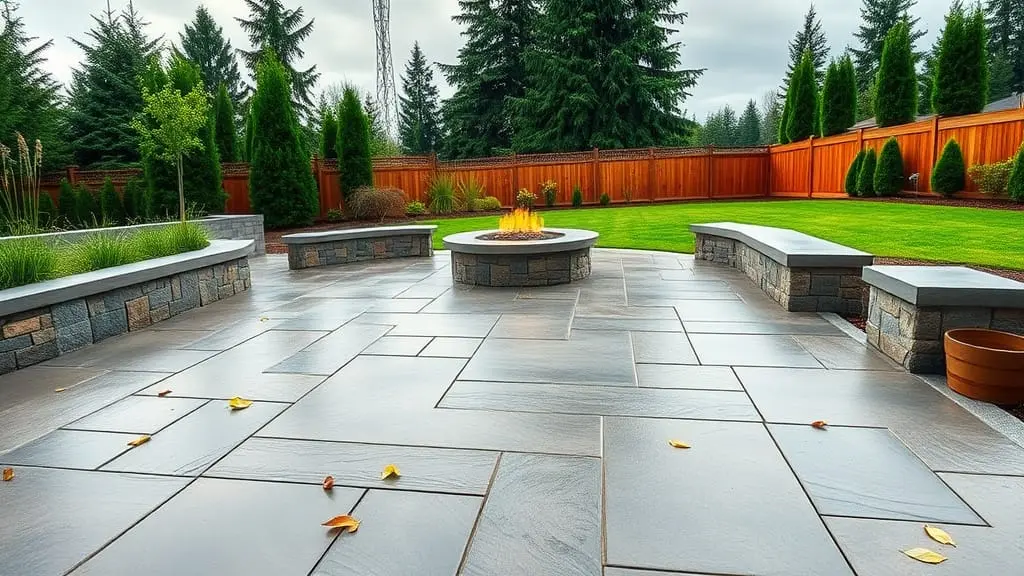
Homeowners considering stamped concrete for their Bellingham property inevitably ask the same question: how long will it actually last? It's a fair question—decorative concrete represents a significant investment, and Whatcom County's marine climate is harder on hardscaping than most regions in the country. The answer depends on a combination of installation quality, maintenance discipline, and site-specific conditions that are unique to the Pacific Northwest.
The short answer is that properly installed and maintained stamped concrete in Bellingham typically lasts 25 to 30 years before requiring major renovation. However, "properly installed and maintained" is doing a lot of heavy lifting in that sentence. We've seen stamped patios in Sehome that look pristine after 20 years, and we've repaired installations in Cordata that failed in under five. The difference almost always comes down to the factors we'll explore in this comprehensive guide.
Realistic Lifespan Expectations for Bellingham
National marketing materials for stamped concrete often cite lifespans of 25 to 50 years. While that upper range is achievable in arid climates like Arizona or Nevada, it's not realistic for Whatcom County. Here's what our decades of local experience suggest:
- Excellent installation + diligent maintenance: 25-30+ years before major renovation needed
- Good installation + moderate maintenance: 18-25 years before significant repair or resurfacing
- Average installation + minimal maintenance: 10-15 years before serious deterioration becomes apparent
- Poor installation or neglected maintenance: 5-8 years before costly repairs or full replacement
These estimates reflect Bellingham's specific combination of 37 inches of annual rainfall, marine moisture, freeze-thaw cycling, and the biological growth (moss, algae, lichen) that comes with our damp climate. Properties in especially exposed locations—like waterfront homes in Boulevard Park or hillside properties in Silver Beach—may experience accelerated wear on the lower end of these ranges.
How Bellingham's Climate Attacks Stamped Concrete
Understanding why stamped concrete degrades in our climate is essential for understanding how to prevent it. There are four primary mechanisms at work.
Freeze-Thaw Cycling
Bellingham winters hover in the 35-45°F range, which is precisely the worst temperature band for concrete. We experience approximately 30-40 freeze-thaw cycles per year—far more damaging than a single hard freeze that stays frozen for weeks. Each cycle allows water to penetrate, freeze, expand by roughly 9%, and then thaw. This creates microscopic fractures that compound over time. The stamped surface, with its imprinted grooves and textures, has more surface area for water to collect than flat concrete, making it inherently more vulnerable to this cycle.
Persistent Moisture Saturation
From October through April, Bellingham's surfaces rarely dry completely. This prolonged saturation means the sealer on stamped concrete is working overtime compared to installations in drier climates. Moisture constantly tests every micro-crack, unsealed edge, and worn spot in the protective coating. Installations we've observed in low-lying areas of Birchwood and near the waterfront in Fairhaven experience this saturation most intensely, particularly on north-facing surfaces that receive limited direct sunlight during winter months.
Biological Growth
Moss, algae, and lichen aren't just cosmetic nuisances in Bellingham—they're active agents of deterioration. These organisms produce mild acids as metabolic byproducts that slowly etch the sealer and concrete surface. More critically, moss rootlets can penetrate hairline cracks and expand them. Shaded properties throughout the Samish neighborhood and under the dense tree canopy in Sudden Valley face the most aggressive biological growth. Left untreated, moss can shorten stamped concrete's lifespan by years.
UV and Thermal Cycling
While Bellingham isn't known for intense sun, our summer months do deliver significant UV exposure—enough to degrade acrylic sealers over time. More importantly, south-facing surfaces can experience dramatic daily temperature swings during spring and fall: near-freezing at dawn, then warming to 60°F+ in afternoon sun. This thermal cycling causes differential expansion and contraction that stresses the stamped surface and its sealer. South-facing patios on properties along South Hill and Alabama Hill are particularly affected.
Installation Practices That Determine Longevity
No amount of maintenance can compensate for poor installation. The decisions made during the initial pour establish the maximum potential lifespan of your stamped concrete. Here's what separates installations that last decades from those that fail prematurely.
Concrete Mix Design
For Bellingham installations, we specify a minimum 4,000 PSI concrete mix with 5-7% entrained air. Air entrainment is the single most important factor in freeze-thaw resistance—the microscopic air bubbles provide pressure relief valves for expanding water. We also specify a maximum water-to-cement ratio of 0.45, which many residential contractors exceed. Excess water makes the concrete easier to work but dramatically weakens the finished product. A properly engineered mix costs roughly $15-$20 more per cubic yard but extends lifespan by years.
Subgrade Preparation
Bellingham's glacial till soil is notoriously variable—dense clay in some areas, pockets of sand and gravel in others. Proper subgrade preparation for stamped concrete requires a minimum 4-inch compacted gravel base over undisturbed or properly compacted soil. In areas with poor drainage—common in Geneva, Happy Valley, and parts of the Lettered Streets—we increase the base depth to 6 inches and install perimeter drainage to prevent water from pooling beneath the slab. Skipping proper subgrade work is the most common cause of premature cracking we see in failed installations.
Slab Thickness and Reinforcement
Standard stamped concrete patios should be a minimum of 4 inches thick, with driveways at 5-6 inches. We reinforce all stamped installations with either fiber mesh or welded wire mesh, and often both. Control joints must be cut at intervals no greater than 10-12 feet to manage inevitable shrinkage cracking—and these joints need to be incorporated into the stamp pattern design so they don't detract from the aesthetic. Poor control joint planning is immediately visible and is a hallmark of inexperienced contractors.
Stamping and Finishing Technique
The timing and technique of the stamping process itself significantly impacts longevity. Stamps must be applied at precisely the right stage of concrete cure—too early and the pattern is mushy, too late and the imprint is shallow and the surface will wear quickly. In Bellingham's cool, damp conditions, this timing window is often different than what contractors trained in warmer climates expect. Experienced local contractors adjust their approach for ambient temperature and humidity, which on a typical Bellingham summer day might be 65°F with 75% humidity.
The Sealing Schedule That Extends Lifespan by Years
If installation is the foundation of longevity, sealing is the ongoing life support system. In Bellingham's climate, proper sealing is absolutely non-negotiable—and it's the maintenance item most commonly neglected.
Initial Sealing
The first sealer application should occur 28 days after the pour, once the concrete has fully cured. We apply two coats of high-quality acrylic sealer with a non-slip additive. This initial application costs approximately $1.50-$2.50 per square foot and is typically included in the installation price from reputable contractors.
Maintenance Resealing
In Bellingham's wet climate, resealing is required every 2-3 years—not the 3-5 years often cited by national sources. Signs that it's time to reseal include: water no longer beading on the surface, visible color fading, a chalky or dull appearance, and any areas where the previous sealer is peeling or flaking. Professional resealing typically costs $1.50-$3.00 per square foot. For a standard 400-square-foot patio, budget $600-$1,200 per application. Over 25 years, that's approximately $5,000-$12,000 in sealing costs alone—a significant but necessary investment to protect your $6,000-$12,000 installation.
Signs Your Stamped Concrete Is Aging
Knowing what to watch for allows you to intervene before minor issues become major problems. Here are the progression stages we observe on Bellingham stamped concrete.
Early Warning Signs (Years 3-8)
- Color fading: Gradual loss of vibrancy, particularly in high-traffic areas and south-facing surfaces
- Sealer wear: Dull patches where sealer has worn thin, especially near entry points and furniture placement areas
- Minor hairline cracks: Usually following control joints or stress points, these are normal and manageable if sealed promptly
- Moss establishment: First signs of green growth in textured recesses, common throughout neighborhoods like Sunnyland and York
Moderate Wear Signs (Years 8-15)
- Pattern softening: The stamped texture becomes less crisp as surface wear accumulates, particularly in walkway paths
- Color differentiation: Obvious contrast between protected areas (under furniture) and exposed areas shows cumulative UV and weather damage
- Surface scaling: Small flakes of the top concrete layer peel away, indicating freeze-thaw damage from deferred sealing
- Joint deterioration: Expansion and control joints may show widening or edge crumbling
Advanced Aging Signs (Years 15-25)
- Structural cracking: Cracks that go beyond the surface into the slab, often indicating subgrade settlement
- Significant color loss: The surface appears washed out and bears little resemblance to the original color
- Widespread scaling: Large areas of surface deterioration requiring professional resurfacing
- Settlement or heaving: Visible unevenness indicating soil movement beneath the slab
Real Examples from Local Installations
Rather than speaking in abstractions, here are patterns we've observed across Bellingham and Whatcom County.
A stamped ashlar slate patio installed in Edgemoor in 2006 remains in excellent condition as of 2024—18 years and counting. The homeowner has resealed faithfully every two years and power washes each spring. The total maintenance investment has been approximately $8,000, protecting a $9,500 original installation that still looks remarkable.
Conversely, a stamped flagstone driveway installed in Ferndale in 2015 required full removal and replacement in 2022—just seven years later. The original contractor used a standard 3,500 PSI mix without adequate air entrainment, and the homeowner sealed the surface only once. By year five, scaling was widespread, and by year seven, large sections had deteriorated beyond repair. The replacement cost was $14,000—more than the original installation.
A third example from the Columbia neighborhood: a stamped concrete pool deck installed in 2010 with proper specifications and maintained on a two-year sealing schedule. At 14 years old, it shows moderate color fading and some pattern softening in the highest-traffic zones, but remains structurally sound and aesthetically pleasing. We estimate it has another 8-12 years of functional life before requiring resurfacing.
How to Maximize Your Stamped Concrete's Lifespan
Based on our experience across Whatcom County—from downtown Bellingham to Lynden, Blaine, and Birch Bay—here's our comprehensive advice for getting the maximum return on your stamped concrete investment:
- Hire experienced local contractors: Insist on a 4,000+ PSI mix with air entrainment. Ask about their subgrade preparation process. Get references from installations at least 5 years old in the Bellingham area
- Never skip or delay resealing: Mark your calendar for every 2 years. This single habit is worth thousands of dollars in prevented damage
- Address cracks immediately: A hairline crack sealed today costs $50-$100. That same crack left for two winters can become a $500-$1,500 repair
- Manage biological growth proactively: Annual moss and algae treatment prevents the acid etching and root penetration that degrade the surface
- Ensure proper drainage: Water should never pond on stamped concrete. If you notice pooling, address the drainage issue before it causes damage
- Use appropriate deicing products: Never use rock salt or calcium chloride on stamped concrete. Magnesium chloride or sand are safer alternatives for Bellingham's occasional ice events
Stamped concrete is an excellent investment for Bellingham homeowners who understand and commit to the maintenance requirements of our climate. With proper installation and faithful care, your stamped patio, driveway, or walkway can provide decades of beauty and functionality—far outlasting many alternative materials at a competitive total cost of ownership.
Ready to get started? Contact us today for a free estimate — we serve all of Bellingham and Whatcom County.