
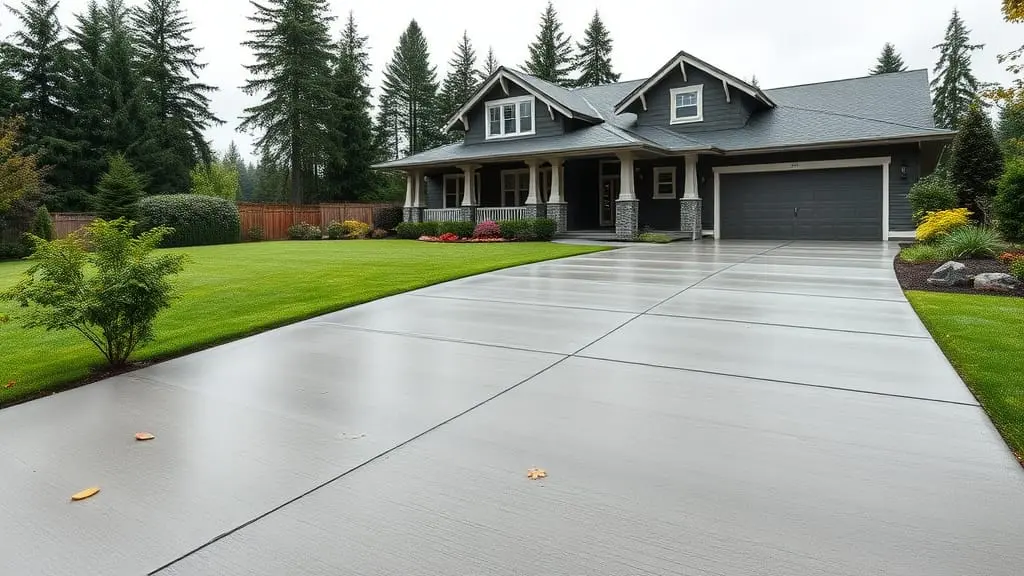
If you live on one of Bellingham's many hillsides, you already know the challenges that come with a steep driveway. Whether your property sits on South Hill, Alabama Hill, or the winding roads of Sehome, getting a durable, safe, and properly engineered driveway requires more than simply pouring concrete on a slope. Grade, drainage, traction, and structural reinforcement all demand specialized techniques that flat-lot contractors may not fully understand.
As driveway installation specialists who have poured hundreds of sloped driveways across Whatcom County, we have seen firsthand what works and what fails on Bellingham's hillside terrain. This guide covers the engineering principles, material choices, and cost factors that go into building a sloped driveway that will last decades in our demanding marine climate.
Understanding Bellingham's Hillside Driveway Challenges
Bellingham is built on glacially carved terrain. The city's topography ranges from sea-level waterfront in Boulevard Park and Fairhaven to elevations exceeding 500 feet in neighborhoods like Alabama Hill and parts of Samish. Many residential lots have driveway grades between 8% and 18%, and some exceed 20%. For context, most building codes consider anything above 14% to be a steep driveway, and grades above 20% require special engineering.
The challenges compound in our climate. With 37 inches of annual rainfall, a wet season running from October through April, and winter temperatures that fluctuate between 35-45 degrees Fahrenheit, sloped driveways face water runoff, freeze-thaw cycles, and moss growth that flat driveways simply do not encounter at the same intensity. Glacial till soil throughout Whatcom County adds another layer of complexity, as it drains poorly and can shift under load when saturated.
Common Failure Modes We See Locally
We frequently get calls to replace sloped driveways that were installed without proper hillside engineering. The most common failures include:
- Surface erosion and scaling: Water running downhill across a smooth concrete surface accelerates wear, especially during freeze-thaw cycles. We have seen driveways in South Hill lose their surface layer within five years because no texturing or drainage cuts were incorporated.
- Cracking from soil movement: Saturated glacial till shifts under load. Without adequate base preparation and reinforcement, slabs crack and heave. A homeowner in Happy Valley recently contacted us after their 10-year-old driveway developed a 2-inch vertical displacement from subsurface water channeling under the slab.
- Washout at the base: Where a sloped driveway meets a garage floor or street, water concentrates. Without proper drainage infrastructure, this transition zone erodes the base material and undermines the slab edge.
- Vehicle traction loss: Smooth-finished concrete on grades above 10% becomes dangerously slippery when wet or icy, a serious safety issue during Bellingham winters.
Engineering Solutions for Steep Grades
A properly engineered sloped driveway starts well before the concrete truck arrives. The design phase must account for grade percentage, soil conditions, water flow, structural loads, and transition zones at both the top and bottom of the slope.
Grade Assessment and Design
We begin every hillside project with a thorough grade assessment. Using survey equipment, we map the existing slope and determine the optimal driveway path. Sometimes the most direct route from the street to the garage is not the best route. On properties in Sehome and the Lettered Streets, where lot widths are narrow, we may design a curved or switchback approach to reduce the effective grade percentage.
For grades between 8% and 14%, standard reinforced concrete with proper finishing and drainage is usually sufficient. Grades between 14% and 20% require enhanced reinforcement, thicker slabs (typically 6 inches minimum rather than the standard 4 inches), and more aggressive drainage infrastructure. Above 20%, we strongly recommend alternatives such as terracing the driveway with retaining walls to create stepped sections, each with a manageable grade.
Base Preparation for Hillside Stability
On flat lots, a 4-inch compacted gravel base is standard. On hillside properties, we go significantly deeper. Our typical hillside specification includes:
- Excavation to competent soil: We remove all topsoil and organic material, often excavating 12-18 inches below the planned slab surface.
- Compacted structural fill: We place 6-10 inches of crushed rock in 2-inch lifts, mechanically compacting each lift to 95% density. This creates a stable base that will not shift when saturated.
- Geotextile fabric: On properties with particularly poor drainage, such as those in Edgemoor near Chuckanut Drive, we install geotextile fabric between the native soil and the gravel base to prevent fine particles from migrating upward and weakening the base.
- Sub-slab drainage: A perforated pipe system installed within the gravel base, connected to a daylight outlet or storm drain, prevents water from accumulating beneath the slab. This is essential for properties on Bellingham's west-facing slopes, where groundwater seepage is common.
Reinforcement Strategies
Standard driveway construction uses wire mesh or fiber reinforcement. For sloped driveways, we upgrade to number 4 rebar on 12-inch centers in both directions. On driveways exceeding 14% grade, we reduce that spacing to 10-inch centers and add continuous rebar along the downhill edge to resist the tendency for the slab to creep downslope over time.
We also use thickened edges along both sides of the driveway. Rather than a uniform 6-inch slab, we thicken the edges to 8-10 inches, creating an integrated footing that anchors the driveway to the hillside. For driveways in Alabama Hill where grades regularly exceed 15%, this thickened edge detail is standard practice.
Textured Finishes for Traction and Safety
A smooth steel-troweled finish on a sloped driveway is a recipe for disaster in Bellingham's wet climate. We offer several traction-enhancing finishes, each suited to different grade percentages and aesthetic preferences.
Broom Finish (Heavy)
The most common and cost-effective traction finish. We drag a stiff-bristled broom perpendicular to the slope direction, creating parallel grooves that channel water to the sides and provide excellent tire grip. For grades up to 12%, a heavy broom finish provides adequate traction. We recommend this for most residential driveways in neighborhoods like Cordata and Sunnyland where slopes are moderate.
Exposed Aggregate
For steeper grades and homeowners who want a more decorative look, exposed aggregate provides superior traction. After placing the concrete, we apply a surface retarder and wash away the top layer of paste to reveal the aggregate beneath. The natural stone texture provides excellent grip even when wet. We have installed exposed aggregate driveways on 18% grades in South Hill that remain safe to walk and drive on throughout winter.
Scored or Grooved Patterns
We can cut grooves into the fresh concrete in a diamond or crosshatch pattern. These grooves serve double duty: they channel water off the surface and provide aggressive traction. For grades above 15%, we typically combine a broom finish with scored grooves every 18-24 inches across the width of the driveway. This combination provides maximum traction while still allowing easy snow removal.
Stamped Concrete on Slopes
Stamped concrete can work on moderate slopes (up to about 10% grade), but the texture depth of the stamp pattern is critical. Shallow patterns like ashlar slate provide minimal traction, while deeper patterns like cobblestone or flagstone offer significantly better grip. We advise against stamped concrete on grades exceeding 12%, as the sealer required for stamped concrete maintenance can actually reduce traction when wet.
Drainage Requirements for Sloped Driveways
Water management is arguably the single most important factor in sloped driveway longevity. A 20-foot-wide driveway on a 15% grade, during a typical Bellingham rainstorm, concentrates a surprising volume of water at the bottom of the slope. Without proper drainage infrastructure, this water undermines the driveway, floods the garage, and erodes adjacent landscaping.
Surface Drainage Design
We incorporate several surface drainage strategies depending on the specific site conditions:
- Cross-slope grading: Even on a driveway that slopes steeply from top to bottom, we incorporate a subtle side-to-side grade (typically 1-2%) to direct water toward one or both edges. This prevents the entire volume of runoff from concentrating at the bottom.
- Swale cuts: Shallow V-shaped channels formed into the concrete surface at intervals down the slope, directing water to the edges before it builds momentum.
- Trench drains: At the bottom of the slope, where the driveway meets the garage or a flat area, we install a trench drain (also called a channel drain) that captures all runoff and directs it to the storm system. This is standard on virtually every hillside driveway we install in Bellingham.
- French drains along edges: Gravel-filled trenches with perforated pipe along the driveway edges capture both surface runoff and subsurface water, directing it away from the driveway and the structure.
Stormwater Compliance
Bellingham enforces strict stormwater management codes, and hillside properties receive extra scrutiny. Any new impervious surface, including driveways, that adds more than 200 square feet requires stormwater management review. On properties in the Lake Whatcom watershed, including parts of Silver Beach and Sudden Valley, the requirements are even more stringent. We handle all permitting and design our drainage systems to comply with current city and county regulations.
Retaining Walls Along Sloped Driveways
Many hillside driveways in Bellingham require retaining walls on one or both sides. These walls serve several critical functions: they create a level base for the driveway by cutting into the hillside on one side and filling on the other, they prevent soil from washing onto the driveway surface, and they protect adjacent landscaping and structures from the effects of excavation.
For driveways in Alabama Hill and South Hill, retaining walls ranging from 2 to 6 feet in height are common. We typically construct these from formed and poured concrete or concrete masonry units (CMU) with proper drainage behind the wall. Walls exceeding 4 feet in height require engineered design and building permits in Bellingham, adding to both the timeline and cost.
On particularly challenging properties, we have designed terraced driveway systems where a series of shorter retaining walls creates stepped driveway sections, each at a manageable grade. A recent project on Alabama Hill used three retaining walls to navigate a 22% grade, creating driveway sections that each stayed below 12%. The homeowner gained not only a safe driveway but also usable terraced landscaping areas on either side.
Cost Considerations for Sloped Driveway Work
Sloped driveway projects cost more than their flat-lot equivalents. Understanding where those costs originate helps homeowners budget accurately and make informed decisions about design options.
Cost Premiums for Hillside Work
- Base preparation: Expect to pay 30-50% more for excavation, gravel base, and compaction on a sloped site compared to a flat lot. The additional depth, geotextile fabric, and sub-slab drainage add material and labor costs.
- Reinforcement upgrades: The shift from wire mesh to rebar grid increases material costs by approximately $1.50-$2.50 per square foot. Thickened edges add another $1.00-$1.50 per linear foot of edge.
- Drainage infrastructure: Trench drains, French drains, and storm system connections typically add $2,000-$5,000 to a hillside driveway project, depending on complexity and connection distance.
- Retaining walls: When required, retaining walls represent a significant additional cost. Budget $40-$80 per square face foot for poured concrete walls, including excavation, forming, and backfill drainage.
- Equipment access: Narrow, steep lots in neighborhoods like the Lettered Streets and Sehome often require pump trucks to deliver concrete because standard mixer trucks cannot navigate the grade. Pump truck rental adds $800-$1,500 to the project.
Typical Project Costs (2024 Bellingham Market)
For a standard two-car driveway (approximately 500-700 square feet) on a hillside property:
- Moderate slope (8-14% grade): $12,000-$20,000 including enhanced base, rebar reinforcement, textured finish, and basic drainage
- Steep slope (14-20% grade): $18,000-$30,000 including heavy reinforcement, retaining walls on one side, comprehensive drainage system
- Extreme slope (20%+ grade): $30,000-$50,000+ for terraced systems with multiple retaining walls, engineered design, and full drainage infrastructure
Compare these figures to a flat-lot driveway of similar size, which typically runs $7,000-$12,000 in the Bellingham market. The premium for hillside work is substantial, but it reflects the additional engineering, materials, and labor required to build a driveway that will remain safe and functional for 25-30 years in our climate.
Choosing the Right Contractor for Hillside Work
Not every concrete contractor has experience with steep-grade driveway engineering. When evaluating contractors for a hillside driveway project in Bellingham, ask about their experience with sloped work specifically. Request references from hillside projects and, if possible, visit completed installations to inspect the drainage details, edge conditions, and surface finish quality.
A qualified contractor should be able to explain their approach to base preparation, reinforcement, drainage, and traction finishing for your specific grade percentage. They should also be familiar with Bellingham's stormwater codes and permitting requirements, particularly if your property falls within the Lake Whatcom watershed or a designated critical area.
We have spent years refining our hillside driveway techniques across Bellingham's most challenging terrain, from the steep switchbacks of Alabama Hill to the narrow lots of Sehome and the waterfront grades of Edgemoor. Every project begins with a thorough site evaluation, and we provide detailed proposals that outline exactly what is needed for your specific slope, soil, and drainage conditions.
Ready to get started? Contact us today for a free estimate — we serve all of Bellingham and Whatcom County.