
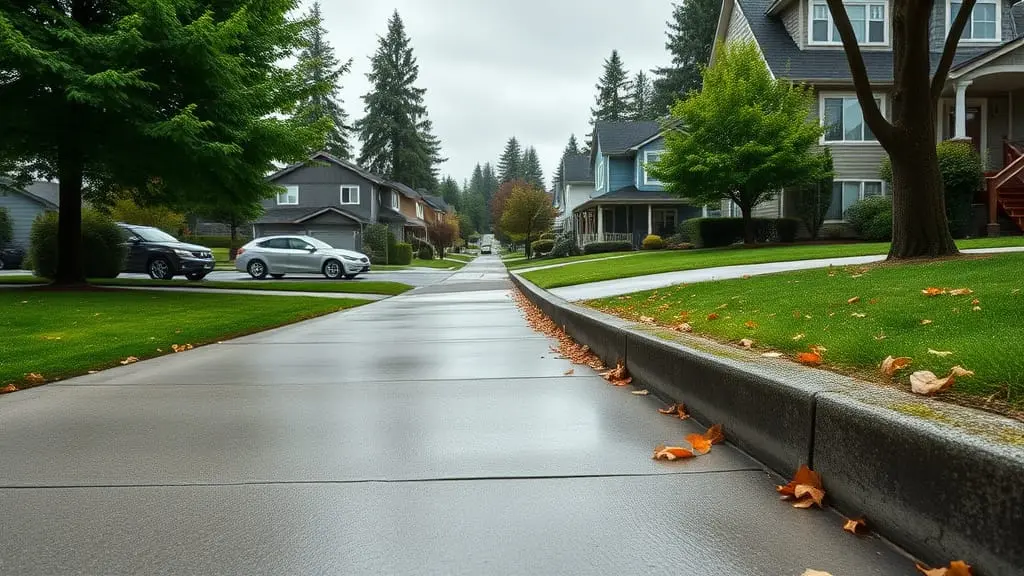
Bellingham's sidewalks endure a punishing combination of tree root heaving, freeze-thaw cycles, heavy rainfall, and decades of use. If you have walked through the Lettered Streets, Sehome, or Fairhaven neighborhoods, you have seen the results firsthand—cracked panels, uneven sections creating trip hazards, and entire slabs lifted inches by the roots of mature street trees. Knowing when replacement is necessary, who pays for it, and what the process entails can save you thousands of dollars and prevent liability headaches.
As sidewalk and curb contractors serving Bellingham and Whatcom County, we replace and repair sidewalks throughout the city every week. This guide walks you through everything homeowners and property owners need to know about sidewalk replacement in our community.
Signs Your Sidewalk Needs Replacement
Not every crack requires full replacement. Understanding the difference between cosmetic issues and structural failures helps you make informed decisions and prioritize spending.
Replacement Is Likely Needed
- Vertical displacement of 1 inch or more between panels: This is a trip hazard under both Bellingham municipal code and ADA standards. We see this constantly in Sunnyland and Columbia where mature maple and birch trees line the streets, their root systems pushing concrete panels upward over decades.
- Multiple interconnected cracks spanning entire panels: When a panel has more than two or three significant cracks, the structural integrity is compromised and water infiltration accelerates deterioration. Bellingham's 37 inches of annual rain penetrates these cracks, freezes in winter, and widens them further with each cycle.
- Severe spalling or surface deterioration: When the top surface is flaking away, exposing aggregate and rebar, the concrete has reached the end of its service life. This is common on sidewalks poured before the 1970s that used lower-quality concrete mixes without adequate air entrainment for freeze-thaw resistance.
- Significant settling or sinking: If entire panels have sunk, creating ponding areas that hold water, replacement is necessary. Standing water on sidewalks in Bellingham promotes moss and algae growth, creating dangerously slippery surfaces during our wet season from October through April.
- Tree root damage throughout the panel: When roots have lifted, cracked, or fragmented a panel, simply grinding the surface is a temporary fix. The roots will continue to grow and displace the concrete unless addressed during replacement.
Repair May Be Sufficient
- Single hairline crack: Cracks less than 1/4 inch wide that do not create a vertical offset can be sealed to prevent water infiltration.
- Minor surface wear: Slight roughening or shallow scaling can be addressed with concrete resurfacing rather than full replacement.
- Small vertical offset (under 1/2 inch): Grinding or mud-jacking may correct minor level differences at a fraction of the replacement cost.
Who Is Responsible: City vs. Homeowner
This is the question that generates the most confusion—and sometimes frustration—among Bellingham property owners. The answer depends on several factors.
Bellingham's Sidewalk Responsibility Policy
Under Bellingham Municipal Code, property owners are generally responsible for maintaining the sidewalk adjacent to their property, even though the sidewalk is located within the city's right-of-way. This means that if your sidewalk is cracked, heaved, or deteriorated, the repair cost falls on you as the property owner.
However, there are important exceptions and programs:
- City-initiated projects: When the city undertakes a street improvement project, sidewalk replacement may be included at city expense. This has occurred recently on portions of streets in Fairhaven and parts of the Samish neighborhood during utility upgrades.
- Tree root damage from city trees: If the damage is caused by a tree in the city right-of-way (a "street tree" maintained by the city), you may have grounds to request the city share in repair costs. Documentation of the tree's role in the damage is important—our team can help identify root-caused damage during our assessment.
- City sidewalk repair program: Bellingham periodically operates cost-sharing programs for sidewalk repair and ADA compliance upgrades. Contact the Public Works department to ask about current programs, as availability varies by budget year.
- Notice of repair: The city can issue a notice requiring property owners to repair or replace damaged sidewalks within a specified timeframe, typically 60-90 days. Failure to comply can result in the city performing the work and billing the property owner, plus administrative fees.
Whatcom County and Smaller Cities
In unincorporated Whatcom County and smaller cities like Ferndale, Lynden, Blaine, and Everson, sidewalk responsibility policies vary. Ferndale and Lynden follow similar property-owner-responsibility models. In many unincorporated areas, there are no sidewalks at all, and any new sidewalk construction is entirely the property owner's responsibility, subject to county permitting.
The Sidewalk Replacement Process
Understanding the step-by-step process helps you plan timing, budget, and expectations. Here is what a typical sidewalk replacement project in Bellingham looks like:
Step 1: Assessment and Permitting
Sidewalk work within the city right-of-way requires a Right-of-Way Use Permit from the City of Bellingham Public Works department. This permit ensures the work meets city standards for sidewalk width, thickness, slope, ADA compliance, and finish. Permit fees typically range from $150-$400 depending on the scope of work.
We begin every project with an on-site assessment. We measure the number of panels requiring replacement, evaluate the condition of adjacent panels, identify root intrusion, check for underground utility conflicts, and assess drainage patterns. For properties in the Lettered Streets and Sehome, we frequently discover that what appeared to be a two-panel problem extends to four or five panels once we examine the full extent of root damage.
Step 2: Tree Root Management
Root intrusion is the leading cause of sidewalk failure in Bellingham's older neighborhoods. When roots have lifted panels, simply replacing the concrete over the same roots guarantees a repeat failure within 5-10 years. Proper root management options include:
- Root pruning: Carefully cutting offending roots while preserving the tree's health. An ISA-certified arborist assessment may be required for significant root pruning, especially on city-owned street trees. Cost: $300-$800.
- Root barriers: Installing a linear root barrier (typically 18-24 inches deep) between the tree and the new sidewalk to redirect root growth downward. Cost: $15-$25 per linear foot.
- Sidewalk realignment: Routing the new sidewalk around the root zone where space permits. This is sometimes the best option on wider right-of-way sections in neighborhoods like Edgemoor and Silver Beach.
- Thickened edge or bridging: Pouring a thicker slab section (6 inches instead of the standard 4 inches) over the root zone, sometimes with rebar reinforcement, to resist future heaving. Cost: $5-$10 per square foot additional.
Step 3: Demolition and Removal
The old concrete panels are saw-cut along their edges, broken up with a hydraulic breaker or jackhammer, and removed. The concrete removal process generates significant debris—a typical 5-panel replacement produces 2-3 tons of broken concrete that must be hauled away. In tight neighborhoods like the Lettered Streets and Sunnyland, equipment access can be challenging, and we may need to use smaller equipment or hand-carry debris to a truck staged on the street.
Step 4: Subgrade Preparation
With the old concrete removed, we excavate to the proper depth—typically 8-10 inches below finished grade to accommodate 4-6 inches of compacted base material and 4 inches of concrete. The subgrade is graded to ensure proper cross-slope for drainage (typically 2% toward the curb) and compacted with a plate compactor. On Bellingham's glacial till soil, which can be extremely variable, we sometimes encounter soft spots that require additional excavation and replacement with imported structural fill.
Step 5: Forming and Pouring
We set forms to the correct width (typically 5 feet for residential sidewalks in Bellingham, though older neighborhoods may have 4-foot walks), grade, and cross-slope. Control joints are placed every 5 feet to control cracking. The concrete mix used for Bellingham sidewalks includes air entrainment (6-7% air content) for freeze-thaw resistance—a critical specification that some contractors skip, leading to premature surface scaling in our climate.
After pouring, the surface receives a broom finish for slip resistance. In our wet climate, the broom finish direction matters—we orient it perpendicular to the direction of travel to channel water off the walking surface. Edges are tooled with a 1/4-inch radius edger for a clean, professional appearance.
Step 6: Curing and Backfill
New concrete requires 7 days of curing before foot traffic and 28 days before heavy loads. We apply curing compound immediately after finishing to retain moisture—essential in Bellingham's climate where the combination of wind and intermittent sun can cause surface drying even on overcast days. After the concrete has cured, we backfill along the edges with topsoil and seed to restore the parking strip.
ADA Requirements for Sidewalk Replacement
Any sidewalk replacement project in Bellingham must comply with current ADA (Americans with Disabilities Act) standards, regardless of the original sidewalk's design. Key requirements include:
- Minimum width: 48 inches clear (60 inches preferred and often required by Bellingham city standards)
- Maximum cross-slope: 2% (1:50 ratio)
- Maximum running slope: 5% (1:20 ratio), unless matching existing grade
- Surface condition: No vertical offsets greater than 1/4 inch, no gaps wider than 1/2 inch
- Curb ramps: If replacement occurs at an intersection, a compliant curb ramp with detectable warning surface (truncated domes) must be installed if one does not already exist
ADA compliance can increase project costs, particularly when existing grades or narrow right-of-way make achieving compliant slopes difficult. In hilly neighborhoods like Alabama Hill, Happy Valley, and parts of Sehome, the running slope of the existing terrain may exceed ADA maximums, requiring creative solutions like stepped sidewalks with landings or ramps. Our team is experienced in designing ADA-compliant solutions that work within Bellingham's challenging topography.
Costs for Sidewalk Replacement in Bellingham
Sidewalk replacement in Bellingham is typically priced per square foot or per panel. Here are current market rates for 2025:
Per-Square-Foot Pricing
- Standard sidewalk replacement (4-inch thickness): $12-$18 per square foot
- Heavy-duty sidewalk across driveways (6-inch thickness): $15-$22 per square foot
- ADA curb ramp installation: $1,500-$3,500 per ramp
- Root barrier installation: $15-$25 per linear foot additional
Typical Project Costs
- Single panel replacement (25 sq ft): $500-$750
- Three-panel replacement (75 sq ft): $1,200-$1,800
- Full frontage replacement (250 sq ft, 50 LF): $3,500-$5,500
- Full frontage with curb ramp and root management: $5,500-$9,000
These costs include demolition, hauling, subgrade preparation, forming, pouring, finishing, curing, and backfill. Permit fees ($150-$400) are additional. Projects requiring significant root management, arborist consultation, or challenging site access may be at the higher end of these ranges.
Timing Your Sidewalk Replacement
Bellingham's climate creates a defined construction season for concrete work. The optimal window for sidewalk replacement is May through October, when temperatures consistently stay above 50°F and extended dry periods allow for proper curing.
Winter pours (November through March) are possible but carry higher risk and cost. Cold weather requires heated enclosures, accelerating admixtures, and extended curing protection—adding 15-25% to project cost. We have successfully poured sidewalks in December for homeowners in York and Samish who received city repair notices with tight deadlines, but we recommend scheduling during the dry season whenever possible.
If you receive a notice of repair from the City of Bellingham, contact us immediately even if the deadline falls during the wet season. We can often negotiate timeline extensions with the city by demonstrating that the project is contracted and scheduled, buying time to wait for better pouring conditions.
Our team handles every aspect of sidewalk replacement—from initial assessment through permitting, construction, and final city inspection. Whether you need a single panel fixed in Cordata, a full frontage replaced in the Lettered Streets, or ADA-compliant upgrades for a commercial property in Barkley Village, we deliver durable results built for Bellingham's demanding climate.
Ready to get started? Contact us today for a free estimate — we serve all of Bellingham and Whatcom County.