
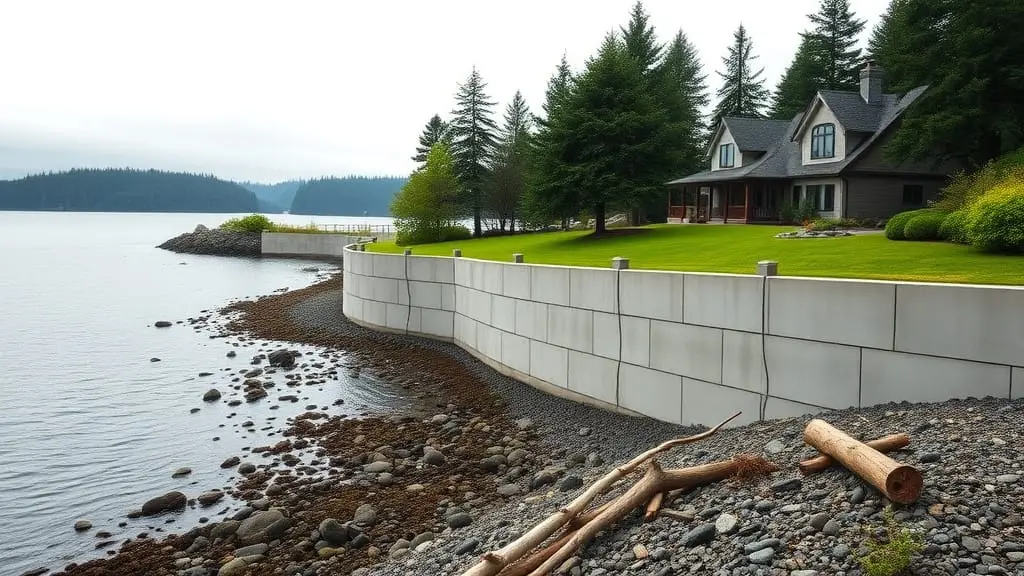
Waterfront property along Bellingham Bay is among the most valuable real estate in Whatcom County, but that premium comes with a significant structural responsibility: maintaining the seawalls and bulkheads that protect your property from tidal forces, wave action, and erosion. Marine concrete faces the harshest conditions in construction, a relentless combination of saltwater corrosion, cyclical tidal loading, biological attack, freeze-thaw cycling, and the sheer mechanical force of waves driven by Pacific storms. When a seawall fails, the consequences are not abstract: they involve rapid property loss, structural damage to homes and outbuildings, and remediation costs that can exceed $100,000.
Our seawall and bulkhead crews have repaired and replaced marine concrete structures throughout the Bellingham Bay shoreline, from Boulevard Park and the Fairhaven waterfront to Edgemoor, Chuckanut Bay, and the industrial waterfront along Roeder Avenue. This guide explains the unique challenges of marine concrete in our local environment, the repair and replacement methods available, and the complex permitting landscape that governs all work below the ordinary high water mark.
How Saltwater Destroys Concrete Along Bellingham Bay
Understanding the specific deterioration mechanisms at work in Bellingham Bay is essential for choosing the right repair approach. Marine concrete does not simply wear out; it is attacked by multiple simultaneous processes that interact and accelerate each other.
Chloride Penetration and Rebar Corrosion
The most damaging process in marine concrete is chloride-induced corrosion of reinforcing steel. Bellingham Bay's saltwater contains approximately 30 parts per thousand of dissolved salts, with chloride ions being the primary corrosion agent. These chloride ions penetrate the concrete through capillary absorption, diffusion, and the wetting-drying cycles created by tidal fluctuation. Once chloride concentration at the rebar depth exceeds approximately 1.2 pounds per cubic yard of concrete, the passive oxide layer protecting the steel breaks down and corrosion begins.
Corroding rebar expands to 6-10 times its original volume, creating internal pressure that cracks and spalls the concrete cover. This exposes more steel to saltwater, accelerating the cycle. We see this deterioration pattern on nearly every aging seawall along Bellingham Bay, with the most severe damage occurring in the tidal splash zone where wetting and drying cycles are most frequent. Seawalls along Boulevard Park, the Fairhaven shoreline, and the Edgemoor waterfront commonly exhibit this progressive spalling pattern.
Freeze-Thaw Damage in the Splash Zone
The splash zone, the area between mean high water and the highest wave reach, experiences the worst freeze-thaw damage on Bellingham Bay seawalls. This zone stays saturated with saltwater and is exposed to air temperatures that drop below freezing during winter cold snaps. When saturated concrete freezes, the expanding ice crystals create internal pressures that progressively degrade the concrete matrix. Salt water lowers the freezing point but also increases the number of freeze-thaw cycles, as the concrete experiences freezing events at temperatures that would not freeze fresh water.
Our winter temperatures of 35-45°F average, with periodic drops to 25-30°F during Arctic outflow events, create 20-40 freeze-thaw cycles per winter in the splash zone. Non-air-entrained concrete, or concrete where the original air entrainment has been compromised by age, can lose surface material at rates of 1/8 to 1/4 inch per year under these conditions.
Biological and Chemical Attack
Marine organisms contribute to concrete deterioration along Bellingham Bay. Boring organisms create pathways for water infiltration. Algae and barnacle growth traps moisture against the concrete surface. Sulfate-reducing bacteria in marine sediments produce hydrogen sulfide that attacks cement paste. The acidic conditions created by decomposing organic matter in the intertidal zone further accelerate deterioration, particularly at the mud line where seawalls meet the bay floor.
Signs Your Seawall Needs Repair
Early detection of seawall deterioration saves significant money by allowing targeted repairs rather than full replacement. Here are the warning signs we look for during marine concrete assessments.
- Visible rebar exposure: Rust staining on the concrete surface, or exposed reinforcing steel where concrete has spalled away, indicates active corrosion requiring immediate attention
- Horizontal cracking along rebar lines: These cracks follow the path of corroding rebar and indicate expanding corrosion that will soon cause spalling
- Efflorescence and white deposits: Calcium carbonate deposits on the seawall face indicate water moving through the concrete, dissolving cement paste and weakening the structure
- Leaning or tilting: Any deviation from vertical indicates foundation undermining, soil pressure changes, or structural failure requiring engineering assessment
- Settlement behind the wall: Sinking soil or pavement behind the seawall indicates washout through cracks or failed weep holes, a serious structural warning
- Erosion at the toe: Scour at the base of the seawall undermines the foundation and can cause catastrophic failure during storm events
We offer comprehensive seawall assessments for waterfront property owners along Bellingham Bay, including visual inspection, concrete core sampling, rebar corrosion testing, and structural evaluation. The assessment fee of $500-$1,500 is a fraction of the cost of emergency repairs after a failure event.
Repair Methods for Bellingham Bay Seawalls
The appropriate repair method depends on the extent of deterioration, the structural condition of the wall, and the remaining service life of the existing structure. We employ several repair strategies ranging from surface treatments to full structural rehabilitation.
Concrete Patching and Spall Repair
For localized damage where the bulk of the seawall remains structurally sound, concrete patching can restore the protective cover over reinforcing steel and extend service life by 10-20 years. The process involves removing all deteriorated concrete to sound material, cleaning and treating exposed rebar with corrosion-inhibiting coatings, and applying marine-grade repair mortar that bonds to the existing concrete.
We use polymer-modified repair mortars specifically formulated for marine environments, with low permeability and high chloride resistance. These materials cost 3-5 times more than standard repair mortars but provide dramatically superior performance in saltwater exposure. Patch repair costs for Bellingham Bay seawalls typically range from $150-$400 per square foot of repair area, with a minimum project cost of $5,000-$8,000 to mobilize marine construction equipment.
Cathodic Protection
For seawalls with widespread rebar corrosion but structurally adequate concrete, cathodic protection systems can halt corrosion without removing and replacing concrete. Sacrificial zinc anodes or impressed current systems shift the electrochemical potential of the rebar, stopping the corrosion reaction. This approach is particularly cost-effective for large seawalls where the volume of concrete repair would be prohibitively expensive.
Cathodic protection system installation on Bellingham Bay seawalls costs $30-$60 per square foot of protected wall area, with annual monitoring and anode replacement costs of $500-$2,000. The systems typically provide 20-30 years of corrosion protection.
Concrete Encasement and Jacketing
When deterioration is extensive but the existing seawall alignment and foundation remain adequate, concrete jacketing adds a new reinforced concrete layer around the existing structure. This method essentially creates a new seawall using the old one as a form, restoring structural capacity and providing fresh concrete cover with modern marine-grade mixes. Jacketing costs $200-$500 per linear foot for typical residential seawalls along Bellingham Bay.
Full Replacement
When deterioration has progressed beyond repair, full seawall replacement is necessary. Modern replacement seawalls use concrete mixes with supplementary cementitious materials like silica fume and fly ash that dramatically reduce chloride permeability. Epoxy-coated or stainless steel reinforcement eliminates corrosion vulnerability. Properly designed replacement seawalls have a design life of 50-75 years in Bellingham Bay conditions.
Full seawall replacement costs in Whatcom County range from $500-$1,200 per linear foot, depending on wall height, soil conditions, and access constraints. A typical 100-foot residential seawall replacement runs $50,000-$120,000, including demolition, engineering, and permitting.
Environmental Permits: The Complex Regulatory Landscape
Any work on or near Bellingham Bay's shoreline triggers a web of environmental regulations that requires careful navigation. The permitting process for seawall work is among the most complex in construction, involving multiple state and federal agencies with overlapping jurisdiction.
Required Permits and Approvals
- U.S. Army Corps of Engineers Section 10/404 Permit: Required for any work in or affecting navigable waters. The Corps reviews projects for impacts to navigation, water quality, and aquatic habitat. Processing time: 3-12 months depending on project scope.
- Washington Department of Ecology Shoreline Conditional Use Permit: Local governments administer the Shoreline Management Act. Bellingham's Shoreline Master Program regulates all development within 200 feet of the shoreline.
- Washington Department of Fish and Wildlife Hydraulic Project Approval (HPA): Required for any work that will use, divert, obstruct, or change the natural flow of state waters. The HPA includes timing restrictions that limit in-water work to specific seasonal windows, typically July through September for Bellingham Bay.
- Washington Department of Natural Resources Aquatic Lands Lease: If your seawall sits on or over state-owned aquatic lands (below the ordinary high water mark), a lease agreement may be required.
- City of Bellingham Building Permit: Required for structural work on seawalls within city limits.
- SEPA Review: State Environmental Policy Act review may be triggered for larger projects.
In-Water Work Windows
The timing restrictions imposed by HPA permits are the single biggest scheduling constraint for seawall work along Bellingham Bay. In-water work is generally restricted to the July 16 through September 15 window to protect migrating salmon, forage fish, and marine mammals. Some projects may receive expanded windows based on site-specific conditions, but planning for the standard two-month window is essential. This means that permitting must begin 6-12 months before the target construction window to ensure approvals are in place.
Mitigation Requirements
Modern seawall permits increasingly require habitat mitigation, particularly if the project involves expanding the seawall footprint or replacing a natural shoreline with hardened structure. Common mitigation measures include incorporating habitat features into the seawall design such as textured surfaces for marine organism attachment, intertidal benches for habitat, and native vegetation plantings above the ordinary high water mark. These requirements add 10-25% to project costs but are non-negotiable for permit approval.
Waterfront Neighborhoods Affected
Seawall and bulkhead issues affect waterfront property owners throughout Bellingham Bay and Whatcom County's marine shoreline. The neighborhoods with the highest concentration of residential seawalls include:
Boulevard Park and South Bellingham Waterfront: Properties along South State Street and the waterfront south of downtown feature seawalls dating from the 1950s through 1980s, many reaching the end of their design life. The combination of direct bay exposure, tidal range, and age creates urgent repair needs for many property owners in this area.
Edgemoor and Chuckanut: Upscale waterfront properties along Chuckanut Drive and the Edgemoor neighborhood face particularly aggressive marine exposure. The fetch across Bellingham Bay produces significant wave energy during winter storms, and these properties experience the full force of southwesterly storm winds. Seawall maintenance here is a continuous investment in property protection.
Birch Bay: The Birch Bay shoreline features a mix of bulkheads and seawalls protecting vacation homes and full-time residences. The shallow bay creates unique wave dynamics, and many older bulkheads were constructed using timber that has deteriorated and now requires replacement with concrete or composite materials.
Blaine and Semiahmoo: Drayton Harbor and the Semiahmoo shoreline present marine concrete challenges compounded by proximity to the harbor entrance where tidal currents are strongest. Properties along Marine Drive and the Semiahmoo spit require seawalls engineered for both wave action and current-induced scour.
Silver Beach and Lake Whatcom: While not marine, Lake Whatcom waterfront properties in Silver Beach and Sudden Valley have bulkhead and retaining wall needs driven by wave action from boat wakes and winter storms. Freshwater exposure is less aggressive than saltwater, but freeze-thaw damage is actually more severe due to the higher elevation and colder winter temperatures around the lake.
Investing in Your Waterfront Property
A seawall is not a set-and-forget structure. It requires periodic inspection, timely maintenance, and strategic repair to deliver its full design life. We recommend professional seawall inspections every 3-5 years for properties along Bellingham Bay, with annual visual inspections by the property owner looking for the warning signs described above.
The cost of proactive seawall maintenance is a fraction of emergency repair or replacement. A $5,000-$15,000 repair program addressing early-stage deterioration can extend a seawall's service life by 15-25 years, deferring a $50,000-$120,000 replacement. For waterfront property owners throughout Whatcom County, this represents one of the highest-return maintenance investments available.
Ready to get started? Contact us today for a free estimate — we serve all of Bellingham and Whatcom County.