
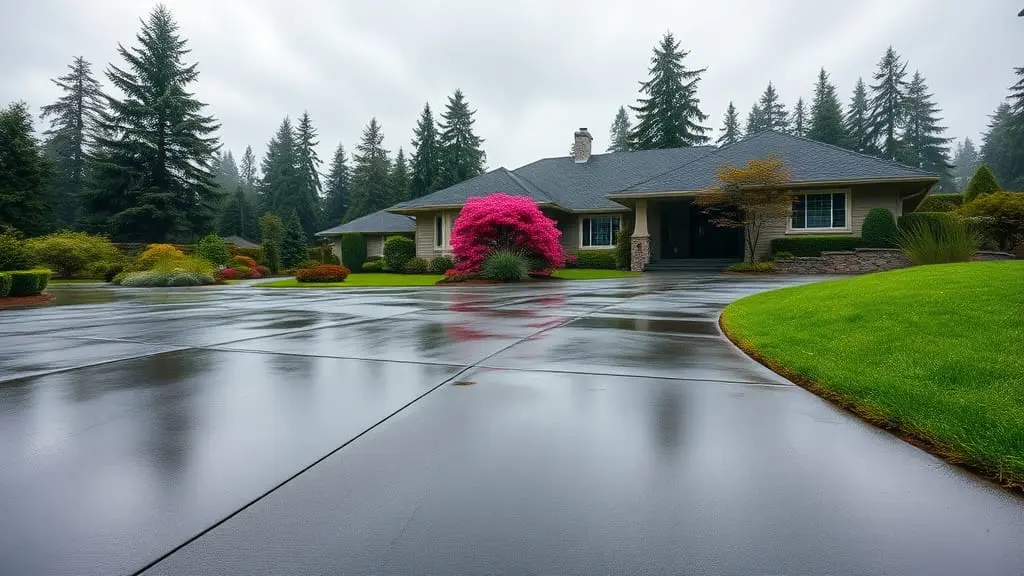
Concrete sealing is the single most cost-effective maintenance step you can take to extend the life of your driveway, patio, walkway, or garage slab in Bellingham. Yet it is also one of the most commonly skipped. Our crews see the consequences every week: driveways in Cordata with surface scaling after just five winters, patios in Fairhaven with deep moss staining that no amount of power washing can remove, and garage floors in South Hill that are flaking apart because water penetrated unsealed concrete and froze.
As concrete sealing and maintenance specialists serving Whatcom County, we have tested and applied every major category of concrete sealer in our specific climate conditions. What works in Arizona or even Portland does not always perform well here. Bellingham's combination of 37 inches of annual rain, marine humidity from Bellingham Bay, winter temperatures hovering in the 35-45 degree range that create persistent freeze-thaw cycles, and our notorious moss and algae growth demands a sealer strategy tailored to the Pacific Northwest.
Why Unsealed Concrete Fails Faster in Bellingham
Concrete is porous. Even a high-quality 4,000 PSI residential mix contains microscopic capillaries and pore spaces that absorb water. In a dry climate, this is a minor issue. In Bellingham, it is a primary cause of premature concrete failure.
The Freeze-Thaw Mechanism
Between November and March, Bellingham typically experiences 30-50 freeze-thaw cycles per winter. Each cycle follows the same destructive pattern: rain saturates the concrete during the day, temperatures drop below 32 degrees overnight, the absorbed water freezes and expands by approximately 9%, and tiny internal fractures develop. Repeat this dozens of times per season and the cumulative damage becomes visible as surface scaling, spalling, and pop-outs.
Homeowners in elevated neighborhoods like Alabama Hill, South Hill, and Happy Valley experience more freeze-thaw cycles than waterfront areas like Boulevard Park and Edgemoor, because cold air settles in valleys while hilltop properties face greater wind chill exposure. We have observed that unsealed driveways on Alabama Hill deteriorate approximately 30% faster than identical concrete at lower elevations.
Moss, Algae, and Biological Growth
Bellingham's damp climate promotes aggressive biological growth on concrete surfaces. Moss, algae, and lichen establish on unsealed concrete within one to two years, particularly on north-facing surfaces and shaded areas. Properties in Sehome, the Lettered Streets, and Samish, where mature tree canopy limits sun exposure, are especially prone. These organisms are not just cosmetic problems. Their root structures (rhizoids) penetrate concrete pores, physically breaking down the surface matrix over time. They also retain moisture against the concrete, accelerating freeze-thaw damage.
A quality sealer fills those surface pores and creates a barrier that biological growth cannot easily penetrate. Sealed concrete in shaded Bellingham neighborhoods typically stays moss-free for 2-3 years between treatments, versus constant growth on unsealed surfaces.
Types of Concrete Sealers: Which Works Best in the PNW
Concrete sealers fall into two fundamental categories, and the distinction matters enormously for Bellingham applications.
Penetrating Sealers (Our Top Recommendation for Bellingham)
Penetrating sealers absorb into the concrete and react chemically with the calcium hydroxide in the cement paste to form a water-resistant barrier below the surface. They do not change the appearance of the concrete or create a surface film. The concrete still looks and feels like concrete, but it repels water from within.
Types of penetrating sealers:
- Silane sealers: Small molecular structure penetrates deeply (up to 1/4 inch). Excellent for driveways and exterior slabs exposed to heavy rain. Lifespan in Bellingham: 5-7 years. Cost: $0.15-$0.30 per square foot for material.
- Siloxane sealers: Slightly larger molecules that form a near-surface barrier. Good water repellency but shallower penetration than silane. Lifespan in Bellingham: 3-5 years. Cost: $0.10-$0.25 per square foot for material.
- Silane/siloxane blends: Combine the deep penetration of silane with the near-surface protection of siloxane. This is what we use most frequently on Bellingham exterior concrete. Lifespan: 5-7 years. Cost: $0.20-$0.40 per square foot for material.
- Silicate densifiers: React with concrete to form calcium silicate hydrate crystals that fill pores and harden the surface. Primarily used for garage floors, basement slabs, and interior applications. Not a standalone sealer for exterior use in our climate but excellent as a primer coat. Cost: $0.10-$0.20 per square foot for material.
Why penetrating sealers win in Bellingham: They allow moisture vapor to escape from within the concrete (breathability), which prevents the sealer from peeling or delaminating in our persistently damp conditions. Film-forming sealers trapped over wet concrete is the number one sealing failure we see in Whatcom County.
Film-Forming Sealers
Film-forming sealers sit on the concrete surface and create a physical barrier. They are available in various finishes from matte to high gloss and can enhance color, making them popular for stamped and decorative concrete.
Types of film-forming sealers:
- Acrylic sealers: The most common film-forming option. Available in water-based and solvent-based formulations. Solvent-based acrylics provide a wet-look sheen and better water resistance but carry higher VOC content. Lifespan in Bellingham: 1-3 years (significantly shorter than in drier climates). Cost: $0.10-$0.25 per square foot for material.
- Polyurethane sealers: Tougher and more abrasion-resistant than acrylics. Better suited for garage floors and high-traffic interior slabs. Lifespan in Bellingham exterior use: 2-4 years. Cost: $0.25-$0.50 per square foot for material.
- Epoxy sealers: Extremely durable and chemical-resistant but not UV-stable. Suitable for interior applications like garage floors and basement slabs. They will yellow and chalk if used outdoors. Cost: $0.30-$0.60 per square foot for material.
Film-forming cautions for Bellingham: The biggest risk with film-forming sealers in our climate is moisture entrapment. If the concrete is not thoroughly dry when the sealer is applied, or if ground moisture wicks up through the slab, the sealer traps that moisture and turns white or cloudy (a condition called blushing). It can also peel and flake, creating an unsightly mess that requires chemical stripping to remove. We only recommend film-forming sealers for protected, well-drained applications or for interior slabs.
Application Timing: The Bellingham Window
Timing is critical for concrete sealing in our climate. The concrete surface must be dry, and you need a minimum 48-hour window of dry weather after application for proper curing. In Bellingham, this narrows your reliable application window considerably.
Best Months for Sealing
- July and August: The optimal window. Consistent dry weather, warm surface temperatures for proper sealer penetration, and low humidity. This is when we schedule the majority of our sealing projects.
- June and September: Good secondary windows. Check the 10-day forecast carefully. Early June and late September can bring unexpected rain.
- May and October: Possible but risky. Only attempt sealing during confirmed dry spells of at least 5 consecutive days.
- November through April: Not recommended for exterior concrete sealing in Bellingham. The concrete is too wet, ambient humidity is too high, and temperature fluctuations compromise curing.
Surface Temperature Requirements
Concrete surface temperature should be between 50 and 90 degrees Fahrenheit for most sealers. In Bellingham, aim for application during mid-morning on a sunny day. Early morning concrete may still have dew moisture. Late afternoon sun on west-facing surfaces in neighborhoods like Edgemoor and Silver Beach can overheat the concrete, causing sealers to bubble and cure too quickly.
Surface Preparation: The Step Most DIYers Skip
Sealer performance depends entirely on surface preparation. A premium sealer applied to a dirty, contaminated, or improperly profiled surface will fail within months. Proper prep accounts for 60-70% of a successful sealing job.
Cleaning Requirements
- Power washing: All exterior concrete must be thoroughly pressure-washed at 3,000-3,500 PSI with a surface cleaner attachment before sealing. This removes dirt, moss, algae, efflorescence, and any previous sealer residue.
- Moss and algae treatment: For heavily affected surfaces common in Sehome and Samish, apply a sodium hypochlorite (bleach) solution or commercial moss killer 24-48 hours before pressure washing. The chemical treatment kills the organisms to their roots; the pressure washer then removes the dead material.
- Oil and stain removal: Driveways and garage aprons in Sunnyland, York, and Columbia often have oil stains from older vehicles. These must be treated with a concrete degreaser before sealing, as oil contamination prevents sealer absorption.
- Drying time: After power washing, the concrete needs 24-48 hours of dry weather to fully dry before sealer application. In direct sun, 24 hours is usually sufficient. Shaded surfaces need the full 48 hours.
Crack and Joint Repair
Seal all cracks wider than 1/8 inch with flexible polyurethane caulk before applying the concrete sealer. Expansion joints should be checked and recaulked if the existing material is deteriorated. Sealer will not bridge cracks or seal deteriorated joints. If your concrete has significant structural damage, consider concrete resurfacing or replacement before investing in sealing.
DIY vs. Professional Sealing: Cost Comparison
Concrete sealing is one of the few concrete maintenance tasks that a capable homeowner can do themselves, but there are important trade-offs to consider.
DIY Sealing Costs
- Sealer material (600 sq ft driveway): $80-$200 depending on product
- Pressure washer rental: $75-$150 per day
- Roller, sprayer, and supplies: $30-$60
- Moss treatment chemicals: $20-$40
- Total DIY cost: $205-$450
- Time investment: 6-10 hours over 2-3 days
Professional Sealing Costs
- Standard penetrating sealer (600 sq ft): $400-$800
- Premium penetrating sealer (600 sq ft): $600-$1,200
- Film-forming sealer for decorative concrete (600 sq ft): $700-$1,400
- Includes: Surface prep, power washing, crack repair, sealer application, and cleanup
When to Hire a Professional
We recommend professional application in these situations:
- Stamped or decorative concrete: Incorrect sealer selection or application technique can permanently damage the appearance of decorative finishes
- Large surfaces (over 800 sq ft): Professional spray equipment ensures even coverage at the correct application rate
- Previously sealed surfaces: Determining existing sealer type and compatibility requires experience to avoid delamination
- Significant moss or staining: Professional-grade cleaning equipment and chemicals achieve results consumer products cannot match
Resealing Schedule for Whatcom County
How often you need to reseal depends on the sealer type, the exposure conditions, and the concrete's use.
- Penetrating silane/siloxane blends on driveways: Every 5-7 years
- Penetrating silane/siloxane blends on patios: Every 5-7 years (shaded areas may need it sooner)
- Acrylic film-forming on stamped concrete: Every 2-3 years in Bellingham (every 1-2 years in heavily shaded locations)
- Polyurethane on garage floors: Every 3-5 years depending on traffic
- Silicate densifiers on interior slabs: One-time application in most cases
A simple water test tells you when resealing is needed: pour a cup of water on the concrete surface. If it beads up and sits on the surface, the sealer is still working. If it absorbs into the concrete and darkens the surface within 30 seconds, it is time to reseal.
Common Sealing Mistakes We See in Bellingham
After years of repairing failed sealer applications throughout Whatcom County, here are the most frequent mistakes:
- Sealing wet concrete: The number one failure cause in our climate. We have stripped and resealed driveways in Cordata and Barkley Village where the homeowner applied sealer after just a few hours of drying following pressure washing.
- Over-application: More is not better. Excess sealer pools in low spots and creates a slippery, cloudy film. Apply at the manufacturer's recommended coverage rate.
- Wrong sealer type: Using a film-forming sealer on an exterior slab that gets ground moisture from below. We see this frequently on older slabs in Ferndale and Lynden where no vapor barrier was installed beneath the concrete.
- Skipping surface prep: Applying sealer over dirt, moss residue, or old deteriorated sealer. The new product fails to bond and peels off within months.
- Ignoring the weather forecast: Applying sealer with rain in the 48-hour forecast. Even a brief shower during the cure window can wash penetrating sealers out of the pores before they react chemically.
Proper concrete sealing is one of the highest-return investments you can make in your Bellingham property's hardscaping. A $600 professional sealing job on a driveway can prevent $5,000 or more in premature driveway repair or replacement costs. In our climate, it is not optional maintenance. It is essential protection.
Ready to get started? Contact us today for a free estimate — we serve all of Bellingham and Whatcom County.