
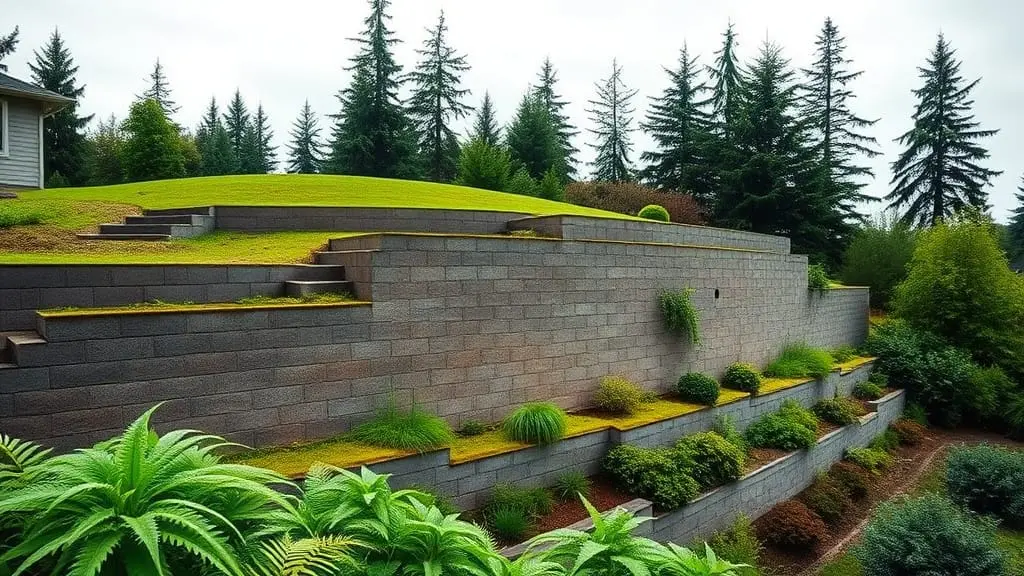
Bellingham is built on hills. From the steep slopes of South Hill and Alabama Hill to the bluffs of Edgemoor and the wooded terrain of Sudden Valley, hillside living is part of what makes Whatcom County special. But those hills come with a structural reality that every hillside homeowner eventually confronts: gravity, water, and soil don't always cooperate. When they don't, a retaining wall may be the only thing standing between your property and serious damage.
Knowing when a retaining wall is a genuine necessity versus a nice aesthetic addition can save you thousands of dollars — either by acting before a slope failure causes catastrophic damage, or by avoiding unnecessary construction when simpler solutions exist. This guide helps Bellingham hillside homeowners recognize the warning signs that demand professional attention.
Understanding Slope Instability in Whatcom County
Whatcom County's unique geology creates conditions that are particularly prone to slope instability. Understanding why our slopes fail helps you recognize early warning signs before they become emergencies.
Glacial Till and Clay Layers
Most of Bellingham sits atop glacial till — a dense, mixed deposit left by ice-age glaciers. While glacial till is generally stable when dry, it contains clay layers that become slippery when saturated. These clay layers act as slip planes: when water saturates the soil above a clay layer, the upper soil mass can begin to slide on the lubricated clay surface below. This is the primary mechanism behind most hillside failures we see in neighborhoods like South Hill, Sehome, and the Samish neighborhood.
Rainfall Saturation
With 37 inches of annual rainfall concentrated between October and April, Bellingham's slopes spend half the year saturated. This sustained moisture loading is far more dangerous than occasional heavy rains because it raises pore water pressure within the soil over weeks and months. Properties in Happy Valley, Silver Beach, and parts of the Geneva neighborhood sit on slopes that are perpetually challenged during the wet season.
Vegetation Loss and Root Decay
Tree roots are nature's reinforcement system. When mature trees are removed for construction, views, or storm damage, their root systems decay over the following 5-10 years. As roots decompose, they leave channels that concentrate water flow and lose the tensile strength that was holding soil in place. We've seen numerous slope failures in Edgemoor and Birchwood that can be traced to tree removal several years prior.
Warning Signs That You Need a Retaining Wall
The following signs range from early indicators to urgent warnings. If you observe any combination of these on your property, a professional evaluation is warranted.
Soil Movement and Erosion
- Soil creep on slopes: Trees, fence posts, or utility poles that lean downhill indicate the soil is slowly moving. This "creep" is the earliest stage of slope movement and a clear signal that the slope is under stress. Check fence posts on sloped portions of your property — if they've tilted since installation, the soil is migrating
- Bare soil patches on slopes: Areas where grass or groundcover won't establish, exposing bare soil to rain impact and surface erosion. These patches often appear on steeper portions of slopes and expand each wet season
- Erosion channels and gullies: Small channels carved by concentrated water flow indicate the slope is eroding actively. Left unchecked, these gullies deepen and widen, eventually undermining larger areas. Common on unmanaged slopes throughout the Columbia and York neighborhoods
- Soil accumulation at the base of slopes: Deposits of sediment at the bottom of a slope — particularly against a foundation, fence, or walkway — mean soil is actively migrating downhill
- Bulging or heaving at the toe of a slope: If the ground at the base of a slope is pushing outward or upward, the entire slope mass may be creeping. This is a serious sign that precedes more dramatic movement
Structural Damage Indicators
- Foundation cracks on the downhill side: If your home is built into a hillside and you notice new or widening cracks in the foundation wall facing downhill, lateral soil pressure may be pushing against the foundation. This requires immediate evaluation — your foundation may be acting as an undesigned retaining wall, and it may not be strong enough for the loads it's receiving
- Leaning or failing fences on slopes: A fence that was straight when installed but now leans or has snapped posts along a slope is a visible measure of ground movement. The soil has literally carried the fence posts with it
- Cracking or heaving in sidewalks and pathways: Concrete walkways on or near slopes that have cracked, shifted, or developed uneven surfaces indicate the ground beneath them is moving
- Retaining wall failure: If you have an existing retaining wall that is leaning, cracking, bulging outward, or showing gaps at joints, it's failing. A failing wall is more dangerous than no wall at all because it can collapse suddenly under the accumulated load it was holding back
- Doors and windows sticking: In hillside homes, doors and windows that no longer open or close smoothly may indicate that slope movement is shifting the building's framing. While there are many causes for sticking doors, the pattern of which doors are affected can reveal directional ground movement
Water-Related Warning Signs
- Standing water at the base of slopes: Water that collects against foundations, driveways, or walkways at the base of a slope indicates the slope is shedding water in concentrated locations rather than absorbing it evenly
- Springs or seeps emerging from slopes: Water emerging from a hillside indicates the water table is intersecting the slope face. This saturated zone can trigger slope failure, particularly during sustained wet periods. Properties throughout the hillside areas of Bellingham, including Boulevard Park and Sunnyland, commonly exhibit seasonal seeps
- Water flowing under or around existing walls: If water is piping through or under a retaining wall, the wall's drainage system has failed. Hydrostatic pressure behind the wall will eventually cause structural failure
When a Retaining Wall Is Necessary vs. Nice-to-Have
Not every slope needs a retaining wall. Understanding the difference between structural necessity and aesthetic preference helps you allocate your budget appropriately.
Retaining Wall Is Necessary When:
- Slope movement is threatening a structure (home, garage, adjacent property)
- Erosion is undermining foundations, driveways, or utilities
- An existing retaining wall has failed and the slope is unretained
- You're building on a hillside and need to create a level building pad
- A structural engineer has determined the slope's factor of safety is below acceptable limits
- Water erosion is threatening your property or a neighbor's property
- Permit requirements mandate slope stabilization for construction projects
Retaining Wall Is Nice-to-Have When:
- You want to create level garden terraces on a gentle slope
- You'd like to expand usable yard space on a moderately sloped lot
- The slope is stable but you want to improve aesthetics and define landscape zones
- You're adding a patio on a mildly sloped area that could be managed with grading alone
Alternatives That May Suffice
For mild slope issues, less expensive alternatives may be adequate:
- Regrading: Reshaping the slope to a shallower angle (typically 2:1 or 3:1 horizontal to vertical) can stabilize moderate slopes. Cost: $2,000-$8,000 depending on volume
- Terracing with low walls: Instead of one tall wall, a series of 2-3 foot walls with level terraces between them can be more economical and doesn't typically require engineering. Cost: $3,000-$8,000
- Bioengineering: Strategic planting of deep-rooted native species (willows, alders, salal, Oregon grape) can stabilize slopes over time. This is most appropriate for slopes away from structures where a gradual solution is acceptable. Cost: $1,500-$5,000
- French drains and subsurface drainage: If water is the primary issue, improving drainage may stabilize the slope without building a wall. Cost: $3,000-$10,000
Bellingham Neighborhoods Most Affected
While slope issues can occur anywhere with grade changes, certain Bellingham neighborhoods are disproportionately affected due to their topography:
- South Hill: Perhaps the most affected neighborhood. The steep grades and older homes built before modern slope engineering standards mean many properties need retaining solutions. We work in South Hill frequently, addressing everything from minor erosion to major slope stabilization projects
- Alabama Hill: Similar challenges to South Hill with steep lots and glacial till soil. Many homes have undersized or aging retaining walls that need replacement
- Sehome: The slopes below Sehome Hill and near the university present complex drainage and stability challenges, particularly for homes built on cut-and-fill lots
- Edgemoor: Bluff-top properties face unique challenges including erosion at the bluff face. Retaining walls here must account for marine exposure and sometimes require special engineering
- Sudden Valley: The rolling, wooded terrain means virtually every lot has some slope element. The combination of steep lots, tree cover, and seasonal streams creates challenging conditions
- Silver Beach and Boulevard Park: Properties near the waterfront with bluff exposures require careful slope management to prevent property loss
Engineering Requirements and Permits
In Bellingham and Whatcom County, retaining walls over 4 feet in height (measured from the bottom of the footing to the top of the wall) require a building permit and, in most cases, engineering by a licensed structural engineer or geotechnical engineer. However, even walls under 4 feet may require permits if:
- They support a surcharge (additional load above the wall, such as a driveway, structure, or sloped soil continuing above)
- They're located in critical areas (steep slopes, landslide hazard areas, wetland buffers, or shoreline zones)
- They affect drainage patterns on adjacent properties
- They're part of a larger construction project that requires overall grading permits
Bellingham's Critical Areas Ordinance (CAO) imposes additional requirements for properties in mapped landslide hazard areas and steep slopes (40% grade or steeper). If your property is in a designated critical area, a geotechnical report will be required before any retaining wall construction. A geotechnical investigation typically costs $3,000-$8,000 and includes soil borings, stability analysis, and specific design recommendations.
Engineering design for a retaining wall typically costs $2,000-$5,000 for stamped structural drawings. While this seems like a significant upfront cost, engineered walls are built correctly the first time and satisfy permit requirements, insurance requirements, and future buyer due diligence.
Cost Expectations for Bellingham Retaining Walls
Retaining wall costs vary dramatically based on height, length, material, and site conditions. General ranges for the Bellingham market:
- Small landscape walls (under 3 feet, per linear foot): $50-$150
- Medium structural walls (3-6 feet, per linear foot): $150-$400
- Large structural walls (6-10 feet, per linear foot): $400-$800
- Major retaining systems (10+ feet, per linear foot): $800-$1,500+
A typical residential retaining wall project in Bellingham — say a 4-foot-high, 50-foot-long wall — runs approximately $10,000-$20,000 including engineering, permits, construction, and drainage. More complex projects involving tall walls, difficult access, or challenging soil conditions can reach $30,000-$60,000 or more.
The cost of not building a necessary retaining wall, however, is almost always higher. A slope failure that damages a foundation can cost $50,000-$150,000 to remediate. A failure that affects a neighbor's property introduces liability. And a failure that triggers a foundation emergency during the wet season leaves you scrambling for contractors in the busiest time of year.
Taking the Next Step
If you've identified warning signs on your Bellingham hillside property, the most important thing you can do is get a professional evaluation before the next wet season. A qualified contractor can assess your specific situation, determine whether a retaining wall is necessary, and recommend the most appropriate and cost-effective solution for your property's unique conditions.
Don't wait for a dramatic slope failure to act. The warning signs described in this guide are your property's way of telling you that the forces of gravity and water are winning. A proactive retaining wall project completed during the dry season costs significantly less and carries far less risk than an emergency response after a wet-season failure.
Ready to get started? Contact us today for a free estimate — we serve all of Bellingham and Whatcom County.