
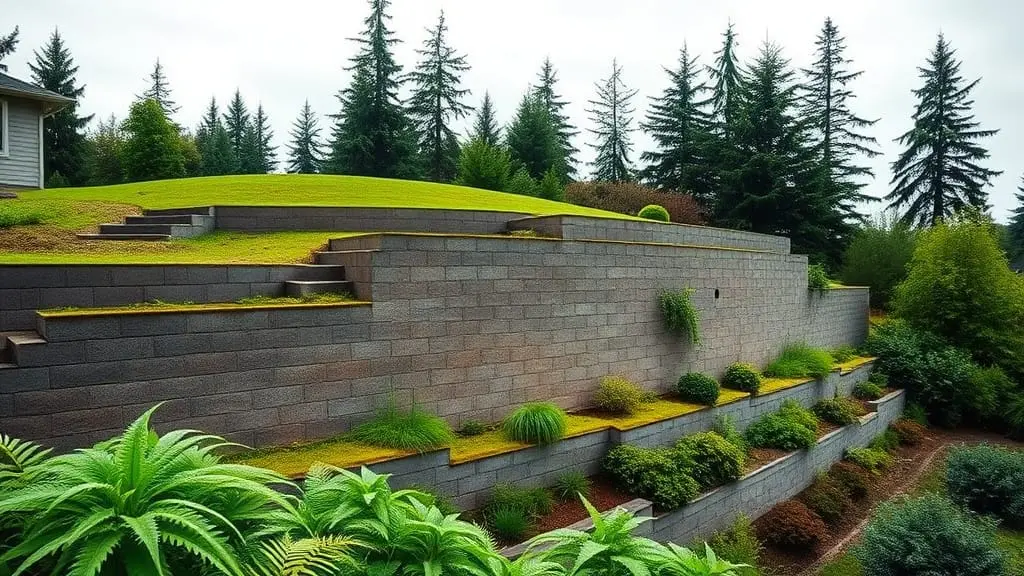
Building a retaining wall in Bellingham involves far more than choosing materials and hiring a contractor. Whatcom County's steep terrain, glacial till soil, and proximity to sensitive waterways mean that retaining wall construction is one of the most heavily regulated residential projects you can undertake. Understanding permit requirements before you begin saves time, prevents costly fines, and ensures your wall is engineered to last decades in our demanding Pacific Northwest climate.
As concrete contractors who have navigated Bellingham's permitting process on hundreds of retaining wall projects—from modest garden walls in Sehome to large-scale hillside stabilization in South Hill—we have seen how confusing the regulatory landscape can be. This guide breaks down everything Whatcom County homeowners need to know about retaining wall permits, engineering requirements, setback rules, and environmental protections.
When Do You Need a Retaining Wall Permit in Bellingham?
The permit threshold in Bellingham is determined primarily by the height of the wall and the surcharge conditions above and below it. Many homeowners are surprised to learn that even relatively modest walls can trigger the permitting process.
City of Bellingham Requirements
Within the Bellingham city limits—covering neighborhoods like Fairhaven, the Lettered Streets, Sunnyland, Columbia, and Cordata—the rules are straightforward in principle but nuanced in practice:
- Walls under 4 feet (measured from the bottom of the footing to the top of the wall): Generally exempt from a building permit, provided the wall does not retain a surcharge such as a driveway, structure, or slope steeper than 2:1. However, grading permits may still be required if significant earthwork is involved.
- Walls 4 feet and above: A building permit is required. Engineered plans stamped by a licensed structural or geotechnical engineer registered in Washington State must accompany the application.
- Walls of any height retaining a surcharge: If your wall supports a driveway, parking area, building foundation, or steep slope, a permit and engineering are required regardless of wall height. This catches many homeowners off guard in hilly neighborhoods like Alabama Hill and Happy Valley, where even a 3-foot wall may hold back a sloped yard that supports a garage above.
- Walls within critical areas: Bellingham's Critical Areas Ordinance (CAO) adds another layer. Walls near landslide hazard areas, steep slopes (40% grade or greater), wetlands, or shorelines trigger additional review, and in some cases, a separate critical areas permit.
Whatcom County Requirements (Unincorporated Areas)
If your property is in unincorporated Whatcom County—including Sudden Valley, areas around Ferndale, Everson, Sumas, and rural parcels near Lynden—the county's requirements differ from the city's:
- Walls under 4 feet: Generally exempt, similar to the city, but county inspectors are particularly vigilant about surcharge conditions on rural properties with septic systems, outbuildings, and agricultural loads.
- Walls 4 feet and above: Building permit and engineered plans required. The county planning department may also require a Stormwater Management Plan depending on the scope of grading.
- Shoreline Management Act (SMA) review: Properties near Birch Bay, Lake Whatcom (including Sudden Valley), the Nooksack River corridor near Everson, and other regulated shorelines face an additional shoreline permit or exemption process that can add 4-8 weeks to the timeline.
Engineering Requirements: What Gets Engineered and Why
Engineering is the single most important—and often most expensive—step in the retaining wall permitting process. Bellingham's geology makes this especially critical. The glacial till soil that underlies much of Whatcom County is notoriously unpredictable, with layers of clay, sand, gravel, and hardpan that can vary dramatically across a single lot.
Geotechnical Investigation
For walls 4 feet and taller, most projects in Bellingham require a geotechnical report. This involves:
- Soil borings or test pits: A geotechnical engineer drills or excavates at the proposed wall location to characterize the soil profile. Expect 1-3 borings depending on wall length, at a cost of $2,500-$5,000 for a typical residential project.
- Bearing capacity analysis: Determines how much weight the soil can support. Sandy soils in areas like Silver Beach and Birchwood typically have good bearing capacity, while the heavy clay found in parts of Samish and York may require deeper footings or soil improvement.
- Slope stability assessment: For hillside walls—common in South Hill, Alabama Hill, and the Geneva neighborhood—the engineer evaluates whether the proposed wall could trigger or exacerbate slope instability. Bellingham's 37 inches of annual rain saturates hillside soils, making this analysis essential.
- Drainage recommendations: The engineer specifies drainage requirements behind the wall, including gravel backfill depth, perforated drain pipe sizing and placement, and outfall locations.
Structural Engineering
A structural engineer designs the wall itself based on the geotechnical findings. The structural plans must include:
- Wall dimensions and reinforcement: For concrete retaining walls, this means specifying rebar size, spacing, and placement within the wall and footing. A typical 6-foot concrete wall in Bellingham requires #4 or #5 rebar at 12-16 inches on center vertically, with horizontal reinforcement as well.
- Footing design: Width, depth, and reinforcement of the footing. In Bellingham, footings must extend below the frost line—typically 12-18 inches in our marine climate, though engineers often specify deeper footings on hillside sites.
- Drainage detail: Engineered drawings show the drainage system behind the wall, including weep holes, drain rock, filter fabric, and perforated pipe placement.
- Surcharge loading: If the wall supports a driveway, structure, or slope, the engineer calculates the additional lateral forces and designs accordingly.
Structural engineering fees for a residential retaining wall in Bellingham typically run $1,500-$4,000, depending on wall complexity, height, and site conditions.
Setback Rules and Property Line Considerations
Retaining walls must comply with the setback requirements of the applicable zoning district. In Bellingham, this creates some frequently misunderstood situations.
- Walls as structures: Bellingham treats retaining walls over 4 feet as structures, meaning they must meet the setback requirements for your zoning district. In most residential zones (R-1, R-2), this means a 5-foot side yard setback and a 20-foot front yard setback. Rear yard setbacks vary by zone.
- Walls under 4 feet: Shorter walls that do not require a permit are generally exempt from structural setback requirements, but they must still comply with property line regulations—you cannot build on your neighbor's property.
- Easements: Many older Bellingham neighborhoods—particularly the Lettered Streets, Sehome, and Fairhaven—have utility easements, stormwater easements, or shared driveway easements that restrict where you can build. Always check your title for recorded easements before planning a wall location.
- Sight triangle requirements: Walls near intersections or driveway entrances must not obstruct visibility. The city requires a clear sight triangle at corners, which can affect wall height and placement on corner lots in neighborhoods like Sunnyland and Columbia.
A common mistake we see is homeowners in Edgemoor and Silver Beach who assume they can build right to their property line because their lot is large. Even on half-acre lots, setback rules apply. We always recommend a property survey before beginning design—a $500-$1,000 investment that can prevent a $20,000 problem if the city requires you to move or remove a wall built in violation.
Environmental Regulations Near Waterways
Bellingham's abundant waterways add significant regulatory complexity for retaining wall projects. If your property is near any of the following, additional permits and review are almost certainly required:
- Whatcom Creek and Padden Creek: Properties in Sehome, the Lettered Streets, Fairhaven, and South Hill adjacent to these waterways fall within the city's shoreline jurisdiction. Walls within 200 feet of the ordinary high water mark require a Shoreline Substantial Development Permit or exemption. Padden Creek is also a salmon-bearing stream, triggering state WDFW review.
- Lake Whatcom watershed: Including Sudden Valley, Geneva, and portions of South Hill. Enhanced stormwater requirements apply because the lake is Bellingham's drinking water source.
- Bellingham Bay shoreline: Properties along Boulevard Park and the waterfront must comply with the city's Shoreline Master Program.
- Wetlands: Found throughout Cordata, Barkley Village, and low-lying areas near Ferndale. Wetland buffers range from 50 to 150 feet and may require a critical areas determination letter.
Environmental review adds both time and cost. A Shoreline Exemption typically costs $200-$500 and takes 2-4 weeks. A full Shoreline Substantial Development Permit can run $1,000-$2,500 and require 2-6 months for processing.
The Permitting Process: Timeline and Costs
Here is what to expect when applying for a retaining wall permit in Bellingham or Whatcom County:
Step-by-Step Process
- Step 1 — Pre-application meeting (optional but recommended): Meet with the city or county planning department to discuss your project. This is free and can identify potential issues early. Allow 1-2 weeks to schedule.
- Step 2 — Geotechnical investigation: Hire a geotechnical engineer to assess soil conditions. Timeline: 2-4 weeks for investigation and report.
- Step 3 — Structural engineering: Hire a structural engineer to design the wall based on the geotech report. Timeline: 2-4 weeks for design and plan preparation.
- Step 4 — Permit application: Submit completed application with engineered plans, geotechnical report, site plan, and any environmental review documents. Application fees for a retaining wall building permit in Bellingham range from $500-$1,500 depending on wall value.
- Step 5 — Plan review: The city or county reviews your submittal. For straightforward projects, expect 3-6 weeks. Complex projects with environmental components may take 8-16 weeks or longer.
- Step 6 — Permit issuance: Once approved, you receive your permit and can begin construction. The permit is typically valid for 18 months.
- Step 7 — Inspections: During construction, the city or county will inspect the footing, rebar placement, drainage, and final wall. You must call for inspections at each required stage—building without inspection approval is a code violation.
Total Permit-Related Costs
For a typical residential retaining wall over 4 feet in Bellingham, expect these permit-related expenses:
- Geotechnical investigation: $2,500-$5,000
- Structural engineering: $1,500-$4,000
- Building permit application fee: $500-$1,500
- Property survey (if needed): $500-$1,000
- Environmental review (if applicable): $200-$2,500
- Total permit-related costs: $5,200-$14,000
These costs are in addition to the actual retaining wall construction cost, which typically ranges from $50-$150 per square face foot depending on material and wall height. For a 50-linear-foot wall at 6 feet tall, that is $15,000-$45,000 in construction costs alone.
Common Permitting Mistakes to Avoid
Over years of building retaining walls throughout Whatcom County, we have seen homeowners make these costly errors:
- Building without a permit: The city actively enforces permit requirements. If a neighbor reports an unpermitted wall, or an inspector notices one during a different project, you may be required to retroactively permit the wall—which means engineering, inspections, and potentially rebuilding portions that do not meet code. Fines can range from double the permit fee to $500 per day of violation.
- Underestimating wall height: Height is measured from the bottom of the footing to the top of the wall, not from grade. A wall that appears to be 3 feet above ground may actually be 5 feet when the footing depth is included, pushing it past the permit threshold.
- Ignoring surcharge conditions: That "short wall" holding back your sloped driveway? It is carrying surcharge loads and requires engineering regardless of height. We have seen this frequently on properties in Happy Valley and Alabama Hill where driveways descend steeply to garages.
- Building multiple short walls to avoid permits: Some homeowners attempt to build two 3.5-foot walls instead of one 7-foot wall. The city treats terraced or tiered walls as a single system when they are within a certain horizontal distance of each other (typically the height of the lower wall). This approach rarely avoids the permit requirement and often results in enforcement action.
- Neglecting drainage: Even when a permit is not required, failing to install proper drainage behind any retaining wall in Bellingham's wet climate is a recipe for failure. Our 37 inches of annual rain, concentrated between October and April, generates tremendous hydrostatic pressure behind walls. We have rebuilt dozens of failed walls in neighborhoods like Samish and York where the original builder skipped drainage, and the wall pushed out or collapsed within 5-10 years.
How We Help Navigate the Process
Our team manages the entire permitting process for our clients throughout Bellingham and Whatcom County. From coordinating with geotechnical and structural engineers, to preparing and submitting permit applications, to scheduling inspections, we handle every detail. We have established relationships with the Bellingham Planning Department and Whatcom County building officials, which helps us anticipate requirements and avoid delays.
Whether you need a modest garden wall in Cordata that falls below the permit threshold or a major hillside retaining wall system in South Hill requiring full geotechnical investigation and shoreline review, we provide accurate cost estimates that include all engineering, permitting, and construction expenses upfront. No surprises, no hidden fees, and no permit violations.
Ready to get started? Contact us today for a free estimate — we serve all of Bellingham and Whatcom County.