
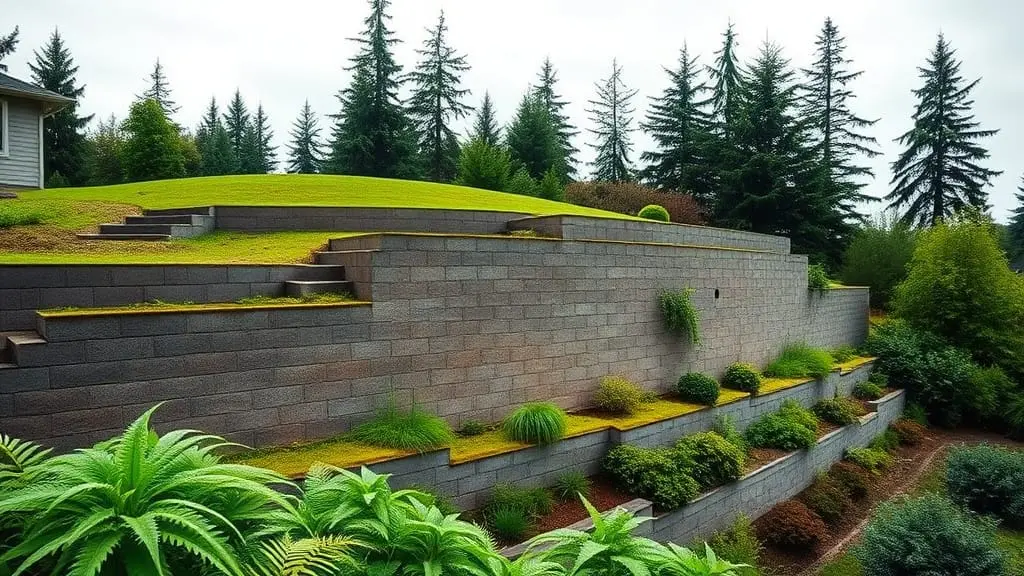
Once you've determined that your property needs a retaining wall, the next major decision is material selection. In Whatcom County, this choice matters more than in milder climates because our combination of 37 inches of annual rainfall, freeze-thaw cycles, glacial till soil, and aggressive moss and algae growth puts every material to the test. The wall that looks great on a California hillside may fail within a decade in Bellingham.
As retaining wall contractors who've built hundreds of walls throughout Bellingham, Ferndale, Lynden, Blaine, and the surrounding communities, we've seen how each material performs over decades in our specific conditions. This guide provides an honest comparison to help you choose the right material for your project.
Poured Concrete Retaining Walls
Poured concrete (also called cast-in-place concrete) remains the gold standard for structural retaining walls in the Pacific Northwest. A properly designed and constructed poured concrete wall can last 50-100 years in our climate — longer than virtually any other option.
How They're Built
Poured concrete retaining walls involve setting up formwork, installing steel reinforcement (rebar), and pouring concrete into the forms. The wall is typically a "cantilever" design with an L-shaped or T-shaped footing that uses the weight of the soil on the heel to resist overturning. After curing (7 days for form removal, 28 days for full strength), the forms are stripped and the wall is backfilled with drainage gravel.
Performance in Whatcom County
- Strength: Highest structural capacity of any retaining wall material. A 4,000 PSI mix with proper rebar handles the lateral earth pressures from Bellingham's heavy, wet glacial till
- Durability: With air-entrained concrete (standard in our region), poured walls resist freeze-thaw damage extremely well. We have walls built 30+ years ago in South Hill and Sehome showing minimal weathering
- Water resistance: A monolithic wall has no joints for water to penetrate, providing the best moisture management when combined with proper drainage
- Height capability: Engineered for any height. For tall walls (10+ feet) common on steep lots in Alabama Hill and Edgemoor, poured concrete is often the only practical choice
Costs
- Small walls (under 4 feet): $200-$350 per linear foot installed
- Medium walls (4-8 feet): $350-$600 per linear foot installed
- Tall walls (8-12+ feet): $600-$1,200 per linear foot installed
Pros and Cons Summary
Pros: Strongest material, longest lifespan, no joints to fail, best for tall walls, minimal maintenance, excellent freeze-thaw resistance.
Cons: Higher upfront cost, plain appearance unless textured or faced, requires formwork and skilled labor, longer construction timeline, difficult to modify after construction.
Concrete Masonry Unit (CMU) Block Walls
CMU block walls — built from standard or split-face concrete blocks with steel reinforcement and grout-filled cores — are a popular middle-ground option. They offer good structural performance at a moderate price point and provide more design flexibility than plain poured concrete.
How They're Built
CMU retaining walls start with a poured concrete footing. Blocks are laid in courses with vertical rebar in grout-filled cores and horizontal reinforcement for lateral strength. The wall is waterproofed on the soil side, a drain system is installed, and the wall is backfilled with gravel.
Performance in Whatcom County
- Strength: When properly reinforced and grouted, CMU walls approach the structural capacity of poured concrete. The key word is "properly" — we've repaired numerous CMU walls in Bellingham where cores were left ungrouted or reinforcement was insufficient
- Durability: CMU block is susceptible to moisture absorption, which makes it vulnerable to freeze-thaw damage in our climate. The mortar joints are the weakest point, and we see joint deterioration beginning as early as 15-20 years in exposed walls. Sealed and properly maintained, a CMU wall can last 40-60 years
- Aesthetics: Split-face or textured CMU blocks provide an attractive finished appearance without the need for a separate facing material. Multiple colors and textures are available, making CMU walls popular in neighborhoods like Barkley Village and Cordata where appearance matters
- Maintenance: CMU walls in Bellingham benefit from sealing every 5-7 years to reduce moisture absorption. Mortar joints should be inspected and repointed as needed. Moss and algae growth on CMU is common in shaded locations and should be cleaned periodically to prevent biological deterioration of the mortar
Costs
- Small walls (under 4 feet): $150-$300 per linear foot installed
- Medium walls (4-8 feet): $300-$500 per linear foot installed
- Tall walls (8-12 feet): $500-$900 per linear foot installed
Pros and Cons Summary
Pros: Good structural capacity, attractive split-face options, moderate cost, design flexibility, easier to install utilities through the wall.
Cons: More vulnerable to freeze-thaw than poured concrete, mortar joints require maintenance, construction quality varies significantly, slower to build than poured concrete for tall walls.
Natural Stone Retaining Walls
Natural stone walls offer unmatched aesthetic appeal and can complement the Pacific Northwest landscape beautifully. However, their structural limitations and cost must be carefully considered for Whatcom County applications.
Types of Stone Walls
- Dry-stacked stone: Individual stones are carefully fitted together without mortar. The wall relies on gravity and the friction between stones for stability. Limited to approximately 3-4 feet in height for structural applications
- Mortared stone: Stones are laid with mortar between them, creating a more rigid structure. Can reach greater heights than dry-stack but is still generally limited to 6 feet or less without significant engineering
- Stone-faced concrete: A poured concrete or CMU structural wall with natural stone veneer applied to the visible face. This provides the strength of concrete with the appearance of stone and is suitable for any height
Performance in Whatcom County
- Strength: Dry-stacked walls have limited structural capacity and should not be relied upon for critical slope retention above structures. Mortared stone walls are stronger but still cannot match concrete for tall-wall applications. For structural retaining situations in Bellingham, we typically recommend stone-faced concrete over full-stone construction
- Durability: The stone itself is essentially permanent — natural granite, basalt, and sandstone will outlast any manufactured material. However, the mortar in mortared walls is vulnerable to the same freeze-thaw deterioration as CMU joints. Dry-stacked walls avoid this issue entirely but may shift over time on Bellingham's active slopes
- Drainage: Dry-stacked walls are inherently self-draining — water passes freely through the joints, eliminating hydrostatic pressure buildup. This is a significant advantage in our wet climate. Mortared walls require the same drainage provisions as concrete and block walls
- Aesthetics: Stone walls blend naturally with the Pacific Northwest landscape. Locally sourced basalt and granite complement the character of neighborhoods like Fairhaven, the Lettered Streets, Edgemoor, and Sudden Valley. The natural appearance ages gracefully, and the moss that grows on stone in our climate actually enhances many installations
Costs
- Dry-stacked (under 3 feet): $250-$500 per linear foot installed
- Mortared stone (under 6 feet): $400-$800 per linear foot installed
- Stone-faced concrete (any height): $500-$1,200 per linear foot installed
Stone is the most expensive retaining wall material per linear foot, driven primarily by labor costs. However, for landscape walls where appearance is a priority — such as alongside a patio or deck installation — stone can be the most rewarding investment.
Pros and Cons Summary
Pros: Best aesthetics, essentially permanent material, dry-stack provides natural drainage, ages beautifully in our climate, increases property value.
Cons: Highest cost, height limitations for full-stone construction, labor-intensive, heavy materials require good site access, mortared joints need maintenance.
Segmental Retaining Wall (SRW) Systems
Segmental retaining walls — also known as interlocking block walls or modular block systems — are manufactured concrete units that stack together using a mechanical interlock, pins, or a lip system. Brand names like Allan Block, Versa-Lok, and Belgard are common in the Whatcom County market.
How They're Built
SRW systems sit on a compacted gravel leveling pad rather than a poured footing. Blocks stack in offset courses, stepping back slightly ("batter") to lean the wall into the soil. Geogrid reinforcement — high-strength plastic grid extending into the backfill — provides additional stability for taller walls.
Performance in Whatcom County
- Strength: SRW systems are engineered for specific height and loading conditions. Most systems can reach 6-8 feet without geogrid and 15-20+ feet with geogrid reinforcement. This makes them suitable for the vast majority of residential retaining applications in Bellingham
- Durability: SRW blocks are manufactured to tight specifications and typically meet or exceed 4,000 PSI compressive strength. Quality blocks perform well in our freeze-thaw environment. However, less expensive blocks from big-box stores may not meet these standards — for structural applications, always use commercial-grade blocks
- Drainage: The dry-stack joints between blocks provide inherent drainage, reducing hydrostatic pressure. A drainage aggregate zone behind the wall and perforated drain pipe at the base complete the drainage system
- Aesthetics: Modern SRW systems offer a wide range of face textures, colors, and profiles. Options range from rough-hewn natural stone looks to clean, contemporary profiles. They're popular in Barkley Village, Cordata, and newer developments in Ferndale where modern aesthetics are desired
- Maintenance: SRW walls are low-maintenance. No mortar joints to repoint, no sealing required (though optional). In Bellingham, the primary maintenance is cleaning moss and algae growth, which is purely cosmetic
Costs
- Small walls (under 4 feet, no geogrid): $100-$250 per linear foot installed
- Medium walls (4-8 feet, with geogrid): $250-$450 per linear foot installed
- Tall walls (8-12 feet, engineered with geogrid): $450-$750 per linear foot installed
Pros and Cons Summary
Pros: Most economical for medium-height walls, inherent drainage, wide aesthetic options, faster installation than poured concrete, no curing time required, individual blocks replaceable if damaged.
Cons: Not suitable for the tallest walls (15+ feet), requires adequate space behind the wall for geogrid installation, quality varies by manufacturer, limited structural capacity without geogrid, cannot support surcharges as well as poured concrete.
The Critical Role of Drainage
Regardless of which material you choose, drainage behind the retaining wall is the single most important factor in long-term performance in Whatcom County. More retaining walls fail due to poor drainage than any other cause. Every retaining wall in our climate should include:
- Drainage aggregate: A minimum 12-inch zone of clean, free-draining gravel or crushed rock immediately behind the wall, extending from the footing to near the top of the wall
- Perforated drain pipe: A 4-inch perforated pipe at the base of the wall, within the drainage aggregate, sloped to daylight or connected to a storm system
- Filter fabric: Geotextile fabric between the drainage aggregate and the native soil to prevent fine particles from clogging the drainage system over time
- Surface drainage: Grading behind the wall to direct surface water away from the wall rather than letting it flow over the top and saturate the backfill
In Bellingham's climate, we specify an oversized drainage zone — typically 18-24 inches of aggregate rather than the 12-inch minimum — because the volume of water our walls must handle during peak wet season is substantial. This added drainage capacity costs relatively little compared to the wall itself but dramatically extends the wall's service life.
Making Your Decision
The right material depends on your specific combination of structural requirements, aesthetic preferences, budget, and site conditions. Here's our general guidance for Whatcom County projects:
- Choose poured concrete when structural demands are high (tall walls, heavy surcharges, critical slope retention near structures), when maximum lifespan is the priority, or when the wall will be hidden by landscaping and appearance isn't a concern. This is our recommendation for most structural walls on hillside properties in South Hill, Alabama Hill, and Sehome
- Choose CMU block when you want an attractive exposed wall at a moderate price point, particularly for walls in the 3-6 foot range. Split-face CMU provides a finished appearance without the cost of stone. Plan for periodic sealing and maintenance
- Choose natural stone when aesthetics are the top priority and the wall is under 4-6 feet. Stone is ideal for landscape terracing, garden walls, and accent walls in high-visibility locations. For taller structural walls, consider stone-faced concrete to get the appearance without the structural limitations
- Choose segmental block for the best balance of cost, appearance, and performance in medium-height applications. SRW systems are particularly well-suited for residential landscape projects where the wall doesn't support structures or critical infrastructure. Their inherent drainage is a significant advantage in our wet climate
Whichever material you choose, invest in proper engineering for walls over 4 feet, ensure comprehensive drainage, and hire contractors experienced with retaining wall construction in Whatcom County. A well-built wall of any material serves your property for decades; a poorly built wall of the best material can fail within years. Design and construction quality always matters more than material selection.
Ready to get started? Contact us today for a free estimate — we serve all of Bellingham and Whatcom County.