
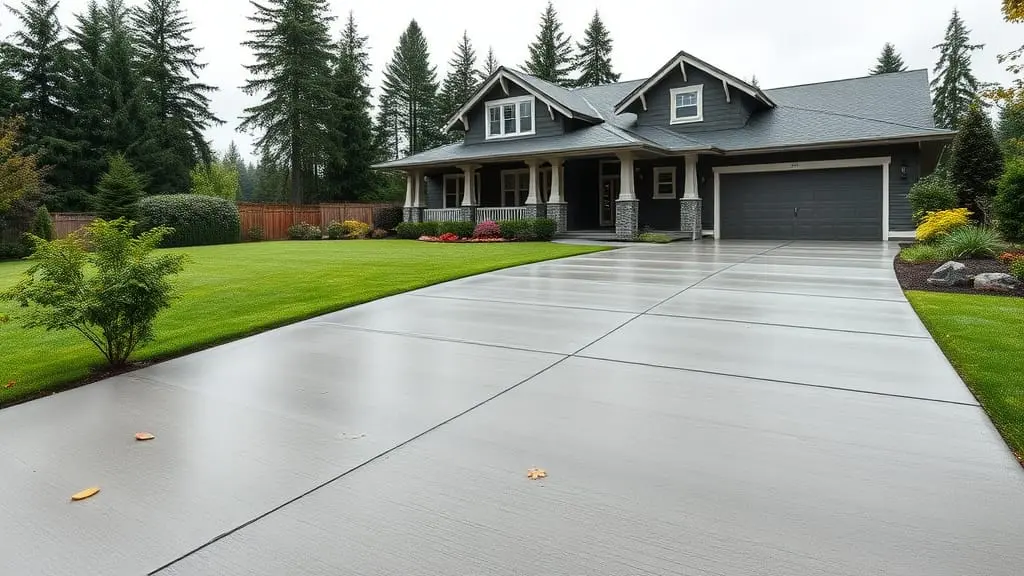
If you own a home in Bellingham or anywhere in Whatcom County, the odds are good that your concrete driveway has developed cracks. It's not a matter of if—it's a matter of when. Our Pacific Northwest climate is uniquely punishing to concrete surfaces, and even well-installed driveways eventually show the effects of years of rain, freeze-thaw cycles, and the difficult soil conditions that define our region.
The good news is that not every crack means your driveway needs replacing. Many cracks can be repaired effectively and affordably, extending your driveway's life by years or even decades. The key is understanding what type of crack you're dealing with, what caused it, and whether repair or replacement is the right call for your situation. As driveway repair specialists serving Whatcom County, we've repaired thousands of cracked driveways and can help you make sense of what your driveway is telling you.
Why Concrete Driveways Crack in the Pacific Northwest
Before you can fix a crack, you need to understand why it appeared. Pacific Northwest driveways face a combination of stresses that driveways in drier, warmer climates simply don't encounter. Understanding these causes helps you choose the right repair approach and prevent future damage.
Freeze-Thaw Cycles
Bellingham's winter temperatures hover in the 35–45°F range—right in the sweet spot for maximum freeze-thaw damage. Water seeps into the microscopic pores of the concrete during the day, freezes overnight when temperatures dip below 32°F, and expands by approximately 9%. This expansion creates internal pressure that fractures the concrete from within. Each cycle makes existing cracks wider and deeper, and creates new ones.
What makes Bellingham's freeze-thaw damage worse than many other regions is frequency. While places like Montana or Minnesota experience longer, more sustained freezes, our climate cycles between freezing and thawing repeatedly throughout winter—sometimes multiple times in a single week. These rapid cycles are more destructive than a single prolonged freeze because each cycle creates new stress fractures. Homes in higher-elevation neighborhoods like Alabama Hill, South Hill, and Happy Valley experience more freeze-thaw cycles than those closer to the bay in Boulevard Park or Fairhaven.
Glacial Till Soil Movement
Whatcom County's glacial till soil is dense, clay-heavy, and retains enormous amounts of water. When this soil becomes saturated during our October-through-April wet season, it expands. When it dries out in summer, it contracts. This seasonal expansion and contraction creates uneven pressure beneath your driveway slab, causing sections to shift, settle, or heave.
Properties in Sehome, Columbia, and the Lettered Streets neighborhood are particularly susceptible because the soil composition in these areas tends to have higher clay content. We've seen driveways in these neighborhoods develop settlement cracks within 5–7 years of installation when the subbase wasn't properly designed for local soil conditions.
Tree Root Pressure
The Pacific Northwest is defined by its trees, and Bellingham is no exception. Douglas firs, Western red cedars, big-leaf maples, and alders all produce aggressive root systems that can exert tremendous upward pressure on concrete slabs. Properties in Birchwood, Samish, Silver Beach, and anywhere with mature tree cover commonly develop heaving cracks where roots push up from below.
Root-caused cracks are distinctive—they typically appear as raised, tent-shaped bulges rather than flat surface cracks. If you can see or feel the concrete is higher on one side of the crack, tree roots are likely the culprit.
Inadequate Subbase Preparation
Many driveways in Whatcom County—particularly those installed during building booms in the 1980s through 2000s—were poured over insufficient gravel subbases. The standard 4-inch gravel base that works fine in well-drained soils elsewhere simply isn't adequate for our glacial till. Without a proper 6–8 inch compacted base and adequate drainage, the concrete is sitting on soil that shifts, settles, and heaves with moisture changes.
Excessive Moisture Exposure
With 37 inches of annual rainfall and persistent marine moisture from Bellingham Bay, our driveways are essentially wet for half the year. Constant moisture exposure accelerates every form of concrete deterioration: it enables freeze-thaw damage, promotes chemical erosion, encourages moss and algae growth (which retain even more moisture), and gradually weakens the cement matrix that holds concrete together.
Types of Driveway Cracks and What They Mean
Not all cracks are created equal. The type, size, pattern, and location of cracks tell an experienced contractor what's happening beneath the surface and what repair approach is appropriate.
Hairline Cracks (Less Than 1/8 Inch Wide)
These thin surface cracks are the most common and least concerning. They're typically caused by normal concrete shrinkage during curing, minor surface stress, or early-stage freeze-thaw effects. Hairline cracks are cosmetic rather than structural and are easily addressed with surface sealers or crack fillers.
Repair approach: Apply a concrete crack filler or flexible sealant. For a DIY fix, clean the crack with a wire brush, blow out debris, and apply a polyurethane or silicone-based crack filler. Cost: $10–$30 in materials for most driveways.
Moderate Cracks (1/8 to 1/2 Inch Wide)
These cracks indicate more significant stress—usually from soil movement, tree roots, or inadequate control joints. They may be cosmetic or structural depending on whether the slab has shifted vertically on either side of the crack. Moderate cracks that are still level across the joint are repairable. Cracks with vertical displacement (one side higher than the other) may indicate ongoing structural movement.
Repair approach: Clean the crack thoroughly, apply a backer rod for cracks deeper than 1/2 inch, and fill with a flexible polyurethane sealant or hydraulic cement. For cracks in high-traffic areas, consider routing the crack wider (creating a uniform channel) before filling for a more durable repair. Professional repair cost: $150–$500 depending on length and severity.
Wide Structural Cracks (Over 1/2 Inch Wide)
Wide cracks, especially those with visible vertical displacement or those that are actively growing wider over time, indicate serious structural issues. These cracks are often caused by significant soil movement, failed drainage, heavy vehicle loads exceeding the slab's capacity, or fundamental design flaws in the original installation.
Repair approach: These cracks often require professional assessment. Options include epoxy injection for structural bonding, slab stabilization through mudjacking or polyurethane foam injection, or partial slab replacement. Professional repair cost: $500–$3,000 depending on approach and scope.
Pattern Cracking (Map Cracking or Alligator Cracking)
When cracks form an interconnected network resembling a map or alligator skin, the issue is typically systemic rather than localized. Pattern cracking in Pacific Northwest driveways is usually caused by: alkali-silica reaction (a chemical reaction between cement and certain aggregates accelerated by moisture), surface scaling from freeze-thaw damage, or a concrete mix that was too wet during installation.
Repair approach: Pattern cracking across large areas generally cannot be repaired effectively with filling. Options include concrete resurfacing (applying a new surface layer over the existing slab) or full replacement. Resurfacing cost: $3–$7 per square foot. Replacement cost: $8–$15 per square foot.
Corner and Edge Cracks
Cracks that radiate from corners or follow driveway edges are typically caused by insufficient support beneath the slab edges. In Bellingham, this often occurs where driveway edges meet landscaping that has settled, or where rainwater has eroded soil from beneath the edges over time. We see this frequently in neighborhoods like Sunnyland, York, and Cordata.
Repair approach: Small corner breaks can be patched with polymer-modified concrete. Larger edge failures require cutting out the damaged section and pouring a new section with proper edge support. Professional repair cost: $300–$1,500 per section.
DIY Crack Repair: Step-by-Step Guide
For hairline to moderate cracks (up to about 1/2 inch wide) with no vertical displacement, DIY repair is practical and can save you significant money. Here's our recommended process for Bellingham conditions:
Materials needed:
- Wire brush or angle grinder with masonry wheel
- Shop vacuum or compressed air
- Backer rod (for cracks deeper than 1/2 inch)
- Polyurethane or silicone crack sealant (not latex—latex fails quickly in our wet climate)
- Caulk gun
- Concrete sealer (penetrating type recommended for PNW)
Step 1: Clean the crack thoroughly. Use a wire brush to remove loose material, then vacuum or blow out all debris. For cracks with moss or algae (extremely common in Bellingham), scrub with a stiff brush and allow to dry completely. This step is critical—sealant won't bond to dirty or damp surfaces.
Step 2: Widen narrow cracks if necessary. For cracks less than 1/4 inch wide, use an angle grinder to widen the crack to at least 1/4 inch. This creates enough space for sealant to bond properly and flex with seasonal movement—important given our temperature swings.
Step 3: Insert backer rod. For cracks deeper than 1/2 inch, press closed-cell backer rod into the crack to a depth of about 1/2 inch below the surface. This creates a proper sealant reservoir and prevents sealant waste.
Step 4: Apply sealant. Fill the crack with polyurethane sealant to just below the surface level. Avoid overfilling—a slightly recessed fill is more durable than one that protrudes above the surface. Tool the sealant smooth with a putty knife dipped in soapy water.
Step 5: Allow proper cure time. Polyurethane sealants need 24–48 hours to cure. In Bellingham's cooler, damper conditions, lean toward the longer cure time. Check the weather forecast and choose a dry window for this project—ideally 48 hours of dry weather.
Step 6: Seal the entire driveway. After the crack repair has cured, apply a penetrating concrete sealer to the entire driveway surface. This protects against future water penetration, freeze-thaw damage, and moss growth. In our climate, this single step is the most impactful thing you can do to extend your driveway's life.
When to Call a Professional
DIY repair is appropriate for cosmetic and minor structural cracks, but several situations require professional assessment and repair:
- Cracks wider than 1/2 inch or any crack with vertical displacement (one side higher than the other)
- Multiple cracks appearing simultaneously—this suggests systemic issues rather than isolated damage
- Cracks that return after repair—recurring cracks indicate the underlying cause hasn't been addressed
- Heaving or sinking sections—slab movement requires stabilization before crack repair is meaningful
- Cracks near your foundation—drainage problems that crack your driveway near the house may also be affecting your foundation
- Pattern cracking over large areas—systemic deterioration requires resurfacing or replacement rather than individual crack repair
A professional assessment typically costs nothing (most reputable Whatcom County contractors offer free estimates) and provides valuable information about the root cause of the cracking, the structural integrity of the remaining slab, and whether repair or replacement offers better long-term value.
When to Repair vs. When to Replace
This is the decision that keeps Bellingham homeowners up at night: is it worth spending money to repair, or should you bite the bullet and replace the whole driveway? Here's how we help our customers think through this decision:
Repair makes sense when:
- Cracks are isolated to a few locations rather than spread across the entire surface
- The slab is structurally sound with no significant settlement or heaving
- The driveway is less than 15–20 years old and was properly installed
- Repair costs total less than 30–40% of full replacement cost
- Drainage and subbase conditions are adequate
Replacement is the better investment when:
- Cracks are widespread (covering more than 25% of the surface area)
- Multiple sections have settled, heaved, or shifted significantly
- Pattern cracking indicates systemic concrete failure
- The driveway is over 25 years old with a history of recurring problems
- Repair costs would exceed 50% of replacement cost
- Drainage problems require major regrading that would disturb the existing slab
For a typical two-car driveway in Bellingham (400–600 sq ft), professional crack repair runs $500–$2,500 depending on severity. Full replacement costs $4,000–$9,000 for a standard finish, or $6,000–$15,000 for decorative options. If you're facing $3,000+ in repairs on a 25-year-old driveway, replacement almost always provides better long-term value—especially when the new installation can include proper drainage and subbase design for our local conditions.
Preventing Future Cracks in Bellingham's Climate
Whether you repair or replace, these preventive measures will minimize future cracking:
- Seal your driveway every 2–3 years: A quality penetrating sealer is your best defense against water penetration and freeze-thaw damage in our wet climate. Budget $300–$600 for professional application or $50–$100 for DIY
- Maintain proper drainage: Ensure water flows away from the driveway surface and doesn't pool anywhere. Clean gutters and downspouts that direct water toward the driveway. With 37 inches of annual rainfall, every gallon counts
- Manage tree roots proactively: If you have large trees near your driveway, consider installing root barriers during driveway replacement. For existing driveways, consult an arborist about root management before cracks develop
- Avoid deicing chemicals: Chemical deicers—particularly rock salt—accelerate concrete deterioration dramatically. In Bellingham, where ice is occasional rather than constant, use sand for traction instead. If you must use a deicer, calcium magnesium acetate is the least damaging option
- Address cracks early: A $20 tube of crack sealant applied to a hairline crack today can prevent a $2,000 repair bill in two years. In our climate, water penetration is the primary driver of crack growth, so sealing cracks before winter is especially important
- Keep the surface clean: Moss, leaves, and organic debris hold moisture against the concrete surface, accelerating deterioration. Annual pressure washing in spring after Bellingham's wet season removes these moisture traps
Living in the Pacific Northwest means accepting that concrete requires more attention than it does in drier climates. But with proactive maintenance and timely repairs, a well-built concrete driveway in Bellingham can serve your home beautifully for 25–30 years or more. The key is responding to cracks promptly and understanding when professional intervention is worth the investment.
We offer free driveway assessments throughout Bellingham and Whatcom County—from Blaine to Everson, Ferndale to Sudden Valley. If you're unsure whether your driveway cracks need professional attention or can be addressed with a weekend DIY project, we're happy to take a look and give you an honest recommendation.
Ready to get started? Contact us today for a free estimate — we serve all of Bellingham and Whatcom County.