
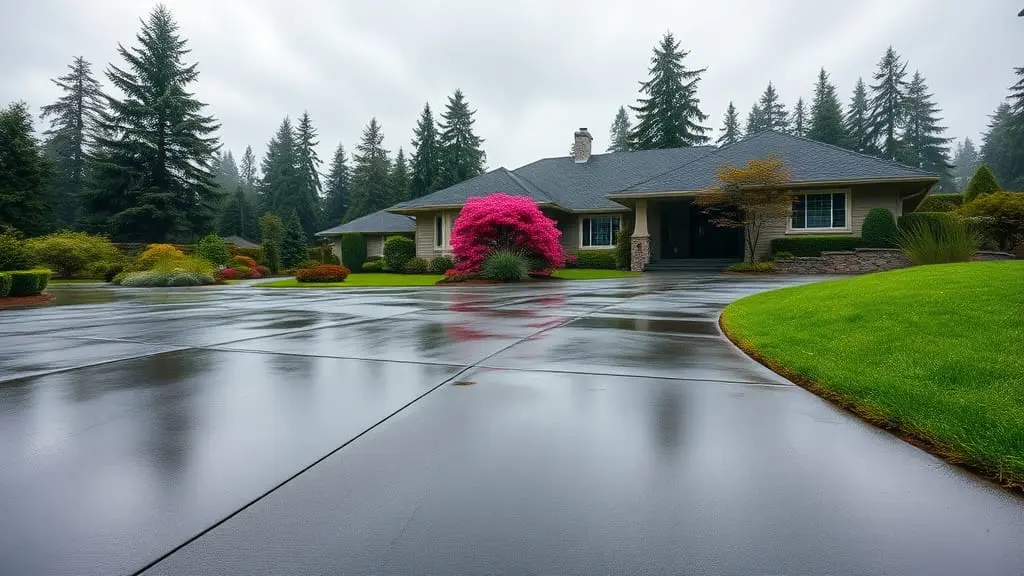
Pouring concrete in Whatcom County between October and March is not just possible—it is routine for experienced local contractors. But the work does not end when the finishers leave. Fresh concrete is at its most vulnerable during the first 48 hours of curing, and Bellingham's winter weather delivers a relentless combination of rain, near-freezing temperatures, and saturated soil that can permanently damage concrete before it reaches design strength. The difference between a slab that lasts 30 years and one that fails within 5 often comes down to what happens during those first critical days and weeks of curing.
Whether you have a new driveway poured in November, a foundation placed in January, or a garage slab finished in early March, this guide covers exactly how to protect your investment through Whatcom County's demanding winter conditions.
Why Winter Is Dangerous for New Concrete
Concrete does not "dry"—it cures through a chemical hydration reaction that requires water, time, and warmth. At 70°F, concrete reaches roughly 70% of its design strength within 7 days. At 50°F, that same milestone takes 14 days. At 40°F, it takes 21 days or more. Below 32°F, the water in fresh concrete can freeze, expanding by approximately 9% in volume and rupturing the cement paste matrix from within. This damage is irreversible.
The Critical 48-Hour Window
Fresh concrete must not freeze during the first 48 hours after placement. Period. If concrete freezes before reaching 500 PSI compressive strength (which typically takes 24-48 hours at moderate temperatures), it can lose up to 50% of its ultimate strength—and no amount of later curing will recover it. In Bellingham's 35-45°F winter temperatures, reaching that 500 PSI threshold requires careful management.
After 48 hours, concrete that has been kept above freezing will have developed enough strength to resist one freeze cycle. But it remains vulnerable to repeated freeze-thaw cycles until it reaches approximately 3,500 PSI, which at winter temperatures can take 14-28 days.
Bellingham's Specific Winter Threats
- Near-freezing overnight temperatures: Winter nights in Bellingham frequently drop to 30-35°F, with occasional dips into the mid-20s. Inland areas like Sudden Valley, Everson, and Sumas routinely see temperatures 5-8 degrees colder than waterfront Bellingham. Fresh concrete that survives a 34°F night may not survive a 28°F night.
- Persistent moisture: Our 37 inches of annual rainfall concentrates heavily in winter. Rain falling on curing concrete is less destructive than rain hitting fresh concrete, but sustained moisture prevents proper surface drying and can delay sealing by weeks.
- Wind chill: Wind amplifies cold-weather effects by drawing heat from the concrete surface faster than still air. A 36°F night with 15 mph wind creates effective concrete surface temperatures in the high 20s—below the freezing threshold.
- Saturated subgrade: The glacial till soil beneath most Bellingham properties becomes waterlogged in winter. A saturated subgrade conducts heat away from the bottom of a slab faster than dry soil, cooling the concrete from below while cold air attacks from above.
Curing Protection Methods for Whatcom County Winters
Professional cold-weather concrete protection employs multiple strategies simultaneously. No single method is sufficient for our conditions—effective protection requires a layered approach.
Insulated Curing Blankets
Insulated blankets are the primary defense for winter pours in Whatcom County. These are not ordinary tarps—they are purpose-built insulating covers with R-values between 4 and 12 that trap the heat generated by the hydration reaction itself. Fresh concrete generates significant internal heat during curing (a 4-inch slab can reach 15-25°F above ambient temperature in the first 24 hours). Blankets capture and retain this heat.
- Application timing: Blankets should be placed as soon as finishing operations are complete—typically within 2-4 hours of placement. They must remain in place for a minimum of 72 hours, and we recommend 7 days for winter pours in Bellingham.
- Overlap and sealing: Blanket seams must overlap by at least 12 inches and be weighted or taped to prevent wind from lifting edges. Even a small gap allows cold air to reach the surface. On properties in Birchwood and Fairhaven where bay winds are common, we use additional weights along all edges.
- Monitoring: We place temperature probes under the blankets and monitor them for the first 48 hours. If slab temperature drops below 40°F, supplemental heating is deployed.
- Cost: Insulated blankets add $1.50-$3.00 per square foot to project cost. For a 500-square-foot driveway, that is $750-$1,500—a small fraction of the replacement cost if freeze damage occurs.
Liquid Curing Compounds
Curing compounds are sprayed onto the finished concrete surface immediately after final troweling. They form a membrane that retains the internal moisture needed for hydration while blocking external rain and preventing rapid surface drying. In winter conditions, they serve as the first line of defense applied before blankets go down.
- Types: For winter work, we use resin-based curing compounds (ASTM C309 Type 1D) that provide both moisture retention and some insulating benefit. These are white-pigmented, which also helps absorb solar heat on partly sunny winter days.
- Application rate: 200-300 square feet per gallon, applied in a uniform spray coat. Uneven application creates weak spots. We apply immediately after final finishing—before the surface shows any signs of drying.
- Compatibility: If the concrete will later receive a sealer, stain, or coating, the curing compound must be compatible. Some compounds prevent adhesion of subsequent treatments. We specify dissipating compounds for projects requiring future sealing.
- Cost: $0.10-$0.25 per square foot—minimal cost for essential protection.
Heated Enclosures
For critical pours during Bellingham's coldest stretches—particularly foundation walls, structural slabs, and any work during a cold snap—heated enclosures provide the most reliable protection. These temporary structures surround the pour area and maintain temperatures above 50°F regardless of exterior conditions.
- Methods: Propane-fired indirect heaters (never direct-fired, which produce carbon dioxide that can carbonate and weaken the concrete surface), electric blankets, or hydronic heating systems circulating warm water through tubing placed on the subgrade.
- Duration: Heated enclosures are maintained for 3-7 days depending on concrete mix design and structural requirements. Foundation pours for homes in Sehome and Columbia where deep excavations expose the concrete to cold soil on all sides may require the full 7 days.
- Cost: $3-$8 per square foot for the enclosure period. This is the most expensive protection method but is warranted for structural elements where failure is unacceptable.
Hot Water and Accelerating Admixtures
Concrete mix design itself can be adjusted for cold weather. Ready-mix plants in Whatcom County routinely produce winter mixes with the following modifications:
- Heated mix water: Using water heated to 140-180°F raises the concrete temperature at delivery to 60-70°F, providing a significant head start on curing before temperatures drop overnight. Every degree above 50°F at placement accelerates early strength gain.
- Accelerating admixtures: Calcium chloride (up to 2% by weight of cement) or non-chloride accelerators speed the hydration reaction, allowing concrete to reach the critical 500 PSI threshold faster. Non-chloride accelerators are required for reinforced concrete, as chloride promotes rebar corrosion.
- Higher cement content: Increasing the cement content by 50-100 pounds per cubic yard generates more hydration heat and reaches strength targets faster. This adds $8-$15 per yard to material cost.
- Lower water-to-cement ratio: Reducing water content (using plasticizers to maintain workability) produces denser concrete that is more resistant to freeze-thaw damage and reaches strength faster.
Deicing Salt Damage: The First-Winter Threat
New concrete is far more vulnerable to deicing chemicals than mature concrete, and this is where we see the most preventable damage on Whatcom County properties. Even concrete poured in summer is at risk during its first winter if the wrong deicing products are used.
Why New Concrete Is Vulnerable
Fresh concrete has a higher moisture content and more porous surface than fully cured concrete. Deicing salts—particularly sodium chloride (rock salt) and calcium chloride—create a destructive cycle. Salt lowers the freezing point of surface water unevenly, causing differential freezing that generates internal stresses. On new concrete with higher porosity, salt solution penetrates deeper and the resulting freeze-thaw damage is more severe.
First-Winter Deicing Rules
- No chemical deicers for the first winter: This is non-negotiable. Concrete poured after July should not see any salt-based deicers until the following spring at minimum. Concrete poured between October and March should be protected from deicers for at least 12 months.
- Sand only for traction: Clean sand provides safe traction without any chemical interaction. Apply liberally to driveways, walkways, and sidewalks before expected ice formation.
- Calcium magnesium acetate (CMA) as an alternative: If chemical deicing is absolutely necessary for safety, CMA is the least harmful option for concrete. It is biodegradable and does not cause the scaling that chloride-based products do. It costs more ($20-$30 for a 50-pound bag versus $5-$10 for rock salt), but it will not destroy your new driveway.
- Never use ammonium nitrate or ammonium sulfate: These fertilizer-based deicers are extremely destructive to concrete at any age. They chemically attack the cement paste itself, not just the surface.
Protecting Garage Slabs
Garage floors face a unique winter threat: vehicles tracking salt-laden snow and slush directly onto the concrete surface. A car parked in a heated garage creates a puddle of salt water that sits on the slab for hours. This is how we see garage slab damage in neighborhoods throughout Bellingham—from Happy Valley to Cordata to Barkley Village.
- Apply a penetrating sealer before the first winter: A silane/siloxane sealer applied in fall (at least 28 days after placement) dramatically reduces salt water absorption.
- Use containment mats: Parking on containment mats that capture melt water keeps salt solution off the slab. These cost $50-$100 and prevent thousands in damage.
- Rinse regularly: When temperatures allow, hose down the garage floor to dilute and remove accumulated salt. Even monthly rinsing significantly reduces damage.
Week-by-Week First-Winter Care Timeline
For concrete poured during Whatcom County's October through March season, follow this timeline:
- Days 1-3: Insulated blankets in place, temperature monitored. No foot traffic. No vehicle traffic. No exceptions.
- Days 3-7: Blankets remain. Light foot traffic acceptable if surface is firm. Continue temperature monitoring on nights forecast below 35°F.
- Days 7-14: Blankets can be removed during daytime if temperatures stay above 40°F. Replace overnight if freezing is expected. The surface may appear lighter in color where blankets sat—this is normal and will even out.
- Days 14-28: Concrete has reached approximately 70-80% of design strength at winter curing temperatures. Light vehicle traffic acceptable on driveways. Avoid point loads and heavy equipment. Continue covering during hard freeze events (below 28°F).
- Days 28-90: Concrete approaches full strength. Apply penetrating sealer during a dry stretch when the surface has dried (may require waiting for a break in winter rain). No deicing chemicals.
- Through first spring: Inspect for any cracking, scaling, or surface defects that appeared over winter. Address hairline cracks with flexible filler. Report any significant cracking or spalling to your contractor for warranty evaluation.
What Happens If Protection Fails
Despite best efforts, occasionally winter gets the upper hand. Here is how to assess and address winter damage to new concrete:
- Surface scaling (mild): If only the top 1/16 inch of surface is flaking, the concrete may still be structurally sound. Professional resurfacing can restore the surface for $3-$6 per square foot—far less than replacement.
- Deep spalling: If damage extends more than 1/4 inch into the surface with exposed aggregate visible, structural integrity may be compromised. Core testing can determine actual compressive strength. Slabs below 75% of design strength may need replacement.
- Freeze-induced cracking: Cracks that appeared during a freeze event and show vertical displacement (one side higher than the other) indicate subsurface ice formation that lifted the slab. These require professional evaluation—the damage extends below the visible surface.
- Contractor warranty: Reputable contractors warranty their work against defects, but freeze damage resulting from homeowner failure to follow care instructions (such as applying rock salt during the first winter) typically falls outside warranty coverage. Document your protective measures.
Cost of Winter Protection vs. Cost of Failure
The math is unambiguous:
- Insulated blankets and monitoring (500 sq ft driveway): $750-$1,500
- Curing compound application: $50-$125
- Hot water mix and accelerators: $200-$400 additional
- Safe deicing products for first winter: $50-$100
- Total winter protection investment: $1,050-$2,125
Compare that to replacing a freeze-damaged driveway: $4,000-$7,500 for demolition and new installation. Protection costs 15-25% of replacement cost. There is no scenario where skipping protection makes financial sense.
Bellingham's winters are not brutal by national standards, but they are uniquely challenging for concrete. Our persistent cold-and-wet combination—temperatures hovering just above and below freezing for weeks at a time, combined with saturating rain—creates more cumulative stress than a single hard freeze in a dry climate. Local experience matters enormously. A contractor who has managed hundreds of winter pours in Whatcom County knows exactly when to deploy blankets, when to adjust the mix, and when to postpone a pour by a day. That expertise is the most valuable protection of all.
Ready to get started? Contact us today for a free estimate — we serve all of Bellingham and Whatcom County.