
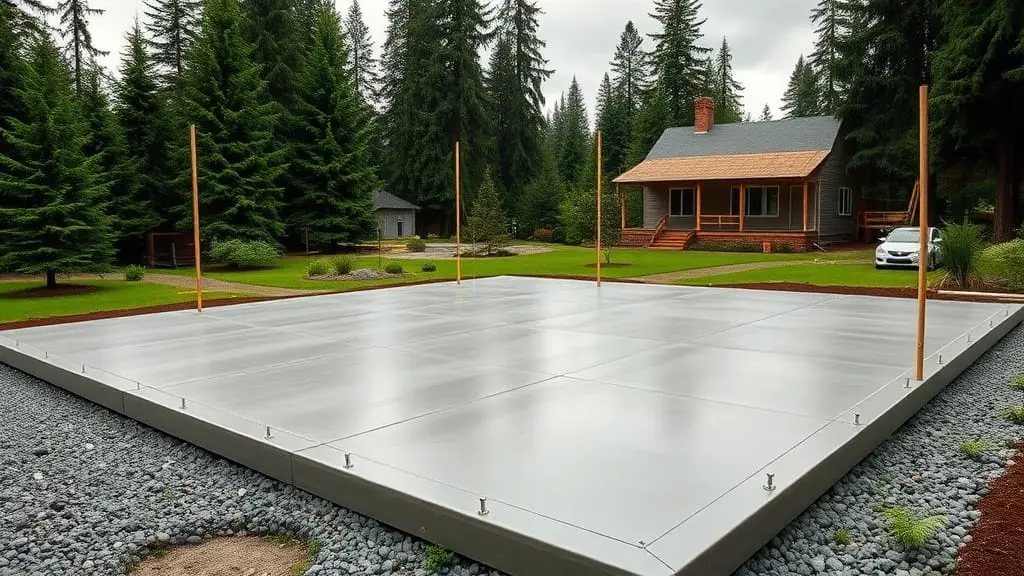
Bellingham receives 37 inches of rain each year, with the vast majority falling between October and April. Every square foot of conventional concrete, asphalt, and roofing on your property sends that rain cascading into storm drains, ditches, and ultimately into Bellingham Bay and Lake Whatcom. The city's strict impervious surface regulations exist to manage this runoff — but for homeowners who've hit their coverage limits, those regulations can feel like a barrier to improving their property.
Pervious concrete offers a solution that satisfies both the homeowner and the environment. Instead of shedding water, pervious concrete absorbs it — allowing rain to pass directly through the surface and percolate into the soil below, just as nature intended. It's the same durable material as standard concrete, engineered differently to create a porous structure that manages stormwater on-site. For properties in Sehome, the Lettered Streets, and other established Bellingham neighborhoods where lot coverage is tight, pervious concrete can mean the difference between being allowed to build that new patio or being told you can't.
What Is Pervious Concrete and How Does It Work?
Pervious concrete (also called permeable concrete or porous pavement) looks similar to standard concrete but functions fundamentally differently. Where conventional concrete is designed to be watertight, pervious concrete is designed to be water-permeable.
The Mix Design
Standard concrete uses a blend of cement, water, coarse aggregate (crushed stone), and fine aggregate (sand) to create a dense, impervious matrix. Pervious concrete eliminates most or all of the fine aggregate. The result is a concrete made primarily of coarse aggregate particles coated with cement paste and bound together — with interconnected void spaces between the aggregate particles that allow water to flow through.
- Void content: Pervious concrete typically contains 15-25% void space (compared to less than 3% in conventional concrete)
- Permeability rate: 3-8 gallons per minute per square foot — fast enough to handle even Bellingham's heaviest downpours
- Compressive strength: 2,000-4,000 PSI depending on mix design, compared to 3,500-5,000 PSI for conventional mixes
- Surface texture: Rougher and more open than conventional concrete, with visible aggregate and small surface voids
The Drainage System
Pervious concrete doesn't just absorb surface water — it's part of a complete stormwater management system. A properly installed pervious concrete project in Bellingham includes:
- Pervious concrete surface layer: Typically 5-8 inches thick, providing the permeable driving or walking surface
- Open-graded aggregate reservoir: 6-12 inches of uniformly-sized crushed stone beneath the concrete that stores water temporarily as it percolates into the soil
- Filter fabric: Geotextile fabric between the aggregate reservoir and native soil to prevent fine soil particles from migrating upward and clogging the system
- Native soil infiltration: The water ultimately percolates into the ground, recharging groundwater and filtering pollutants naturally
On properties with poor-draining glacial till soil — common throughout South Hill, Alabama Hill, and Happy Valley — the aggregate reservoir may need to be oversized, or an underdrain system installed to manage excess water that can't infiltrate fast enough. A soil percolation test before design ensures the system is sized correctly for your specific site.
Bellingham's Impervious Surface Problem
To understand why pervious concrete matters in Bellingham, you need to understand the city's stormwater challenge. As development increases, so does impervious surface coverage — and with it, the volume and velocity of stormwater runoff entering the city's waterways.
The Regulatory Framework
Bellingham enforces impervious surface limits in residential zones — typically 35-50% of total lot area depending on zoning designation. Every roof, driveway, patio, walkway, and conventionally-poured concrete surface on your property counts toward this limit. For a 6,000-square-foot lot in Columbia with a 35% limit, that's only 2,100 square feet of total impervious coverage — including the house itself.
Once you've hit your lot's impervious surface limit, any additional conventional concrete triggers stormwater mitigation requirements — rain gardens, drywells, or other systems that can cost $3,000-8,000 to install. Alternatively, you can't build at all until you remove existing impervious surface to make room.
How Pervious Concrete Changes the Equation
Because pervious concrete allows water to infiltrate into the ground rather than running off, it may qualify for reduced impervious surface calculation under Bellingham's stormwater code. The specific reduction depends on the installation design, the underlying soil conditions, and approval from the city's stormwater management department. In many cases, a pervious concrete driveway or patio can be installed on a property that's already at or near its impervious surface limit — without triggering additional stormwater mitigation requirements.
We recently completed a project in Sehome where a homeowner wanted to add a 350-square-foot patio but was within 2% of their impervious surface limit. Using pervious concrete instead of conventional allowed the project to proceed without a stormwater variance or expensive mitigation infrastructure. The pervious patio cost approximately $2,500 more than conventional concrete would have — but saved the homeowner an estimated $5,000 in stormwater mitigation they would have otherwise needed.
Pervious Concrete Applications for Bellingham Properties
Pervious concrete isn't appropriate for every application, but it excels in several common residential uses throughout Whatcom County.
Driveways
Pervious concrete driveways are the most popular residential application in Bellingham. They handle passenger vehicle traffic well when properly designed (4,000 PSI mix, 6-8 inch thickness, adequate aggregate base). The rougher surface texture actually provides better traction in wet conditions — a meaningful advantage during Bellingham's rain-soaked months from October through April.
Homeowners in Cordata and Barkley Village have installed pervious driveways both for environmental benefits and to maximize lot coverage on newer, smaller lots where impervious surface limits are a real constraint.
Patios and Walkways
Lower-traffic surfaces like patios and garden walkways are ideal for pervious concrete. The slightly coarser texture works well for outdoor living areas, and the absence of standing water after rain is a practical benefit — no more puddles on the patio during Bellingham's long wet season. Properties along Boulevard Park and in Fairhaven have used pervious patios to complement the area's emphasis on environmental stewardship.
Parking Pads and Overflow Parking
RV parking pads, boat trailer storage areas, and overflow guest parking are excellent candidates for pervious concrete. These surfaces see intermittent rather than daily vehicular traffic, and they often represent significant impervious surface additions that can push properties over coverage limits. Agricultural properties in Lynden, Everson, and Sumas have also used pervious concrete for equipment staging areas where stormwater management is a concern.
Pool Decks
Pervious concrete's ability to drain water through its surface makes it a natural fit for pool deck applications. Standing water around pools creates slip hazards and promotes algae growth — both significant concerns in Bellingham's moist climate. A pervious pool deck eliminates puddles and dries faster than conventional concrete, reducing both safety risks and maintenance needs.
Cost Comparison: Pervious vs. Standard Concrete
Pervious concrete costs more than conventional concrete — but the true cost comparison must include the stormwater management implications of each choice.
Direct Costs
- Standard concrete (installed): $10-18 per square foot for a typical residential project in Bellingham
- Pervious concrete (installed): $14-25 per square foot — approximately 20-40% more than standard concrete
The higher cost reflects several factors: the specialized mix design, the deeper aggregate base required, the need for crews experienced in pervious concrete placement (which uses different techniques than standard pours), and the additional quality control testing during installation.
Total Project Cost Including Stormwater
When you factor in stormwater implications, the cost picture often favors pervious concrete:
- Scenario A — Standard concrete on a lot near impervious limit: $6,000 for the patio + $4,000-8,000 for required stormwater mitigation = $10,000-14,000 total
- Scenario B — Pervious concrete on the same lot: $8,500 for the pervious patio + $0 for stormwater mitigation = $8,500 total
For properties well under their impervious surface limit, standard concrete remains the more economical choice. But for lots approaching the threshold — common in older Bellingham neighborhoods like York, Samish, Geneva, and the Lettered Streets — pervious concrete frequently costs less overall.
Maintenance Requirements for Pervious Concrete
Pervious concrete requires different maintenance than standard concrete. The interconnected void spaces that allow water infiltration can become clogged with sediment, organic debris, and fine particles over time — reducing permeability if not maintained.
Regular Maintenance Schedule
- Monthly (during fall leaf season): Remove leaves, needles, and organic debris with a leaf blower or shop vacuum. Bellingham's abundant deciduous and coniferous trees deposit significant material, especially in neighborhoods like Sehome and South Hill
- Quarterly: Pressure wash the surface with a rotary nozzle to dislodge sediment from the upper void spaces. Use clean water only — no chemical cleaners that could contaminate groundwater
- Annually: Professional vacuum sweeping with a regenerative air sweeper to extract sediment from deeper in the void structure. This is the single most important maintenance activity for long-term pervious concrete performance
- As needed: Spot treat moss and algae growth (which thrives in Bellingham's wet climate) with appropriate removers. The porous texture of pervious concrete is more hospitable to moss than smooth conventional concrete
What Happens If You Skip Maintenance?
Neglected pervious concrete progressively loses its permeability as sediment accumulates in the void spaces. Studies show that unmaintained pervious concrete can lose 50-80% of its infiltration capacity within 5-10 years. At that point, it functions more like conventional concrete — defeating its purpose and potentially putting you in violation of stormwater approvals that assumed adequate infiltration.
The good news: regular maintenance is straightforward and keeps pervious concrete performing at design capacity indefinitely. The annual professional vacuum sweeping typically costs $200-400 for a residential driveway — a modest investment to protect a $10,000+ installation.
Green Building Credits and Environmental Benefits
Beyond regulatory compliance, pervious concrete contributes to LEED (Leadership in Energy and Environmental Design) certification in multiple categories — stormwater management, heat island reduction, and water efficiency. For homeowners pursuing green building goals, pervious concrete is one of the most impactful single material choices available.
Stormwater runoff from conventional pavement picks up pollutants — motor oil, brake dust, fertilizers, pet waste — and carries them directly into Bellingham Bay. Pervious concrete acts as a natural filter: water passing through the concrete and aggregate base is cleansed of many pollutants before reaching groundwater. Studies indicate pervious concrete systems can remove up to 90% of surface pollutants through natural filtration.
For properties in the Lake Whatcom watershed — including Silver Beach and Sudden Valley — this filtration function is particularly valuable. Lake Whatcom serves as Bellingham's primary drinking water source, and any reduction in pollutant-laden runoff helps protect water quality for the entire community.
Limitations and Honest Considerations
Pervious concrete isn't a universal solution. Understanding its limitations helps you make an informed decision about whether it's right for your specific project.
- Lower compressive strength: Pervious concrete typically achieves 2,000-4,000 PSI — sufficient for residential use but not appropriate for heavy commercial traffic or structural applications
- Surface texture: The open, rough surface is not suitable for decorative stamped finishes. If aesthetics are a priority, conventional concrete with integrated stormwater management may be preferable
- Freeze-thaw vulnerability: The high void content means more water can be retained within the concrete. In Bellingham's freeze-thaw climate, the aggregate base must drain freely to prevent water from freezing within the concrete layer. Proper design with adequate base depth is essential
- Soil compatibility: On sites with extremely poor-draining glacial till (common in many Bellingham neighborhoods), an underdrain system may be necessary beneath the aggregate reservoir — adding $1,500-3,000 to project cost
- Limited contractor pool: Not all concrete contractors have experience with pervious concrete installation. The placement and finishing techniques differ from conventional work, and inexperienced crews can produce a system that clogs prematurely or fails structurally
- Not suitable for all winter maintenance: Sand and de-icing agents should not be applied to pervious concrete, as they clog the void structure. Snow removal is limited to plowing and shoveling — no sand or chemical treatment
Is Pervious Concrete Right for Your Bellingham Property?
The best candidates for pervious concrete in Whatcom County are homeowners who face one or more of these situations:
- Your property is near or at its impervious surface coverage limit
- You're in the Lake Whatcom watershed and want to minimize runoff impact
- You're building on a site where stormwater management is required and pervious concrete can serve double duty
- You value environmental sustainability and want your hardscape to align with Bellingham's green building culture
- You're willing to commit to regular maintenance to keep the system performing
For homeowners in Blaine, Birch Bay, Ferndale, and other Whatcom County communities with their own stormwater regulations, pervious concrete offers similar benefits — though specific impervious surface rules vary by jurisdiction. We evaluate each property individually, assessing soil conditions, drainage patterns, intended use, and regulatory requirements to determine whether pervious or conventional concrete provides the best overall value.
Pervious concrete represents a genuine advancement in how we build hardscapes — one that aligns practical property improvement with responsible environmental stewardship. In a community like Bellingham that takes its environmental commitments seriously, it's a technology worth understanding and considering for your next project.
Ready to get started? Contact us today for a free estimate — we serve all of Bellingham and Whatcom County.