
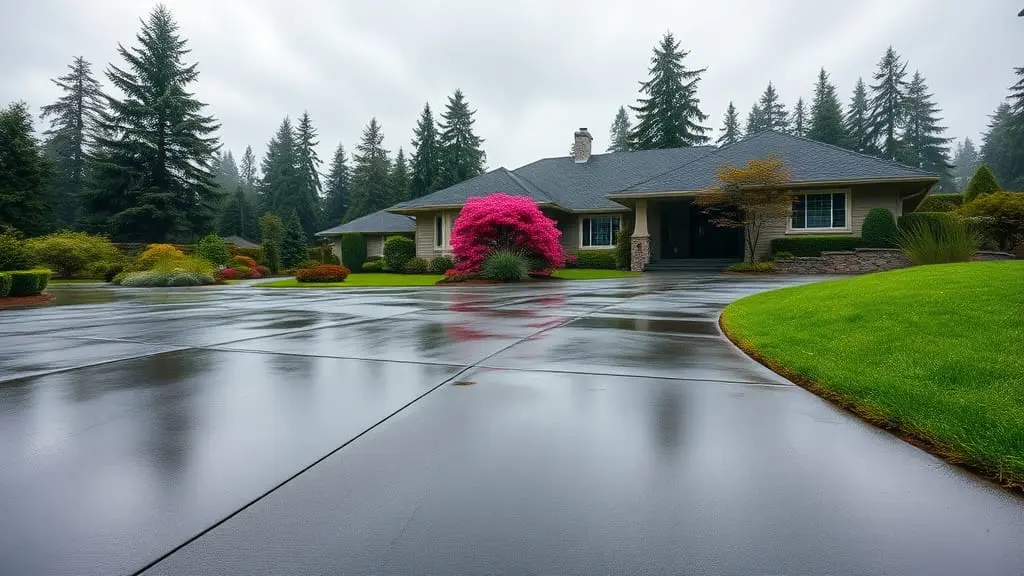
Walk through any established Bellingham neighborhood—the Lettered Streets, Sehome, Samish, or Happy Valley—and you will see it on nearly every north-facing concrete surface: moss. Thick, green, and seemingly harmless, it blankets sidewalks, creeps across patios, and fills every crack and joint it can find. Algae, its less visible cousin, creates the dark green and black staining that appears on driveways and walkways throughout the wet season. Most homeowners view moss and algae as cosmetic nuisances. They are not. Left unchecked, biological growth causes genuine structural deterioration that shortens concrete lifespan by years and creates serious safety hazards.
Whatcom County's marine climate is a paradise for moss and algae. Our 37 inches of annual rainfall, persistent overcast skies, mild 35-45°F winters that never get cold enough to kill spores, and a wet season stretching from October through April create conditions where biological growth is not a possibility—it is a certainty. Understanding how this growth damages concrete and what you can do about it is essential knowledge for every homeowner in the region.
How Moss Physically Destroys Concrete
Moss is not a surface problem. It is an infiltration problem. The root-like structures of moss (called rhizoids) penetrate into the porous surface of concrete, working into microscopic pores and existing cracks. As the moss grows, these rhizoids expand and exert physical pressure that widens those openings. This process is slow—measured in years, not months—but the damage is cumulative and accelerating.
The Moisture Retention Cycle
This is the mechanism that causes the most damage, and it is poorly understood by most homeowners. Moss acts as a sponge, holding moisture against the concrete surface continuously. In Bellingham's climate, a moss-covered slab essentially never dries out between October and April. That six months of sustained moisture contact creates several destructive effects:
- Freeze-thaw amplification: Bare concrete in Bellingham might experience 15-25 freeze-thaw cycles per winter. Moss-covered concrete, because it holds water against the surface during every freezing night, experiences the full destructive force of each cycle. The water held by moss freezes, expands by 9%, and pries apart the surface layer of concrete. Over several winters, this creates the scaling and spalling that homeowners mistakenly attribute to age or poor installation.
- Chemical attack: Moss produces weak organic acids as a byproduct of its metabolism. These acids slowly dissolve the calcium hydroxide in cement paste—a process called biogenic acid attack. On its own, this is minor. But combined with sustained moisture and freeze-thaw cycling, it significantly accelerates surface deterioration.
- Subgrade saturation: Moss growing along the edges of slabs and in expansion joints funnels water directly into the subgrade beneath the concrete. On the glacial till soil prevalent throughout Sehome, Columbia, and South Hill, this trapped moisture has nowhere to drain. The saturated subgrade erodes unevenly, creating voids beneath the slab that lead to settling and cracking.
Crack Exploitation
Moss is opportunistic. It colonizes existing hairline cracks and expansion joints first because these locations offer moisture and protected growing conditions. Once established in a crack, the moss rhizoids physically widen it. A hairline crack that is barely visible in summer can expand to 1/8 inch or more over 3-5 years of moss colonization. Each widening cycle admits more water, more soil, and more biological material, creating a feedback loop that transforms minor cracking into structural failure.
We have removed sections of sidewalk in Fairhaven and the York neighborhood where moss had turned minor settling cracks into complete slab separation over a decade. The original cracks were repairable for a few hundred dollars. By the time the moss was done, full slab replacement at $8-$12 per square foot was the only option.
How Algae Damages Concrete
Algae operates differently from moss but is equally problematic. While moss is visible and textured, algae often appears as a dark discoloration—green, black, or reddish—that many homeowners mistake for simple staining or weathering. Two types are common in Whatcom County:
Green Algae
Green algae thrives on any concrete surface that stays damp and receives even indirect light. It is especially prevalent on driveways and walkways with partial shade—properties in Samish, Silver Beach, and Sudden Valley where mature tree canopies filter but do not eliminate light. Green algae creates a slippery biofilm when wet that is a significant slip-and-fall hazard.
Black Algae (Gloeocapsa Magma)
Black algae produces dark streaks and patches on concrete and is extremely difficult to remove. It protects itself with a hard outer layer that resists pressure washing and standard cleaners. Black algae does not penetrate concrete as aggressively as moss, but its persistent staining degrades property appearance and its moisture-trapping behavior contributes to surface deterioration.
Algae Damage Mechanisms
- Staining: Algae produces pigments that penetrate into the porous concrete surface. Once embedded, these stains resist even aggressive cleaning. We see permanent algae staining on untreated patios throughout Edgemoor and Boulevard Park within 2-3 years of installation.
- Surface etching: Like moss, algae produces acids that slowly dissolve cement paste. The effect is subtle but measurable—algae-covered surfaces develop a rougher texture over time, which paradoxically provides more surface area for additional algae colonization.
- Moisture layer: Algae biofilm traps a thin layer of moisture against the concrete surface continuously. Even a microscopic moisture layer contributes to freeze-thaw damage and chemical weathering.
- Safety hazard: This is the most immediate concern. Wet algae on concrete is dangerously slippery. Walkways, pool decks, and entry steps with algae growth become slip-and-fall liabilities. In a litigious environment, property owners have legal exposure for injuries on algae-slicked surfaces.
Which Concrete Surfaces Are Most Vulnerable
Not all concrete surfaces in Whatcom County face equal biological attack. Understanding vulnerability factors helps you prioritize maintenance:
High-Risk Surfaces
- North-facing walkways and patios: These receive minimal direct sun and stay damp far longer than south-facing surfaces. A north-facing patio in Sehome may not fully dry from October through May. These surfaces develop heavy moss within 1-2 years if unsealed.
- Shaded areas under trees: Dense tree canopy limits UV exposure (which kills algae) and drops organic debris that feeds biological growth. Properties in Happy Valley, Samish, and Silver Beach with mature Douglas firs and Western red cedars are particularly affected.
- Textured and stamped surfaces: The grooves and texture of stamped decorative concrete trap moisture and organic material, providing ideal conditions for colonization. Stamped patios require more aggressive biological maintenance than broom-finished surfaces.
- Flat surfaces with poor drainage: Any area where water pools or drains slowly stays damp longer. Slight depressions, settled areas, and surfaces where the original drainage slope has been compromised are moss magnets.
- Older unsealed concrete: Concrete becomes more porous with age as the surface wears. Unsealed concrete that is 10+ years old absorbs and retains moisture far more readily than newly sealed surfaces, creating ideal biological growing conditions.
Lower-Risk Surfaces
- South-facing driveways: Maximum sun exposure keeps surfaces drier and UV radiation inhibits biological growth. South-facing driveways in Geneva, Sunnyland, and Cordata may only need biological treatment every 2-3 years.
- Recently sealed concrete: A quality penetrating sealer reduces the surface porosity that biological organisms need to establish roots. Sealed surfaces resist colonization and are easier to clean when growth does occur.
- High-traffic areas: Regular foot or vehicle traffic physically disrupts biological growth before it can establish. Your most-used walkway will have less moss than a seldom-used side path.
Effective Removal Methods
Removing established moss and algae requires more than a garden hose. The method you choose depends on the severity of growth, the type of concrete surface, and whether you want to tackle it yourself or hire a professional.
Pressure Washing
Pressure washing is the most effective mechanical removal method. A 3,000-3,500 PSI pressure washer with a 25-degree tip removes most surface moss and algae. Key guidelines:
- Keep the nozzle 8-12 inches from the surface: Closer than 8 inches risks etching the concrete. Further than 12 inches reduces effectiveness.
- Use a surface cleaner attachment for large areas: These spinning-nozzle attachments provide even cleaning without the striping that a wand creates.
- Do NOT pressure wash stamped or decorative concrete at full power: Reduce to 2,000-2,500 PSI and use a 40-degree tip. High pressure can blast away the surface release agent and damage the stamp pattern.
- Pressure washing alone is temporary: Without chemical treatment or sealing afterward, moss and algae will return within 3-6 months in Bellingham's climate.
Chemical Treatment
- Oxygen bleach (sodium percarbonate): The safest option for concrete and surrounding vegetation. Mix 1 cup per gallon of warm water, apply to the surface, let sit 15-30 minutes, then scrub and rinse. Effective on light to moderate algae. Safe for use near gardens and landscaping—a key consideration on Bellingham properties where concrete often borders lush plantings.
- Zinc sulfate: Both a remover and preventative. Apply dry granules along moss-covered surfaces, sweep into cracks and joints, and let rain wash it in. Zinc is toxic to moss but relatively benign to surrounding plants at recommended rates. Apply in fall for best prevention.
- Chlorine bleach (sodium hypochlorite): Highly effective but use with caution. Dilute 1 part bleach to 3 parts water. Kills moss and algae on contact. However, it damages surrounding vegetation, can lighten colored concrete, and degrades sealers. We recommend it only for non-decorative surfaces away from landscaping.
- Commercial moss and algae removers: Products like Wet and Forget or 30 Seconds Outdoor Cleaner are formulated for concrete surfaces. They work more slowly (days to weeks) but are generally safer for surrounding vegetation and surface finishes. Cost: $15-$30 per container, covering 500-750 square feet.
Professional Removal
For severe biological growth—surfaces with thick moss mats, deep root penetration into cracks, or heavy black algae staining—professional treatment is worth the investment. Our process includes hot-water pressure washing (180°F+), chemical treatment targeting the specific biological organism, crack cleaning and sealing, and application of a preventative surface treatment. Professional biological cleaning typically costs $0.50-$1.50 per square foot depending on severity.
Prevention: Sealing as Your First Line of Defense
The most effective long-term strategy against biological growth is preventing it from establishing in the first place. Concrete sealing is the foundation of prevention.
How Sealers Prevent Biological Growth
Penetrating sealers (silane/siloxane formulations) fill the microscopic pores in concrete that moss rhizoids and algae use as anchoring points. By reducing surface porosity, sealers accomplish two things: they deny biological organisms the surface texture they need to attach, and they reduce the moisture absorption that sustains growth. A properly sealed concrete surface dries 3-5 times faster after rain than an unsealed surface—dramatically reducing the damp conditions that moss and algae require.
Sealing Schedule for Whatcom County
- New concrete: Apply first sealer 28-30 days after placement (longer for winter pours—wait until spring).
- Maintenance resealing: Every 2-3 years for penetrating sealers; every 1-2 years for film-forming sealers on decorative surfaces.
- Best timing: July through early September when surfaces are fully dry and rain-free conditions can be maintained for 48 hours after application.
- Cost: DIY sealing costs $0.15-$0.30 per square foot in materials. Professional sealing runs $0.50-$1.50 per square foot, including cleaning and surface preparation.
Additional Prevention Strategies
- Improve drainage: Eliminate low spots where water pools. Regrade soil along slab edges to direct water away. Ensure gutters and downspouts discharge away from concrete surfaces.
- Increase sun exposure: Trim tree branches that shade concrete surfaces. Even increasing direct sun by 2-3 hours per day can significantly reduce biological growth. Properties in Ferndale and Lynden where mature trees shade driveways often see dramatic improvement after selective limb removal.
- Maintain expansion joints: Keep joints filled with flexible sealant to deny moss an entry point. Joints filled with dirt and debris are colonized within a single wet season.
- Apply zinc strips: Zinc strips installed at the top of sloped surfaces (like rooflines for roofs) release trace amounts of zinc during rain that inhibit moss growth downstream. This technique works well along the uphill edge of walkways and patios.
- Annual fall treatment: Apply a preventative moss killer in October before the wet season begins. This pre-emptive treatment costs $20-$40 in products and 30 minutes of labor—far less than spring removal of established growth.
The Real Cost of Neglect
Homeowners who dismiss moss and algae as cosmetic issues eventually pay the price. Here is what deferred biological maintenance costs over a 10-year period on a typical Whatcom County property:
- Annual cleaning and prevention: $200-$400/year = $2,000-$4,000 over 10 years
- Biennial sealing: $300-$800 per application = $1,500-$4,000 over 10 years
- Total proactive maintenance: $3,500-$8,000 over 10 years
Compare that to the cost of neglect:
- Premature sidewalk replacement (400 sq ft): $3,200-$6,000
- Premature driveway replacement (600 sq ft): $5,000-$9,000
- Patio removal and replacement (300 sq ft): $2,400-$5,000
- Foundation waterproofing for moisture damage: $3,000-$8,000
- Total neglect cost: $13,600-$28,000 or more over 10 years
That is a 3-4x cost multiplier for neglecting maintenance that most homeowners can handle in a weekend afternoon each spring and fall.
Act Now, Not Later
If your concrete surfaces already show moss or algae growth, the best time to address it is now—before another wet season allows the growth to deepen its hold. Spring and early summer (April through July) is the ideal treatment window: surfaces can dry after cleaning, sealers can be applied during dry weather, and preventative treatments have months to establish before the October rains return.
For properties in Blaine, Birch Bay, and Bellingham's waterfront areas where salt air and marine moisture amplify biological growth, annual professional treatment is a sound investment. For inland properties in Lynden, Everson, and Sumas where colder winters slow moss growth but summer heat promotes algae, a biennial treatment schedule is typically sufficient.
The Pacific Northwest grows moss on everything—fences, roofs, rocks, and yes, concrete. You cannot eliminate the threat entirely, but with consistent maintenance and proper sealing, you can reduce biological damage to near zero and keep your concrete surfaces looking and performing their best for decades.
Ready to get started? Contact us today for a free estimate — we serve all of Bellingham and Whatcom County.