
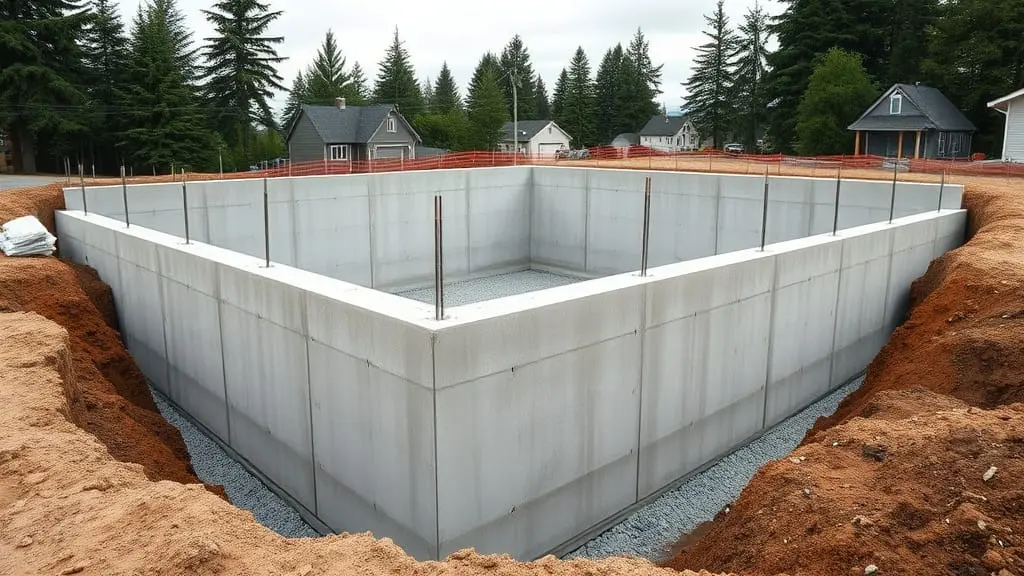
If you own a home in Bellingham or anywhere in Whatcom County, your foundation is almost certainly sitting on glacial till—a dense, complex soil type left behind by the Cordilleran Ice Sheet when it retreated approximately 13,000 years ago. This isn't just a geological curiosity. Glacial till is directly responsible for many of the foundation problems, drainage headaches, and structural issues that Whatcom County homeowners face, and understanding it is the first step toward protecting your home's most critical structural element.
As foundation contractors who have worked on hundreds of properties across Bellingham—from the waterfront homes of Boulevard Park to hillside residences in Edgemoor and the established neighborhoods of the Lettered Streets and Sehome—we've developed an intimate understanding of how our local soil behaves and what it means for the foundations built upon it.
What Is Glacial Till and Why Does Bellingham Have It?
Glacial till is an unsorted mixture of clay, silt, sand, gravel, and boulders deposited directly by glacial ice. Unlike soil deposits formed by rivers or wind, which sort particles by size, glacial till contains an unpredictable mixture of particle sizes all jumbled together. Imagine mixing modeling clay, beach sand, river pebbles, and large rocks into a single mass, then compressing it under millions of tons of ice for thousands of years. That's essentially what lies beneath most of Whatcom County.
The Cordilleran Ice Sheet, which at its maximum extent covered Bellingham under approximately 5,000 feet of ice, advanced and retreated multiple times. Each advance deposited a new layer of till, and each retreat left behind meltwater deposits of sorted sand and gravel. The result is a complex subsurface that can vary dramatically over short distances—a property in Fairhaven might have dense clay till at 3 feet below grade, while a lot 200 feet away encounters a sand and gravel lens at the same depth.
Key Characteristics of Bellingham's Glacial Till
- High density: Glacial till was compressed under enormous weight for millennia, making it extremely dense—often 125-135 pounds per cubic foot. This density gives it good bearing capacity for foundations but makes it nearly impervious to water
- Variable composition: Within a single building footprint, you may encounter stiff clay, loose sand pockets, gravel lenses, and embedded boulders. This variability is the primary engineering challenge
- Poor drainage: The fine-grained matrix of clay and silt between larger particles creates very low permeability. Water doesn't pass through till easily—it sits on top of it, runs along its surface, or builds up hydrostatic pressure against anything embedded in it
- Moderate to high bearing capacity: Despite its challenges, undisturbed glacial till typically provides adequate bearing capacity (1,500-3,000 PSF) for residential construction without the deep foundations required in softer soils
How Glacial Till Causes Foundation Problems
The foundation issues we see most frequently across Bellingham trace back to three fundamental properties of glacial till: its impermeability, its variability, and its behavior when saturated.
Water Retention and Hydrostatic Pressure
This is the single biggest foundation challenge in Whatcom County. When it rains—and with 37 inches of annual precipitation, it rains a lot—water percolates down through topsoil and landscaping until it hits the glacial till layer. Because the till is nearly impervious, water accumulates at this interface, creating a perched water table that can be significantly higher than the regional water table.
For homes with basements or deep crawl spaces, this perched water creates hydrostatic pressure against foundation walls and beneath floor slabs. We routinely measure hydrostatic pressure equivalent to hundreds of pounds per square foot against basement walls in low-lying areas of Birchwood, Geneva, and along the Whatcom Creek corridor. This pressure drives water through any imperfection in the waterproofing—cracks, cold joints, pipe penetrations, and deteriorated coatings are all entry points.
Properties on hillsides face a related problem: subsurface water flowing along the till surface toward downhill foundations. Homes on South Hill, Alabama Hill, and Silver Beach frequently experience water intrusion on their uphill foundation walls even with proper grading at the surface, because the water is traveling beneath the ground along the glacial till layer.
Differential Settlement
Glacial till's variable composition means that different parts of your foundation may be resting on materials with different bearing capacities and compression characteristics. One corner of your home might sit on dense, stable clay till while another sits on a pocket of looser, sandier material that compresses more over time. The result is differential settlement—where one part of the foundation sinks more than another.
Differential settlement manifests as diagonal cracks in foundation walls, doors and windows that stick, visible gaps between walls and ceilings, cracked drywall around openings, and floors that slope noticeably in one direction.
We see differential settlement most frequently in neighborhoods built on transitional soil zones—areas where glacial till borders glacial outwash deposits. Parts of Cordata, Barkley Village, and the Meridian corridor are particularly prone to this because they sit on the edge of the Nooksack River's historical outwash plain, where soil conditions transition over short distances.
Frost Heave Interaction
While glacial till itself is generally too dense for significant frost heave, the saturated soil layer that often sits on top of the till is highly susceptible. When temperatures drop below freezing—which occurs 30-40 times per winter in Bellingham—the water-saturated interface zone between topsoil and glacial till can freeze, expand, and lift shallow foundations, sidewalks, and other structures.
This is particularly problematic for slab foundations and shallow footings that don't extend below the frost line. We've repaired frost-heaved concrete slabs throughout Whatcom County, including garage slabs in Ferndale, patio slabs in Lynden, and walkway sections in Bellingham's Sunnyland neighborhood where the combination of shallow construction and water-logged soil above the till created perfect conditions for heave.
Neighborhood-Specific Soil Conditions
While glacial till is present throughout Whatcom County, its characteristics and the associated foundation challenges vary by location. Here's what we've observed across Bellingham's neighborhoods and the broader county.
Hillside Neighborhoods (South Hill, Alabama Hill, Sehome, Edgemoor, Silver Beach)
Hillside properties typically encounter glacial till closer to the surface—sometimes within 12-18 inches of grade. The primary challenge is lateral water flow along the till surface toward downhill foundations. Homes here frequently need French drain systems and curtain drains installed uphill of the foundation to intercept subsurface water before it reaches the structure. Foundation walls on the uphill side require robust waterproofing membranes and drainage board installations. Boulder encounters during excavation are also more common in hillside till, potentially adding $1,000-$5,000+ to foundation costs.
Flat/Low-Lying Neighborhoods (Birchwood, Cordata, Geneva, Sunnyland, York)
Properties in flatter areas tend to have thicker topsoil layers over the till, but the combination of flat terrain and impervious till creates chronic drainage problems. Water cannot drain vertically through the till or flow laterally away as it would on a slope. Seasonal high water tables can rise to within 18-36 inches of the surface during wet months, making sump pump systems with battery backup essentially mandatory for any below-grade space. Homes in Birchwood and Geneva built before modern drainage codes frequently lack adequate foundation drainage—retrofit drainage systems are among our most common projects in these areas.
Waterfront and Creek-Adjacent Properties (Boulevard Park, Fairhaven, Happy Valley)
Properties near Bellingham Bay or along creek corridors often encounter a mix of glacial till and marine or alluvial deposits. These mixed soils can have particularly variable bearing capacity and may be subject to seasonal saturation from tidal influence or creek water table fluctuations. Foundation design in these areas should always be based on site-specific geotechnical investigation rather than general assumptions.
North County (Ferndale, Lynden, Everson, Sumas)
The agricultural areas north of Bellingham often sit on glacial outwash—sorted sand and gravel deposits from glacial meltwater rivers—rather than till proper. These soils drain better than till but may have lower bearing capacity. The transition zones between outwash and till, common in Ferndale, can create differential settlement concerns similar to those in Bellingham's Cordata area.
East County (Sudden Valley, Blaine Foothills, Birch Bay)
Sudden Valley and the Chuckanut foothills sit on some of the most complex glacial deposits in the county—multiple layers of till, outwash, and lacustrine deposits stacked in variable sequences. Foundation problems in Sudden Valley are common and often severe, driven by steep terrain, dense till, and heavy rainfall with no easy drainage path. Blaine and Birch Bay properties near the coast encounter marine-influenced glacial deposits subject to erosion, sometimes containing marine clay layers with challenging engineering properties.
Soil Testing: What You Need and What It Costs
Before any new construction or major foundation repair in Whatcom County, a geotechnical investigation is the smartest investment you can make. Here's what the process involves:
Standard Geotechnical Investigation
- Test borings: One to three borings drilled 15-25 feet deep, with soil samples collected at regular intervals
- Laboratory analysis: Samples tested for grain size distribution, moisture content, Atterberg limits, and bearing capacity
- Engineering report: A licensed geotechnical engineer provides specific foundation recommendations including type, footing dimensions, and drainage requirements
- Cost: $2,000-$5,000 for typical residential sites; complex sites with steep slopes may run $5,000-$10,000
For existing homes with foundation problems, a targeted investigation with one or two borings near the area of concern typically costs $1,500-$3,000 and provides sufficient information to design a repair strategy.
Engineering Solutions for Glacial Till Challenges
Decades of building on glacial till has produced a well-established set of engineering solutions tailored to Whatcom County conditions.
Drainage Systems
Effective drainage is the single most important engineering intervention for foundations on glacial till. Key components include:
- Perimeter French drains: A perforated pipe in a gravel-filled trench installed alongside the foundation footing. This collects water that accumulates against the foundation and routes it to a discharge point. Cost: $3,000-$8,000 for a typical residential installation
- Curtain drains: For hillside properties, a drain installed uphill of the foundation to intercept subsurface water flowing along the till surface before it reaches the structure. Cost: $2,000-$6,000
- Sump pump systems: For basements and low crawl spaces, a sump pit with automatic pump removes collected water. Battery backup is essential in Bellingham where power outages during storms coincide with the heaviest water intrusion. Cost: $1,500-$3,500 installed with battery backup
- Surface grading: Ensuring the ground slopes away from the foundation at a minimum of 6 inches of fall over the first 10 feet. Simple but often neglected—and remarkably effective. Cost: $500-$3,000 depending on scope
Foundation Waterproofing
- Exterior waterproofing membrane: Rubberized asphalt or polymer membranes applied to foundation wall exteriors. Cost: $8,000-$20,000 for existing homes (requires excavation) or $3,000-$8,000 during new construction
- Drainage board: Dimpled plastic sheet over the membrane creating an air gap for water to flow to the footing drain. Cost: $1,500-$4,000 as an add-on
- Interior waterproofing systems: For existing basements where exterior excavation is impractical, interior channel systems collect wall seepage and route it to a sump pump. Cost: $5,000-$15,000
Structural Solutions for Settlement
- Helical piers: Steel screw-like piers driven to stable bearing layers to stabilize and lift settled foundations. Cost: $1,200-$2,500 per pier, typical homes needing 8-15 piers
- Push piers: Hydraulic rams drive steel piers to load-bearing strata. Cost: $1,000-$2,000 per pier
- Mudjacking or foam injection: For settled concrete slabs, material injected beneath lifts the slab back to level. Cost: $2,000-$6,000
- Carbon fiber reinforcement: For bowed foundation walls, carbon fiber strips bonded to the interior provide stabilization without excavation. Cost: $500-$800 per strip, typically 5-10 strips needed
What Every Whatcom County Homeowner Should Know
Living on glacial till doesn't mean your foundation is doomed—the vast majority of homes in Bellingham have stable, functional foundations. But it does mean you need to be proactive about moisture management and attentive to signs of foundation stress. Here are our key recommendations:
- Maintain your drainage: Clean gutters regularly, ensure downspouts discharge at least 6 feet from the foundation, and keep surface grading sloped away from the home. These simple habits prevent most water-related foundation problems
- Monitor annually: Walk around your foundation each spring looking for new cracks, water staining, efflorescence (white mineral deposits), and changes in existing cracks. Inside, check for sticking doors, new drywall cracks, and uneven floors
- Act early: Foundation problems never get better on their own and always get more expensive to fix over time. A $3,000 drainage improvement today can prevent a $30,000 foundation repair five years from now
- Get site-specific advice: Because glacial till varies so much across Bellingham, general advice has limits. For any significant foundation concern or new construction project, invest in a geotechnical investigation tailored to your specific property
- Budget for maintenance: Sump pumps, drainage systems, and waterproofing all require periodic maintenance. Budget $500-$1,000 annually for foundation-related maintenance to protect your largest investment
Bellingham's glacial till soil is a fundamental fact of life for every homeowner in Whatcom County. Understanding how it behaves—and how to engineer around its challenges—is the key to maintaining a dry, stable, and structurally sound home for decades to come.
Ready to get started? Contact us today for a free estimate — we serve all of Bellingham and Whatcom County.