
The foundation beneath your Bellingham home is arguably the most important structural element you'll never see—and choosing the right type for our local conditions can mean the difference between decades of stability and a lifetime of moisture problems, settling, and costly repairs. Whatcom County's unique combination of glacial till soil, high water tables, 37 inches of annual rainfall, and marine climate creates foundation challenges that simply don't exist in most other regions.
Whether you're building new construction, evaluating a home purchase, or investigating issues with your current foundation, understanding how each foundation type performs in Bellingham's specific conditions will help you make informed decisions that save thousands of dollars over the life of your home.
The Three Primary Foundation Types
Virtually every residential structure in Whatcom County sits on one of three foundation types: concrete slab-on-grade, crawl space, or full basement. Each has distinct characteristics, cost implications, and performance profiles in our climate.
Slab-on-Grade Foundations
A slab foundation is a single layer of concrete, typically 4-6 inches thick, poured directly on a prepared gravel base at ground level. The slab serves simultaneously as the foundation and the ground floor. Plumbing and sometimes electrical conduits are embedded within or beneath the slab before the pour.
Prevalence in Bellingham: Slab foundations are less common in Bellingham proper than in many other U.S. markets, making up roughly 15-20% of residential construction. They're more frequently seen in newer developments in Cordata, Barkley Village, and portions of Ferndale and Lynden where flatter terrain and newer construction codes favor this approach. You'll also find them on mid-century ranch-style homes in Sunnyland and parts of the York neighborhood.
Crawl Space Foundations
A crawl space foundation elevates the home's first floor 18 to 48 inches above grade on a perimeter of concrete stem walls. The space beneath the home provides access to plumbing, electrical, HVAC ducting, and other utilities. The ground within the crawl space may be bare earth, covered with a vapor barrier, or finished with a concrete skim coat.
Prevalence in Bellingham: Crawl spaces are the most common foundation type in Bellingham, found in an estimated 50-60% of homes. They're ubiquitous in established neighborhoods like Sehome, South Hill, Alabama Hill, the Lettered Streets, Fairhaven, and Birchwood. The hilly terrain and well-established building practices in these older neighborhoods made crawl spaces the default choice for decades.
Full Basement Foundations
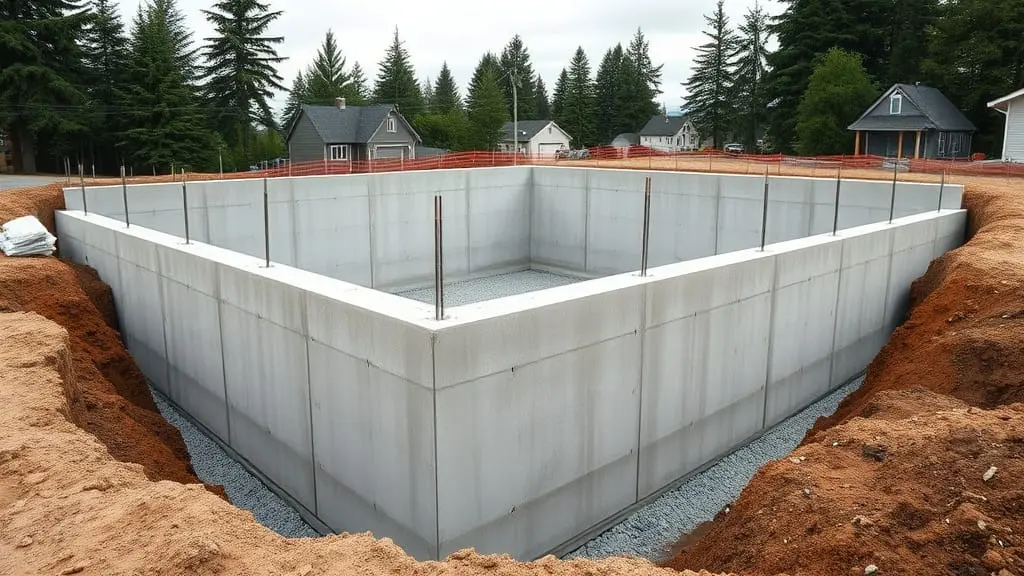
A basement foundation creates a full-height (typically 8-9 feet) below-grade living or utility space beneath the home. The concrete walls extend from the footing to the sill plate, creating a structurally robust enclosure that can serve as conditioned living space, storage, or mechanical rooms.
Prevalence in Bellingham: Full basements account for roughly 25-35% of Bellingham homes. They're especially common in hillside neighborhoods where sloped terrain naturally accommodates a below-grade level—places like Edgemoor, Silver Beach, South Hill, and portions of Boulevard Park where homes are built into hillsides with daylight basements facing downhill.
How Bellingham's Climate Affects Each Foundation Type
Our Pacific Northwest climate subjects foundations to specific stressors that influence which type performs best and what maintenance each requires.
Slab Foundations in Bellingham's Climate
Advantages:
- No below-grade moisture entry: With no space below the living area, there's no crawl space to flood or basement to waterproof. This is significant in a region that receives 37 inches of rain annually
- Thermal mass benefits: The concrete slab absorbs and releases heat slowly, moderating temperature fluctuations—an advantage during Bellingham's mild but damp winters
- Reduced pest access: No crawl space means fewer entry points for rodents and insects, a practical consideration throughout Whatcom County
- Lower construction cost: Typically $5,000-$15,000 less than a crawl space foundation for equivalent square footage
Challenges:
- Plumbing access: Repairs to plumbing embedded in or beneath the slab require cutting through concrete—expensive and disruptive. With Bellingham's older clay sewer laterals and tree root intrusion common near mature Douglas firs, this can be a significant drawback
- Moisture wicking: Without proper vapor barriers, ground moisture wicks through the slab, creating damp interior conditions. Bellingham's high water table in low-lying areas makes this a chronic issue
- Frost considerations: Slab edges must be insulated and footings must extend below frost depth (12 inches minimum per local code) to prevent frost heave during our winter freeze-thaw cycles
- Settlement on glacial till: Slabs are unforgiving of soil movement. On Bellingham's variable glacial till, differential settlement can crack a slab and create structural problems throughout the home
Crawl Space Foundations in Bellingham's Climate
Advantages:
- Utility access: Easy access to plumbing, electrical, HVAC, and drainage systems for inspection, maintenance, and repair
- Moisture management flexibility: A properly ventilated or encapsulated crawl space can manage Bellingham's ground moisture effectively. Encapsulation with vapor barriers and dehumidification has become the gold standard for local crawl space management
- Adaptability to sloped sites: Crawl spaces accommodate Bellingham's hilly terrain by varying stem wall heights, making them suitable for the varied topography in neighborhoods like Alabama Hill and Happy Valley
- Seismic performance: The elevated structure on stem walls provides some isolation from ground movement—a consideration in our seismically active region
Challenges:
- Moisture intrusion: This is the primary challenge for crawl spaces in Bellingham. Standing water, elevated humidity, and condensation are nearly universal problems in unmanaged crawl spaces. We've inspected homes in Birchwood, Samish, and Geneva where crawl space relative humidity exceeds 90% for months at a time
- Mold and rot: Our damp climate creates ideal conditions for mold growth and wood rot in poorly maintained crawl spaces. Floor joists, sill plates, and subflooring are all vulnerable
- Pest habitat: Damp, dark crawl spaces attract rodents, insects, and other pests. Regular inspection is essential
- Energy loss: An uninsulated crawl space beneath the living area is a major source of heat loss. Proper insulation and sealing are necessary but add $3,000-$8,000 to the cost
Basement Foundations in Bellingham's Climate
Advantages:
- Additional living space: A finished basement can add 50-100% more livable square footage to a home. In Bellingham's competitive housing market, this space has significant value—finished basements in Edgemoor and the Lettered Streets add an estimated $50,000-$100,000 in home value
- Natural hillside integration: Bellingham's topography is ideal for daylight basements. Homes on South Hill, Silver Beach, and Boulevard Park can incorporate basements with full windows and walkout access on the downhill side
- Storm shelter and storage: Below-grade space maintains stable temperatures and provides protected storage and utility space
- Structural strength: Full-height concrete walls create an extremely strong foundation that handles lateral soil pressure and vertical loads effectively
Challenges:
- Waterproofing is critical and expensive: Below-grade walls must resist hydrostatic pressure from Bellingham's saturated soils. Proper exterior waterproofing membrane, drainage systems, and sump pumps are mandatory—not optional. Budget $10,000-$25,000 for comprehensive waterproofing on new construction
- High water table conflicts: In low-lying areas of Bellingham—particularly near Whatcom Creek, Padden Creek, and tidal-influenced zones in Fairhaven and Boulevard Park—the seasonal water table can rise to within 2-3 feet of the surface, creating enormous hydrostatic pressure on basement walls
- Highest construction cost: A full basement adds $30,000-$60,000+ to foundation costs compared to a crawl space, and $40,000-$75,000+ compared to a slab. Excavation in glacial till is expensive due to the material's density
- Ongoing maintenance: Sump pumps require power and regular maintenance. A pump failure during a November storm can result in catastrophic flooding. Battery backup systems ($500-$1,500) are essential in Bellingham
Cost Comparison for Whatcom County (2024)
Foundation costs vary significantly based on home size, site conditions, and soil characteristics. These estimates reflect typical single-family home construction in the Bellingham market:
Slab-on-Grade (1,500 sq ft footprint):
- Basic slab with standard preparation: $12,000-$18,000
- Slab with enhanced vapor barrier and insulation: $15,000-$22,000
- Slab with radiant floor heating: $20,000-$30,000
Crawl Space (1,500 sq ft footprint):
- Standard vented crawl space: $18,000-$28,000
- Encapsulated crawl space with vapor barrier and dehumidification: $25,000-$38,000
- Crawl space with full insulation and conditioning: $30,000-$42,000
Full Basement (1,500 sq ft footprint):
- Unfinished utility basement with basic waterproofing: $45,000-$65,000
- Unfinished with comprehensive waterproofing and drainage: $55,000-$80,000
- Finished basement (adds living space): $80,000-$130,000+
Soil Considerations Unique to Whatcom County
Bellingham sits on glacial till—dense, compacted soil deposited by retreating glaciers thousands of years ago. This soil type is both a blessing and a challenge for foundations. It's generally strong enough to support residential structures without deep footings, but its variable composition and poor drainage characteristics create specific problems that must be addressed during foundation design.
A geotechnical soil investigation ($2,000-$5,000) is strongly recommended before any new construction in Whatcom County. This isn't optional for complex sites in areas like Sudden Valley, Edgemoor, or hillside properties along Chuckanut Drive, where soil conditions can vary dramatically over short distances. The investigation will determine bearing capacity, water table depth, soil composition, and drainage characteristics—all of which directly influence foundation type selection.
Building Code Requirements
Whatcom County and the City of Bellingham follow the International Residential Code (IRC) with local amendments. Key foundation requirements include:
- Frost depth: Footings must extend a minimum of 12 inches below finished grade to protect against frost heave
- Minimum concrete strength: 2,500 PSI for footings, though most contractors in the area pour at 3,000-3,500 PSI as standard practice
- Crawl space ventilation: Vented crawl spaces require 1 square foot of ventilation per 150 square feet of crawl space area. Alternatively, sealed/encapsulated crawl spaces are permitted with mechanical ventilation or conditioning
- Seismic considerations: Bellingham is in Seismic Design Category D, requiring specific reinforcement, anchor bolt spacing, and hold-down connections. Foundation walls must be reinforced with both horizontal and vertical rebar
- Retaining wall integration: On sloped sites, foundation walls that also retain earth must be designed for lateral soil pressure per engineering calculations
Our Recommendation by Situation
After decades of foundation work across Whatcom County—from new construction in Lynden and Everson to foundation repair in Bellingham's oldest neighborhoods—here's our guidance:
Choose a slab foundation if:
- Your site is flat with well-drained soil (more common in Ferndale, Lynden, and north county)
- Budget is the primary constraint
- You're building a single-story home or addition
- You have no need for below-grade space
- The water table is reliably below 4 feet
Choose a crawl space foundation if:
- Your site has moderate slope (common throughout Bellingham proper)
- You want utility access and moisture management flexibility
- Budget allows for proper encapsulation and drainage
- You're building in an established neighborhood where crawl spaces are standard
- Soil conditions are variable and you want the ability to inspect and maintain below the structure
Choose a basement foundation if:
- Your site has significant slope that naturally accommodates below-grade space (South Hill, Silver Beach, Edgemoor)
- You want to maximize living space on a limited footprint
- Budget allows for comprehensive waterproofing—this is non-negotiable in Bellingham
- The water table is reliably below the planned basement floor elevation
- You're building in an area where basements add significant property value
Regardless of which foundation type you select, success in Bellingham's climate depends on three non-negotiable elements: proper drainage design, appropriate waterproofing for your specific conditions, and ongoing maintenance. The upfront cost difference between adequate and excellent drainage and waterproofing is typically $5,000-$15,000. The cost of repairing water damage caused by inadequate protection is typically $20,000-$50,000 or more. In Whatcom County's wet climate, investing in moisture management is always the right decision.
Ready to get started? Contact us today for a free estimate — we serve all of Bellingham and Whatcom County.