
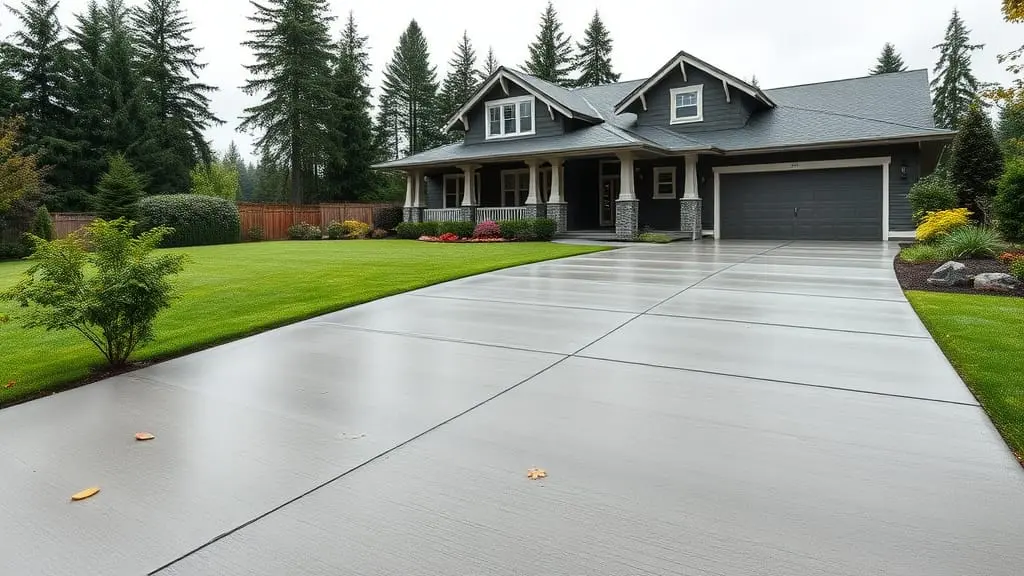
Walk through any established Bellingham neighborhood—from the tree-lined streets of Sehome to the craftsman homes of Fairhaven—and you'll notice a pattern: the driveways that still look great after 15 or 20 years almost always have an exposed aggregate finish. There's a reason for that. In a climate that delivers 37 inches of annual rainfall, keeps surfaces damp for six months straight, and encourages moss growth on anything that sits still, exposed aggregate concrete isn't just an aesthetic choice. It's a practical one.
As concrete contractors who have installed driveways across every corner of Whatcom County, we've seen firsthand how different finishes perform over time in our marine climate. Standard broom-finish driveways develop slick, mossy surfaces. Stamped concrete requires constant resealing. But properly installed exposed aggregate driveways consistently outperform every other option for durability, safety, and low maintenance in the Pacific Northwest. Here's why.
What Is Exposed Aggregate Concrete?
Exposed aggregate is a decorative concrete finish created by removing the top layer of cement paste from freshly poured concrete to reveal the natural stones, pebbles, and sand aggregates embedded within. The result is a textured, visually rich surface that showcases the natural beauty of the stone while providing a durable, slip-resistant surface.
The process works like this: concrete is poured and leveled normally, then a surface retarder is applied that prevents the top layer of cement from fully curing. After the concrete has set enough to support its weight (typically 4–6 hours depending on temperature and humidity), the surface is washed with a pressure washer to remove the uncured paste, exposing the aggregate below. The exposed stone is then sealed with a penetrating or topical sealer to protect and enhance the finish.
The beauty of exposed aggregate lies in the aggregate itself. Here in Whatcom County, we have access to exceptional local aggregates—glacial river rocks in warm earth tones, smooth basalt pebbles in charcoal and black, and quartz-rich gravels that sparkle subtly when wet. The aggregate blend can be customized to match your home's architecture, landscaping, and personal taste, making every driveway installation unique.
Why Exposed Aggregate Outperforms in Bellingham's Climate
The advantages of exposed aggregate aren't just cosmetic. In our specific climate conditions, this finish solves several problems that plague other concrete surfaces.
Superior Slip Resistance in Wet Conditions
This is the single most important advantage for Bellingham homeowners. A standard broom-finish concrete driveway becomes dangerously slippery when wet—and our driveways are wet from October through April. The raised aggregate stones in an exposed finish create thousands of tiny grip points that provide traction even when the surface is soaked. We've installed exposed aggregate driveways on steep properties in South Hill, Geneva, and Alabama Hill specifically because homeowners needed a surface they could walk on safely during our rainy months.
The slip resistance advantage is quantifiable. Industry testing shows that exposed aggregate surfaces achieve a coefficient of friction 30–50% higher than smooth or broom-finished concrete when wet. For families with children, elderly residents, or anyone who has slipped on a wet driveway during a Bellingham November, this difference matters enormously.
Resistance to Moss and Algae Growth
Anyone who has lived in Bellingham for more than a year knows that moss grows on everything. Smooth concrete surfaces are particularly vulnerable because moss spores find it easy to attach to flat, damp surfaces. Exposed aggregate's textured surface actually resists moss colonization more effectively than you might expect. The rounded, hard surfaces of the exposed stones are less hospitable to moss than the porous cement paste of a standard finish.
This doesn't mean exposed aggregate is moss-proof—nothing is in our climate—but our customers in shaded areas like Samish, Birchwood, and Silver Beach consistently report less moss buildup on their exposed aggregate driveways compared to their neighbors' smooth concrete or stamped surfaces. When moss does appear, the textured surface makes it easier to remove with a pressure washer without damaging the finish.
Freeze-Thaw Durability
Bellingham's winters hover in that treacherous 35–45°F range where freeze-thaw cycles cause the most damage to concrete. Water penetrates the surface, freezes overnight, expands, and creates micro-fractures that worsen with each cycle. Over time, this process causes scaling and spalling—where the surface layer of concrete flakes off in patches.
Exposed aggregate handles freeze-thaw cycles better than standard finishes for two reasons. First, the exposed stones are naturally dense and non-porous, so they don't absorb water the way cement paste does. Second, the texture allows water to drain more quickly rather than pooling on the surface, reducing the volume of water available to freeze in the concrete matrix. Combined with a quality penetrating sealer, exposed aggregate driveways in Bellingham routinely last 25–30 years without significant freeze-thaw damage.
Aesthetic Longevity
One of the most frustrating things about stamped or colored concrete in Bellingham's climate is how quickly the surface treatment fades or wears away. Stamped concrete requires resealing every 2–3 years to maintain its color and pattern definition, and even with diligent maintenance, high-traffic areas show wear within 5–7 years.
Exposed aggregate doesn't have this problem because the beauty is inherent in the material itself—it goes all the way through. The stones that make the surface attractive are the same stones that provide structural strength. There's no surface coating to fade, no stamped pattern to wear smooth, and no color release to wash away in our persistent rain. An exposed aggregate driveway in Fairhaven or Edgemoor looks essentially the same at year 20 as it did at year 2, aside from the natural patina that many homeowners actually prefer.
Local Aggregate Options for Whatcom County Driveways
One of the advantages of building in Whatcom County is access to diverse, high-quality local aggregates. The glacial geology of our region has deposited an exceptional variety of stones throughout the Nooksack River valley and surrounding areas. Here are the most popular options we work with:
Natural River Rock Blends
Sourced from local Whatcom County quarries and river deposits, natural river rock blends feature smooth, rounded stones in warm earth tones—tans, browns, creams, and occasional reds. This is our most popular option for residential driveways in neighborhoods like the Lettered Streets, Happy Valley, and York because the warm tones complement the craftsman and traditional architecture common in these areas. A natural river rock exposed aggregate driveway typically costs $12–$16 per square foot installed.
Basalt and Dark Stone Blends
For a more contemporary or dramatic look, dark basalt aggregate creates a striking charcoal-to-black surface that contrasts beautifully with green landscaping and lighter-colored homes. This option has become increasingly popular in modern builds in Cordata and Barkley Village. Dark aggregate blends typically cost $14–$18 per square foot due to the premium material cost.
Mixed Quartz and Granite
Blends that include quartz and granite pieces add subtle sparkle and visual depth to the surface. These aggregates catch light beautifully—even on overcast Bellingham days—and the crystalline surfaces shed water exceptionally well. Mixed quartz blends run $13–$17 per square foot installed.
Custom Blends
For homeowners who want a truly unique driveway, we can create custom aggregate blends that incorporate specific stone types, colors, and sizes. Some of our most beautiful installations in Edgemoor and South Hill have used custom blends that match the natural stone used in the home's landscaping or architectural details. Custom blends typically add $2–$4 per square foot over standard options.
Installation Considerations for Bellingham Properties
Installing exposed aggregate concrete requires more skill and experience than standard concrete work. The timing of the surface retarder application, the wash technique, and the sealing process all require expertise that comes from years of local experience. Here are the key installation factors specific to our area:
Timing and Weather Windows
Exposed aggregate installation is more weather-sensitive than standard concrete because the surface retarder and washing process require specific temperature and humidity conditions. In Bellingham, the ideal installation window runs from late May through early October, when daytime temperatures consistently reach 55–75°F and rain is less frequent. The retarder needs 4–6 hours of dry conditions to work properly, making weather forecasting critical to scheduling.
That said, experienced contractors can successfully install exposed aggregate during shoulder seasons. We've completed beautiful driveways in Ferndale, Lynden, and Blaine as early as April and as late as November by carefully monitoring weather windows and using accelerating admixtures when temperatures are marginal.
Subbase Preparation in Glacial Till Soil
The longevity of any concrete driveway starts below the surface, and this is especially true in Whatcom County. Our glacial till soil retains water, expands when saturated, and creates uneven pressure beneath concrete slabs. For exposed aggregate driveways, we specify a minimum 6-inch compacted gravel subbase (compared to the 4-inch minimum many contractors use) to provide adequate drainage and a stable platform.
On properties with particularly heavy clay soils—common in Columbia, Sehome, and parts of Sunnyland—we often recommend 8 inches of base material and may include a geotextile fabric layer between the native soil and gravel base to prevent clay migration into the drainage layer. This adds $1–$2 per square foot but dramatically extends the driveway's service life.
Drainage Integration
Proper drainage is non-negotiable for any concrete driveway in Bellingham, but exposed aggregate's textured surface actually assists with surface water management. The stone texture creates micro-channels that help direct water toward the driveway's edges, reducing the puddling common on smooth concrete surfaces. We still design every driveway with a minimum 2% cross-slope and appropriate perimeter drainage, but the exposed aggregate finish provides an additional layer of water management that smooth finishes lack.
Maintenance Requirements in Our Climate
One of exposed aggregate's biggest selling points is its relatively low maintenance requirements compared to other decorative concrete options. That said, "low maintenance" doesn't mean "no maintenance," especially in Bellingham's demanding climate.
Sealing Schedule
We recommend sealing your exposed aggregate driveway every 3–4 years in Bellingham's climate. This is notably less frequent than stamped concrete (every 2–3 years) and far less labor-intensive. A quality penetrating sealer costs $1.50–$3 per square foot when professionally applied, or $50–$100 in materials if you do it yourself. The sealer protects against water penetration, enhances the stone colors, and makes the surface easier to clean. Our concrete sealing and maintenance team can handle this for you on a scheduled basis.
Annual Cleaning
A once-annual pressure washing in spring removes any moss, algae, or organic debris that accumulated during the wet season. For most Bellingham driveways, this is a 1–2 hour job with a consumer-grade pressure washer (1,500–2,500 PSI). Avoid using pressure above 3,000 PSI, as this can dislodge aggregate stones from the surface over time. If you prefer professional service, annual cleaning typically costs $150–$300 depending on driveway size.
Spot Treatments
In heavily shaded areas—common under the mature trees found throughout Birchwood, Samish, and Silver Beach—moss may appear between annual cleanings. A simple spray of diluted white vinegar or a commercial moss killer handles these spots without damaging the concrete. Avoid muriatic acid or harsh chemicals that can etch the exposed stones and compromise the sealer.
Cost Comparison: Exposed Aggregate vs. Other Driveway Options
Understanding where exposed aggregate falls in the overall cost spectrum helps with budgeting. For a typical 500-square-foot two-car driveway in Bellingham, here's how the options compare on both initial installation and 20-year total cost of ownership:
- Basic broom finish: $4,000–$6,000 initial / $8,000–$12,000 over 20 years (requires more frequent sealing and eventual resurfacing)
- Exposed aggregate: $6,000–$9,000 initial / $9,000–$14,000 over 20 years (moderate maintenance, exceptional longevity)
- Stamped concrete: $7,500–$12,500 initial / $14,000–$22,000 over 20 years (frequent resealing, potential color fading)
- Concrete pavers: $9,000–$15,000 initial / $16,000–$26,000 over 20 years (joint sand replacement, weed management)
- Asphalt: $2,500–$4,000 initial / $8,000–$14,000 over 20 years (frequent resealing, shorter lifespan, eventual replacement)
When you factor in longevity and maintenance costs, exposed aggregate consistently delivers the best total value for Whatcom County homeowners. The slightly higher upfront cost compared to basic concrete is offset by lower maintenance expenses and a significantly longer service life in our wet climate.
Is Exposed Aggregate Right for Your Property?
Exposed aggregate is an excellent choice for the vast majority of Bellingham driveways, but there are a few situations where other options might be more appropriate:
Exposed aggregate is ideal when:
- Your driveway has any slope—the slip resistance is invaluable on hills common in South Hill, Alabama Hill, and Geneva
- Your property is shaded by trees—moss resistance is superior to smooth finishes
- You want a decorative look without the maintenance demands of stamped concrete
- You plan to stay in your home long-term and value durability over minimum initial cost
- You want a surface that looks better wet than dry—and in Bellingham, that matters
Consider other options when:
- You want a perfectly smooth surface for activities like basketball (a broom finish is better)
- You need the absolute lowest initial cost (basic broom finish costs less)
- You want to replicate the look of brick, stone, or tile patterns (stamped concrete is the better choice)
For most homeowners in Bellingham, Ferndale, Lynden, Blaine, and throughout Whatcom County, exposed aggregate represents the optimal balance of beauty, performance, and value. The natural stone aesthetic complements our Pacific Northwest landscape, the textured surface handles our rain and occasional ice safely, and the durability means your investment will look great for decades with minimal maintenance.
We've been installing exposed aggregate driveways throughout Whatcom County for years and would be happy to show you examples of our work in your neighborhood—from Edgemoor estates to Everson farmhouses—so you can see how different aggregate blends look and perform in real-world conditions.
Ready to get started? Contact us today for a free estimate — we serve all of Bellingham and Whatcom County.