
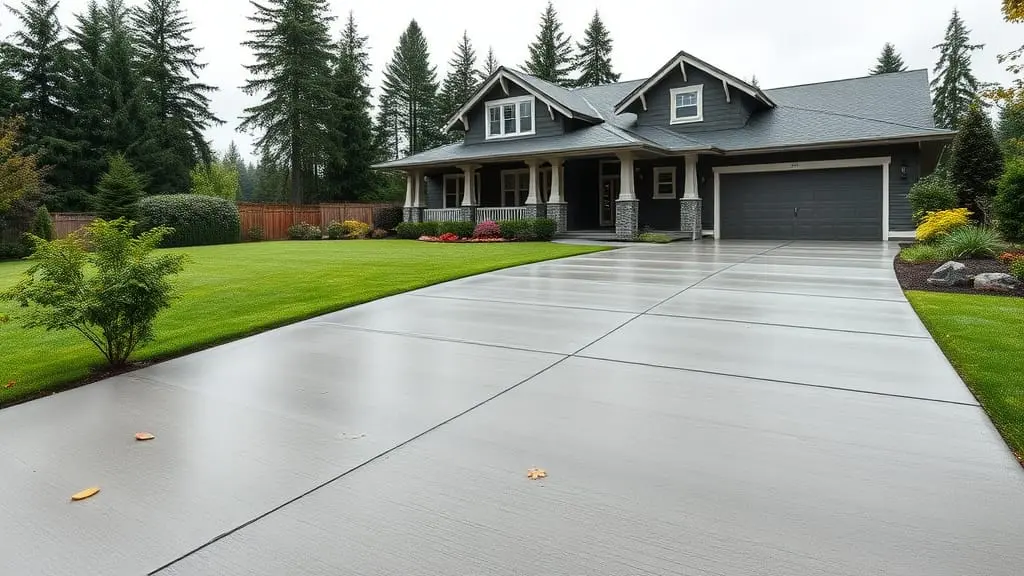
One of the most common questions we hear from Bellingham homeowners is deceptively simple: how wide should my driveway be? The answer depends on far more than just the number of cars you own. Your lot dimensions, garage configuration, local building codes, vehicle sizes, and even your neighborhood's character all factor into the right driveway width. Get it wrong, and you end up with a driveway that is either frustratingly narrow or an oversized concrete pad that wastes money and eats into your yard.
As driveway installation contractors serving Bellingham and Whatcom County, we have poured driveways ranging from 8-foot single-lane approaches on narrow Lettered Streets lots to 30-foot-wide parking courts for Lynden farm properties. This guide will help you determine the optimal width for your specific situation, factoring in Bellingham's codes, climate, and neighborhood characteristics.
Standard Driveway Width Guidelines
Before diving into local specifics, let us establish the baseline dimensions that work for most residential applications. These measurements represent the paved surface width and do not include any borders, curbing, or landscaping strips.
Single-Car Driveway
The absolute minimum width for a single-vehicle driveway is 8 feet, but that leaves zero room for error when parking. We recommend a minimum of 10 feet for a single-car driveway, with 12 feet being ideal. At 12 feet, a driver can open their door fully without stepping onto the lawn, and there is enough room to walk alongside the vehicle carrying groceries or equipment.
In older Bellingham neighborhoods like York, Columbia, and the Lettered Streets, many existing driveways are only 8-9 feet wide, built decades ago when vehicles were narrower. Modern trucks and SUVs, which are increasingly common in the Pacific Northwest, often measure 6.5-7 feet wide with mirrors extended. An 8-foot driveway leaves dangerously thin margins, and we regularly replace these narrow driveways with wider versions for homeowners who have upgraded to larger vehicles.
Two-Car Driveway
For a driveway serving a two-car garage, the minimum width is 16 feet. This allows two vehicles to park side by side, but passengers will need to exit carefully to avoid door dings. We recommend 18-20 feet for comfortable two-car use. At 20 feet, both drivers and passengers can open doors fully, and there is room to walk between vehicles.
Most newer homes in Cordata, Barkley Village, and Ferndale subdivisions are built with two-car garages and 18-20-foot-wide driveways. If you are replacing an existing driveway and have the lot width to accommodate it, going to 20 feet is a worthwhile investment that adds both convenience and resale value.
Three-Car Driveway and Wider
Properties with three-car garages or significant parking needs require driveways of 24-28 feet. At this width, the driveway begins to function more as a parking area than a simple approach lane. We see this configuration most often on larger lots in Edgemoor, Sudden Valley, and rural properties in Lynden and Everson.
Bellingham Municipal Code Requirements
The City of Bellingham has specific regulations governing driveway dimensions that every homeowner should understand before planning a project. These codes exist to balance property access with stormwater management, pedestrian safety, and neighborhood character.
Width Restrictions
Bellingham's municipal code limits residential driveway width at the curb cut (where the driveway meets the public street) to a maximum of 24 feet for single-family residences. This applies throughout the city, from Birchwood to Geneva. If your driveway needs to be wider than 24 feet where it meets your garage, it must taper or flare from the narrower curb cut width.
The code also specifies minimum setbacks from property lines. Driveways must maintain at least 5 feet of separation from side property lines unless a shared driveway agreement exists with the neighboring property. In tight-lot neighborhoods like the Lettered Streets and Sunnyland, this setback requirement can significantly constrain your available driveway width.
Impervious Surface Limits
Bellingham enforces impervious surface coverage limits, typically 35% of the lot area in residential zones. Your driveway counts toward this total, along with your house footprint, patio, walkways, and any other hard surfaces. On smaller urban lots in Sehome and Happy Valley, a wider driveway may push you over this limit.
When clients want a wider driveway but face impervious surface constraints, we sometimes recommend permeable concrete or pavers for a portion of the driveway. These materials count as pervious surface under Bellingham's code, effectively allowing a wider driveway without exceeding coverage limits. A common approach is to pave the tire tracks in standard concrete and fill the center strip with permeable material or landscaping.
Turnaround Areas and Parking Pads
On many Bellingham properties, the driveway serves not just as an approach to the garage but also as a turnaround area, guest parking, or workspace. These additional functions require thoughtful width and layout planning.
Turnaround Pads
If your driveway connects to a busy street where backing out is dangerous, a turnaround area lets you pull forward onto the street. This is particularly valuable on properties along Lakeway Drive, Samish Way, and other arterials where traffic volume and speed make reverse exits hazardous.
A functional turnaround requires a minimum 10-foot by 20-foot pad adjacent to the driveway. The most efficient configuration is a hammerhead design, where the turnaround pad extends perpendicular to the driveway, allowing a three-point turn. On larger lots in Cordata and Ferndale, a full circular turnaround with a 20-foot interior radius provides the most convenient option but requires significant space.
Guest Parking Pads
Adding a parking pad alongside your driveway provides designated guest parking without blocking your garage access. Each parking space should be 9-10 feet wide and 18-20 feet deep. In Bellingham's denser neighborhoods, on-street parking can be scarce, especially during winter when snow narrows available curb space. A dedicated off-street parking pad increases your property's convenience significantly.
We recently completed a project in Fairhaven where we widened a narrow driveway and added a two-car parking pad for a homeowner who operates a vacation rental. The additional off-street parking was actually required by the city's short-term rental permit conditions, illustrating how parking provisions can be tied to property use regulations.
RV and Boat Access
Whatcom County's proximity to the San Juan Islands, Mount Baker, and the Canadian border means many homeowners own recreational vehicles, boats, or trailers. Accommodating these larger vehicles requires specific driveway considerations.
- RV parking width: Most Class A motorhomes and fifth-wheel trailers require a minimum 12-foot-wide parking lane, with 14 feet being more comfortable. The approach driveway must also be wide enough to maneuver into the parking position, typically requiring 14-16 feet of clear width.
- Turning radius: Large RVs and boat trailers need generous turning radii at any curves in the driveway. A minimum inside radius of 15 feet prevents tire tracking off the concrete edge. We design these curves with reinforced edges to handle the concentrated loads.
- Weight considerations: A loaded Class A motorhome can weigh 30,000 pounds or more, far exceeding the loads a standard 4-inch residential driveway is designed for. RV parking areas should use 6-inch concrete with rebar reinforcement on 12-inch centers.
- Length requirements: RV parking pads should be at least 40 feet long for most motorhomes and 50 feet for larger units with tow vehicles. On properties in Lynden and Blaine where RV ownership is common, we often incorporate these longer pads into the overall driveway design.
Narrow Lot Strategies for Older Bellingham Neighborhoods
Many of Bellingham's most desirable neighborhoods were platted in the early 1900s with lot widths of 40-50 feet, which is substantially narrower than the 60-80-foot lots typical of modern subdivisions in Cordata and Ferndale. Building a functional driveway on a narrow lot requires creative solutions.
Shared Driveways
In the Lettered Streets, Sunnyland, and Columbia, shared driveways between adjacent properties are common. A single 16-18-foot-wide driveway running along the property line serves both homes, saving each property from dedicating 10-12 feet of their narrow lot to individual driveways. Shared driveways require a recorded easement agreement and careful design to ensure both parties have adequate access.
Single-Lane with Pullouts
On narrow lots where a full-width two-car driveway would consume too much yard space, we sometimes build a single-lane driveway (10-12 feet) with a wider pullout area near the garage. This provides single-file access along most of the driveway length while allowing side-by-side parking at the top.
Ribbon Driveways
A ribbon driveway consists of two parallel concrete strips (each 2-3 feet wide) with grass or gravel between them. This vintage approach, common in mid-century Bellingham neighborhoods like Samish and York, minimizes impervious surface while providing adequate vehicle support. We pour these with 6-inch-thick concrete and reinforced edges, since each strip bears the full weight of the vehicle wheel loads. Ribbon driveways cost approximately 40% less than a full-width slab and count for significantly less impervious surface coverage.
Driveway Apron and Street Connection
The driveway apron, where your driveway connects to the public street and crosses the sidewalk, is subject to specific city standards in Bellingham. The apron must be built to city specifications, which typically require 6-inch concrete, a minimum width matching the curb cut, and a smooth transition that does not create a tripping hazard for pedestrians.
Replacing a driveway apron requires a right-of-way permit from the city because the apron sits within the public right-of-way. We handle all permitting for our clients and coordinate with the city's inspection schedule. Apron replacement adds approximately $1,500-$3,000 to a driveway project, depending on width and whether sidewalk panels need replacement as well.
Cost Impact of Driveway Width
Driveway width directly impacts project cost because concrete work is priced primarily by the square foot. Here is how width decisions affect your budget for a typical 40-foot-long driveway in the Bellingham market:
- 10-foot width (400 sq ft): $5,200-$7,200 for a basic broom-finish driveway with standard 4-inch slab and gravel base
- 16-foot width (640 sq ft): $8,300-$11,500 for a two-car approach with standard specifications
- 20-foot width (800 sq ft): $10,400-$14,400 for a comfortable two-car driveway
- 24-foot width (960 sq ft): $12,500-$17,300 for the maximum standard residential width
These prices assume flat terrain, standard soil conditions, and basic broom-finish concrete. Add 15-25% for stamped or decorative finishes, 20-40% for sloped lots requiring enhanced engineering, and $1,500-$3,000 for apron replacement. Adding a parking pad or turnaround area increases the total square footage and cost proportionally.
Making the Right Width Decision
The optimal driveway width balances functionality, aesthetics, code compliance, and budget. Here is our general recommendation framework based on decades of experience in Bellingham:
- Single-car garage, tight urban lot: 10-12 feet. Focus on maximizing yard space while providing safe vehicle access.
- Two-car garage, standard suburban lot: 18-20 feet. The sweet spot for daily convenience without excessive concrete.
- Two-car garage with guest parking needs: 20 feet with an adjacent 10x20-foot parking pad. Practical and welcoming.
- RV or boat storage needed: 20-foot main driveway plus a dedicated 14x50-foot RV pad with 6-inch reinforced concrete.
- Rural or large lot: Width can be generous without impervious surface concerns, but avoid overbuilding. A 24-foot driveway with a turnaround pad serves most needs.
We always recommend walking through your daily routine before finalizing driveway dimensions. Drive into the proposed space with your largest vehicle. Open all the doors. Walk around the vehicle carrying bags. Try to picture two vehicles side by side. This practical exercise reveals needs that tape measures alone cannot capture.
Our team provides free on-site consultations throughout Bellingham and Whatcom County, from the compact lots of Fairhaven to the spacious properties of Blaine and Birch Bay. We will measure your lot, review your code constraints, discuss your vehicle and parking needs, and recommend the driveway width that best serves your property.
Ready to get started? Contact us today for a free estimate — we serve all of Bellingham and Whatcom County.