
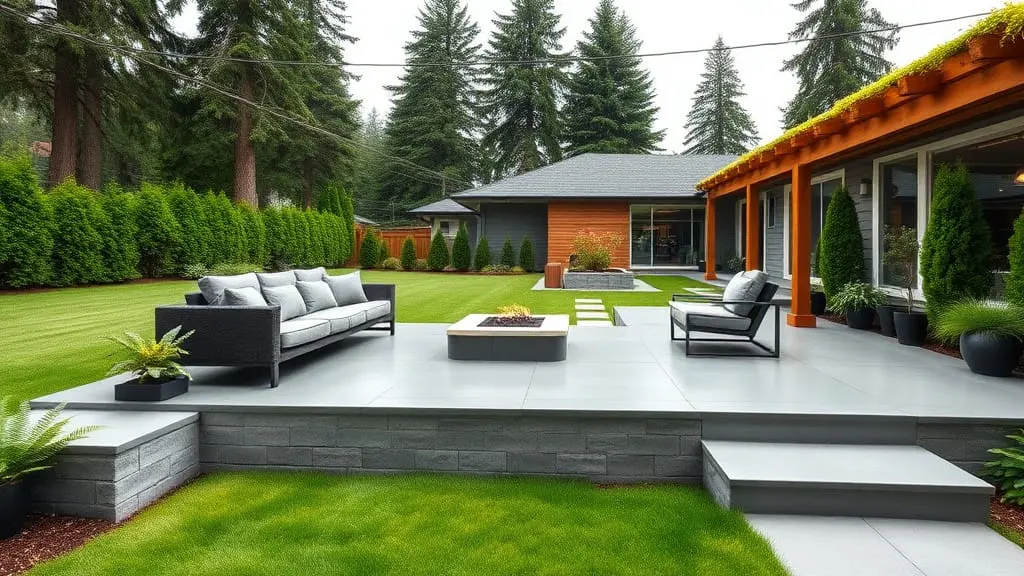
Every spring, Bellingham homeowners face the same question: should I pour my own concrete patio or hire a professional? It is an honest question, and the answer depends on more than just your budget. Our Pacific Northwest climate, glacial till soil, and local code requirements create challenges that catch even experienced DIYers off guard. With 37 inches of annual rainfall, freeze-thaw cycles through the winter months, and strict impervious surface limits enforced by the City of Bellingham, a patio project here is fundamentally different from one in Phoenix or Austin.
As concrete contractors who have poured hundreds of patios across Whatcom County, we have also repaired dozens of failed DIY installations. This guide gives you an honest breakdown of what each path actually involves so you can make an informed decision for your property and skill level.
What a Concrete Patio Project Actually Requires
Before comparing costs, let us walk through what a proper patio installation involves in the Bellingham area. Whether you hire a pro or do it yourself, the steps are the same. The difference is in execution quality and how forgiving each step is of mistakes.
Site Preparation and Excavation
A typical 300-400 square foot patio requires excavating 8-10 inches of soil to accommodate the gravel base and 4-inch concrete slab. In neighborhoods like Sehome, Columbia, and the Lettered Streets, you will hit glacial till within inches of the surface. This dense, compacted soil is extremely difficult to dig by hand. Most DIYers underestimate this step by a factor of three in both time and effort.
You also need to verify underground utility locations before digging. Washington state law requires calling 811 at least two business days before excavation. Properties in older neighborhoods like York and Samish sometimes have unmarked utility lines that predate modern mapping systems.
Base Preparation and Compaction
After excavation, a minimum 4-inch layer of compacted crushed rock is essential. In Bellingham's wet climate, this base layer is what prevents your patio from settling and cracking. The glacial till soil common throughout Whatcom County drains poorly, so the gravel base must be graded to direct water away from your home's foundation. A plate compactor is required to achieve proper density, and the base must be checked for level across the entire area.
Forming, Reinforcement, and Pouring
Concrete forms need to be set at precise grades. In Bellingham, the minimum slope is 2 percent away from structures, with 3-4 percent preferred to handle our heavy seasonal rainfall. Reinforcement using wire mesh or rebar is standard practice. Then you need to coordinate concrete delivery, pour the entire area in one session, screed to level, and finish the surface before the concrete begins to set.
Realistic DIY Cost Breakdown
One of the biggest reasons homeowners consider DIY is cost savings. Let us look at what a 350-square-foot patio actually costs when you do it yourself in the Bellingham market.
Materials and Rentals
- Ready-mix concrete delivery (approximately 4 cubic yards): $800-$1,100. Most Bellingham batch plants have a minimum delivery charge of $200-$300 plus per-yard pricing around $180-$220
- Crushed rock base (3-4 tons): $150-$250 delivered from local suppliers in Ferndale or Lynden
- Lumber for forms: $100-$200 for 2x4 and 2x6 material, stakes, and screws
- Wire mesh or rebar: $80-$150 depending on reinforcement approach
- Concrete tools (bull float, edger, groover, hand float, broom): $150-$300 to purchase, or $75-$150 to rent for a weekend
- Plate compactor rental: $80-$120 per day from Bellingham rental yards
- Wheelbarrows, shovels, rakes, gloves, rubber boots: $100-$200 if you do not already own them
- Curing compound or plastic sheeting: $40-$80
- Control joint sawing (rented saw): $60-$100 per day
Total DIY material and rental cost: $1,560-$2,500 for a 350-square-foot patio. That works out to roughly $4.50-$7.00 per square foot in materials alone.
Hidden DIY Costs Most People Miss
- Concrete waste: Over-ordering by 10 percent is standard practice because running short mid-pour is catastrophic. Extra concrete costs money and you need a plan to dispose of it
- Dump fees: Excavated soil needs to go somewhere. Whatcom County transfer stations charge by the load, and glacial till is heavy. Budget $100-$300 for disposal
- Second delivery charges: If you miscalculate volume, a short load delivery costs $200-$300 in additional delivery fees alone
- Tool purchases you will only use once: A concrete finishing trowel set, bull float with handle extensions, and specialty tools easily add $200-$400
- Time off work: Most DIY patio pours take a full weekend of prep plus a day for the pour itself. Factor in your hourly rate for 24-32 hours of hard physical labor
Professional Installation Costs in Bellingham
A professional concrete patio installation in the Bellingham market typically costs:
- Basic broom-finish patio (350 sq ft): $3,500-$5,250 ($10-$15 per square foot)
- Exposed aggregate finish: $4,550-$7,000 ($13-$20 per square foot)
- Stamped decorative concrete: $5,250-$8,750 ($15-$25 per square foot)
- Colored and stamped with borders: $7,000-$10,500 ($20-$30 per square foot)
Professional pricing includes all materials, labor, equipment, site preparation, base work, forming, pouring, finishing, curing, cleanup, and typically a warranty on workmanship. Most Bellingham contractors also handle permitting when required.
Common DIY Mistakes in Bellingham's Climate
Our wet marine climate punishes concrete installation errors far more than dry climates. Here are the failures we see most often when repairing DIY patios throughout Whatcom County.
Inadequate Base Preparation
This is the number one cause of DIY patio failure in Bellingham. The glacial till soil throughout neighborhoods like South Hill, Happy Valley, and Alabama Hill holds water like a sponge. Without sufficient gravel base depth and proper compaction, water saturates the soil beneath the slab during our October-through-April wet season. When temperatures drop to the 35-45 degree range and freeze-thaw cycles begin, the expanding frozen water heaves the slab unevenly. We have replaced patios in Sunnyland and Geneva that cracked within two winters because the homeowner skipped base compaction entirely.
Incorrect Slope and Drainage
Many DIYers pour a flat slab and expect water to find its own way off. In Bellingham, standing water on a patio surface accelerates moss and algae growth, creates slip hazards, and during freeze events can cause surface scaling. We routinely see DIY patios in Birchwood and Cordata with ponding water because the grade was not set properly. Professional installations always include positive drainage with appropriate slope calculated for the specific site.
Poor Timing and Weather Management
Concrete is extremely sensitive to weather conditions during placement and curing. Bellingham's climate means the ideal pouring window is narrow, typically July through September when temperatures consistently reach 55-75 degrees. Pouring during our cooler months requires specialized techniques. We have seen DIY pours ruined by unexpected rain showers that pitted the surface before finishing was complete, and cold-weather pours where the concrete never achieved proper strength because curing temperatures dropped below 50 degrees overnight.
Finishing Errors
Concrete finishing is genuinely a learned skill. Knowing when the bleed water has evaporated and the surface is ready for floating, how to work the bull float without leaving marks, when to cut control joints, and how aggressively to broom-finish the surface all come from experience. Over-working the surface is the most common amateur mistake. It brings excess water and fine cement particles to the top, creating a weak surface layer that flakes and scales within a year or two of Bellingham weather exposure.
When DIY Actually Makes Sense
We are not going to tell you that every patio needs a professional. There are scenarios where DIY is a reasonable choice:
- Small utility slabs under 100 square feet: A simple pad for a shed, hot tub base, or garbage can area is manageable for a competent DIYer. The smaller area means less concrete to manage during the critical finishing window
- You have genuine construction experience: If you have worked on concrete crews, poured basement floors, or have hands-on experience with finishing, you understand what the work actually requires
- Basic broom finish with no decorative elements: Stamped and decorative concrete require specialized tools and timing that leave zero margin for error
- Flat, well-drained site: If your property has sandy soil and good natural drainage, some of the climate-related risks are reduced. Properties near Birch Bay and parts of Ferndale sometimes have these conditions
- You have reliable helpers: Concrete work cannot be paused. You need at least two other capable adults to help with the pour, and everyone needs to know their role before the truck arrives
When to Hire a Professional
The following conditions strongly favor professional installation:
- Sloped properties: Homes on South Hill, Alabama Hill, and Edgemoor often require engineered grading, retaining wall integration, and complex forming that demands experience
- Decorative finishes: Stamped, colored, or exposed aggregate concrete requires specialized skills that cannot be learned from YouTube videos. The timing window for stamping is measured in minutes, not hours
- Areas over 400 square feet: Larger pours require more concrete delivered faster, more people finishing simultaneously, and more control joints planned in advance. The margin for error shrinks as area increases
- Connection to existing structures: Tying a new patio into an existing slab, foundation, or steps requires proper isolation joints and waterproofing
- Permitting requirements: The City of Bellingham requires permits for hardscaping that affects drainage or exceeds impervious surface limits. Many properties in Sehome and Fairhaven are already close to their 35 percent coverage maximum
- You want a warranty: Professional installations come with workmanship warranties. A DIY patio has no warranty, and fixing failures often costs more than the original professional installation would have
The Real Cost Comparison
For a 350-square-foot broom-finish patio in Bellingham, here is how the numbers actually compare:
- DIY total cost: $1,800-$3,000 in materials, rentals, disposal, and incidentals. Plus 24-32 hours of hard labor across multiple days
- Professional total cost: $3,500-$5,250 installed, including all labor, materials, and cleanup with a workmanship warranty
- DIY savings: $1,500-$2,500, offset by your time investment and risk of failure
If the DIY installation fails within five years due to cracking, settling, or surface deterioration, removal and replacement typically costs $4,000-$7,000. That means a failed DIY attempt ends up costing $5,800-$10,000 total, which is significantly more than hiring a professional from the start.
Making Your Decision
Be honest about your skill level, available time, and risk tolerance. If you have concrete experience, a small and simple project, good site conditions, and reliable helpers, a DIY patio can save you real money. But if your property has challenging soil or slopes, you want any decorative finish, the project exceeds 400 square feet, or you do not have hands-on concrete experience, the professional route delivers better value when you factor in longevity, appearance, and warranty protection.
We have seen too many Bellingham homeowners spend their savings on a DIY pour only to call us two years later for a complete tear-out. The Pacific Northwest climate is simply less forgiving than most regions, and the cost difference between DIY and professional work is smaller than most people assume once you account for tool rentals, material waste, disposal fees, and your own time.
Ready to get started? Contact us today for a free estimate — we serve all of Bellingham and Whatcom County.