
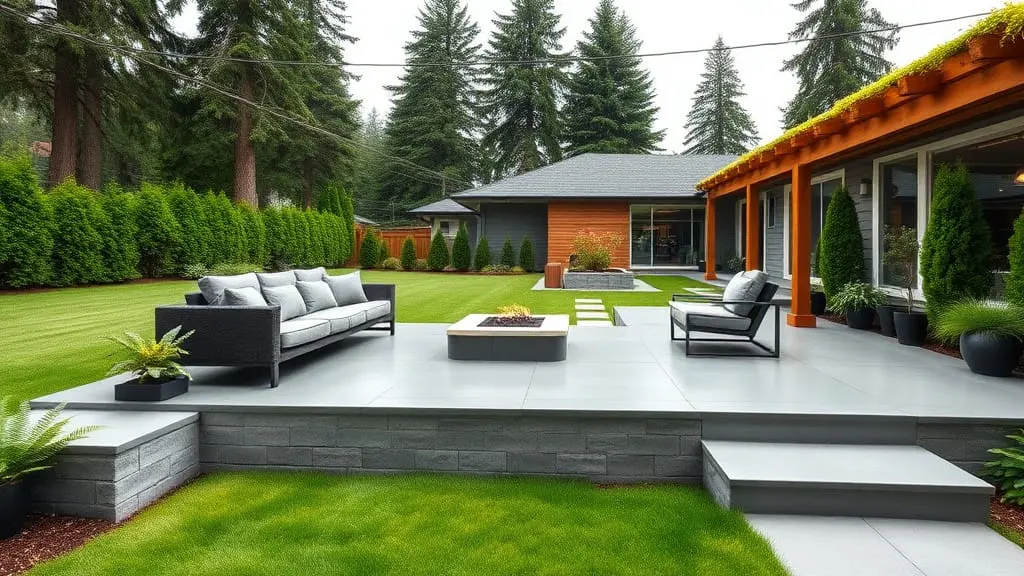
In most parts of the country, deciding whether to cover your patio is a matter of shade preference. In Bellingham, it is a matter of whether you will use your patio six months a year or twelve. With 37 inches of annual rainfall concentrated heavily from October through April, the choice between a covered and open patio fundamentally changes how much value you get from your outdoor living investment. It is, without exaggeration, the most impactful design decision you will make for a Bellingham patio.
As patio installation specialists serving Bellingham and Whatcom County, we have built both covered and open patios across every neighborhood in the area. We have also watched how homeowners actually use their patios across seasons, and the patterns are revealing. This guide breaks down the real-world pros, cons, and costs of each option so you can make the right choice for your property and lifestyle.
How Bellingham's Climate Affects Patio Use
To understand the covered versus open debate, you need to understand the numbers behind Bellingham's weather. Our 37 inches of annual rainfall sounds moderate compared to Seattle's 37 inches or Portland's 43 inches, but the distribution matters. Bellingham averages 155 days per year with measurable precipitation, and most of that falls between October and April. During this seven-month stretch, it rains on approximately 60-70% of days.
Winter temperatures between 35-45 degrees Fahrenheit mean precipitation is almost always rain rather than snow, making an overhead cover effective year-round. Unlike colder climates where snow load makes patio covers impractical for part of the year, Bellingham's mild marine winters allow covered patios to function every single day.
Add in our early sunsets (4:15 PM in December) and the reality becomes clear: an open patio in Bellingham is unusable for meaningful outdoor living roughly half the year. Homeowners in Fairhaven, Sehome, and South Hill tell us consistently that their covered patio section gets five to ten times more use during the wet season than any open section.
The Case for a Covered Patio
A covered patio transforms your outdoor space from a fair-weather luxury into a year-round living area. In Bellingham's climate, the benefits are substantial and compound over the years you live in your home.
Year-Round Usability
The primary advantage is simply this: you can use a covered patio in the rain. Morning coffee in November, an after-work glass of wine during a January drizzle, or weekend brunch with friends in March, all become possible. We have clients in Edgemoor and Happy Valley who use their covered patios 300 or more days per year, compared to the 120-150 days they estimate for their open sections.
Furniture and Finish Protection
Outdoor furniture takes a beating in Bellingham's wet climate. Cushions mildew, metal frames corrode, and wood deteriorates faster under constant moisture. A covered patio allows you to invest in higher-quality, more comfortable furniture that will last years longer. The concrete surface beneath the cover also lasts longer because it is not subjected to the same intensity of moisture cycling, moss growth, and freeze-thaw exposure.
For stamped concrete patios, a cover significantly extends the life of the sealer and reduces maintenance frequency. Stamped concrete under a cover in Bellingham might need resealing every 4-5 years instead of the 2-3 years required for exposed surfaces.
Expanded Entertaining Capability
Bellingham's food and social culture thrives on outdoor gatherings, but planning outdoor events between October and April requires a covered space. With a covered patio, you can host reliably regardless of weather. We have seen covered patios become the most-used room in the house for clients in Cordata and Barkley Village, functioning as a true extension of the indoor living space.
Potential Drawbacks of Covered Patios
- Higher cost: The cover structure adds $4,000-$25,000 depending on type (see cost section below).
- Reduced natural light: A solid cover blocks rain but also blocks the rare Bellingham sunshine. This trade-off is more significant than it sounds, as sun exposure becomes precious during our gray months.
- Building permit requirements: Most covered patio structures in Bellingham require a building permit, adding cost, time, and design constraints.
- Setback restrictions: Covered structures must meet the same setback requirements as the house itself, potentially limiting placement on smaller lots in the Lettered Streets, Sunnyland, and Columbia.
- View obstruction: Roof structures and support posts can interfere with views of Mount Baker, Bellingham Bay, or the San Juan Islands, a significant consideration for properties in Edgemoor, South Hill, and Boulevard Park.
The Case for an Open Patio
Open patios have their own compelling advantages, particularly for certain property types and homeowner preferences in the Bellingham market.
Lower Cost
An open concrete patio costs significantly less because you are only paying for the slab and any surface features. There is no cover structure, no support posts, no roofing materials, and no associated permit costs. For homeowners on a budget, an open patio maximizes the amount of usable outdoor space per dollar spent.
Unrestricted Sky Access
On those glorious Bellingham summer days when the sky is blue and Mount Baker gleams, an open patio connects you directly to the outdoors. There is no roof between you and the stars on a clear August night. For homeowners who primarily use their patio during the May-September dry season, an open design delivers the full Pacific Northwest outdoor experience.
Design Flexibility
Open patios have no structural constraints from support posts or roof lines. You can create flowing, organic shapes, place furniture anywhere, and reconfigure your layout seasonally. Fire pits work better in open spaces where smoke can dissipate freely rather than collecting under a roof. Hot tubs are also better suited to open patios, where steam rises freely and you can stargaze while soaking.
Potential Drawbacks of Open Patios
- Seasonal use limitation: Realistically, an open patio in Bellingham gets consistent use only 5-6 months per year.
- Higher maintenance: Exposed concrete requires more frequent cleaning, sealing, and moss treatment. Budget for annual pressure washing and biennial sealing.
- Furniture exposure: You will either need weather-resistant furniture that can handle year-round exposure, or you will need to store cushions and covers during the wet season.
- Moss and algae: Open patios in shaded areas like Samish and Birchwood develop moss growth that requires regular treatment, especially on textured finishes.
Cover Types for Bellingham Patios
If you decide a covered patio makes sense, the next question is what type of cover. Each option has different characteristics for our climate, different cost profiles, and different permit implications.
Solid Roof Extension
A solid roof that extends from your house over the patio provides complete weather protection. This is the most effective cover type for Bellingham's rain and typically matches your existing roofline for a seamless appearance.
- Cost: $10,000-$25,000 for a 12x16-foot structure, depending on roofing material, ceiling finish, and electrical integration
- Permit required: Yes. Must comply with setbacks, height limits, and structural codes
- Pros: Complete rain protection, integrated appearance, can include ceiling fans, heaters, and lighting
- Cons: Blocks all natural light, highest cost, most restrictive permit requirements
- Best for: Properties where the covered patio will serve as a primary outdoor living room, particularly in Edgemoor, South Hill, and Fairhaven where year-round entertaining is common
Pergola with Polycarbonate Roof
A wood or aluminum pergola frame topped with translucent polycarbonate panels is perhaps the most popular cover choice in Bellingham. It provides full rain protection while allowing diffused natural light to filter through, solving the biggest drawback of solid roofs.
- Cost: $6,000-$14,000 for a 12x16-foot structure
- Permit required: Usually yes, depending on size and attachment to the house
- Pros: Rain protection with natural light, lighter visual footprint than a solid roof, moderate cost
- Cons: Less insulated than a solid roof (no heat retention), polycarbonate panels need occasional cleaning, can look utilitarian if not designed carefully
- Best for: Homeowners who want weather protection without sacrificing daylight, a versatile choice popular in Cordata, Happy Valley, and Sehome
Open Pergola (No Roof Panels)
A traditional pergola with open slats or lattice provides partial sun shade and some rain protection from angled rainfall, but it does not keep you dry during a direct downpour. In Bellingham, an open pergola is more of an architectural element than a functional rain cover.
- Cost: $4,000-$10,000 for a 12x16-foot structure
- Permit required: Varies. Freestanding pergolas under certain size thresholds may be exempt
- Pros: Attractive architectural element, defines outdoor space, supports climbing plants like wisteria or hops
- Cons: Does not provide meaningful rain protection in Bellingham's direct rainfall
- Best for: Aesthetic enhancement of a patio that will primarily be used in dry weather
Retractable Awning
A retractable awning mounted to the house provides on-demand rain protection that retracts fully when you want open sky. This flexibility is appealing but comes with practical limitations in Bellingham's climate.
- Cost: $2,000-$6,000 for a 12-16-foot-wide motorized unit
- Permit required: Generally no, as retractable awnings are typically classified as accessories rather than structures
- Pros: Flexible (rain cover when needed, open sky when desired), no permanent structural footprint, generally no permit needed
- Cons: Must be retracted in wind over 25 mph (common during Bellingham's fall and winter storms), shorter lifespan than permanent structures (10-15 years), limited depth (typically 10-12 feet maximum projection)
- Best for: Homeowners who want flexibility without the commitment or cost of a permanent structure, or properties where setback restrictions prevent permanent covers
Building Permits for Covered Structures in Bellingham
Understanding Bellingham's permit requirements is essential for planning a covered patio. The City of Bellingham Building Division administers these permits, and requirements depend on the structure type, size, and location on your property.
When a Permit Is Required
Generally, any attached structure (connected to the house) or any freestanding structure exceeding 200 square feet requires a building permit. This includes solid roof extensions, most pergolas attached to the house, and freestanding pavilions over 200 square feet. Small, freestanding pergolas under 200 square feet may be exempt, but we always recommend confirming with the building department before construction.
Permit Costs and Timeline
- Residential building permit fee: $300-$800 depending on project valuation
- Plan review: 2-4 weeks for standard residential covered structures
- Required inspections: Foundation/footing, framing, and final inspection at minimum
- Total permit timeline: 4-8 weeks from application to final approval
Setback and Code Requirements
Covered structures must meet the same setback requirements as the primary residence. In most Bellingham residential zones, this means 5-foot side setbacks and 15-25-foot rear setbacks. On narrow lots in the Lettered Streets and York, these setbacks can severely limit where a covered structure can be placed. We help clients navigate these constraints during the design phase, sometimes recommending a retractable awning where a permanent structure would not fit within the code requirements.
Cost Comparison: Covered vs. Open
Here is a direct comparison for a 400-square-foot concrete patio in Bellingham, illustrating the cost difference between covered and open configurations.
Open Patio (400 sq ft, stamped concrete):
- Stamped concrete slab: $10,000-$12,800
- Grading and drainage: $1,500-$3,000
- Sealing (initial): $600-$1,200
- Total: $12,100-$17,000
Covered Patio (400 sq ft, stamped concrete + pergola with polycarbonate roof):
- Stamped concrete slab: $10,000-$12,800
- Grading and drainage: $1,500-$3,000
- Pergola with polycarbonate roof: $6,000-$14,000
- Building permit: $300-$800
- Sealing (initial): $600-$1,200
- Total: $18,400-$31,800
The cover adds roughly $6,300-$14,800 to the project cost. However, when you factor in that the covered patio gets used approximately twice as many days per year, the cost per day of use actually favors the covered option over a 20-year lifespan.
The Hybrid Approach: Our Top Recommendation
After years of building patios in Bellingham's climate and hearing feedback from homeowners about how they actually use their outdoor spaces, we most often recommend a hybrid design that combines covered and open sections. This approach gives you the best of both worlds.
A typical hybrid layout for a Bellingham backyard includes a covered section directly off the house (200-300 square feet) for dining and comfortable seating, transitioning to an open section (150-250 square feet) for a fire pit, hot tub, or open-air lounge. The covered section provides year-round utility while the open section delivers the full outdoor experience during fair weather.
We have built this hybrid configuration in neighborhoods across Bellingham, from Cordata subdivisions to Edgemoor estates and Ferndale family homes. The consistent feedback is that having both covered and open zones creates a patio that gets used far more than either option alone.
Whether you choose covered, open, or a combination, the concrete foundation is the critical first step. A properly poured and finished sealed concrete patio will serve you well for decades in Bellingham's climate, and a cover can always be added later if you start with an open design and decide you want weather protection.
Ready to get started? Contact us today for a free estimate — we serve all of Bellingham and Whatcom County.