
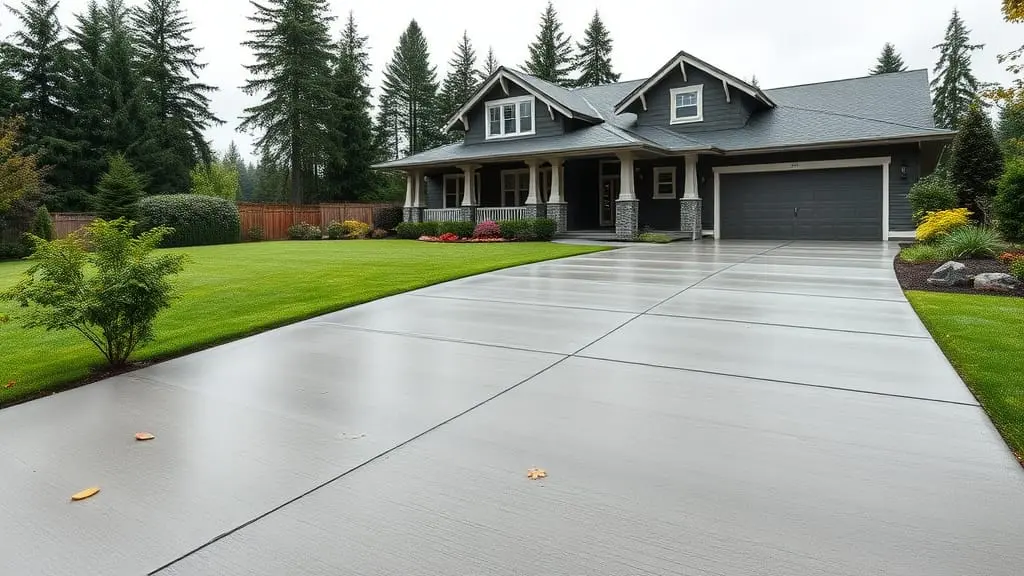
When it comes time to install or replace a driveway in Whatcom County, the debate between concrete and asphalt comes up in nearly every consultation we do. Both materials are proven performers with decades of track record, and both have passionate advocates. But which one actually lasts longer and delivers better value in our specific Pacific Northwest climate? The answer isn't as simple as most internet articles suggest—and much of the conventional wisdom about these materials was written for climates nothing like ours.
As concrete contractors who have worked alongside asphalt installers on mixed projects and replaced countless failed asphalt driveways with concrete throughout Bellingham, Ferndale, Lynden, and beyond, we've developed a data-driven perspective on this comparison. We'll be transparent about where asphalt has advantages and where concrete wins—because our goal is helping Whatcom County homeowners make the right choice for their property, not just selling our preferred material.
Lifespan: The Critical Comparison
Let's start with what most homeowners care about most: how long each material will last in Whatcom County's conditions.
Concrete Driveway Lifespan in Whatcom County
A properly installed and maintained concrete driveway in Bellingham typically lasts 25–35 years, with some lasting 40+ years. The variables that most affect concrete longevity in our climate are:
- Subbase quality: Driveways built on a proper 6–8 inch compacted gravel base over our glacial till soil significantly outlast those on minimum 4-inch bases. We've seen well-based driveways in Sehome and Fairhaven approaching 40 years in excellent condition
- Reinforcement: Rebar-reinforced driveways resist cracking from freeze-thaw cycles and soil movement far better than wire mesh or unreinforced slabs
- Sealing maintenance: Regular sealing (every 2–3 years) prevents water penetration that drives freeze-thaw damage—the primary cause of concrete driveway failure in our climate
- Drainage design: With 37 inches of annual rainfall, driveways that manage water effectively last dramatically longer than those with pooling or inadequate slope
Concrete driveways that fail prematurely in Whatcom County almost always trace back to one of these four factors being compromised during installation. When all four are done right, concrete is extraordinarily durable in our climate.
Asphalt Driveway Lifespan in Whatcom County
Asphalt driveways in the Pacific Northwest typically last 15–20 years before requiring major rehabilitation or replacement. This is notably shorter than the 20–30 year lifespan often cited in national publications, and there are specific reasons why our climate is harder on asphalt:
- UV degradation: While Bellingham is famous for overcast skies, our summer UV exposure is intense enough to break down asphalt binders. The oxidation process turns flexible asphalt brittle, leading to surface cracking
- Constant moisture: Asphalt is somewhat porous, and six months of constant dampness allows water to penetrate the surface layer and undermine the bond between aggregate and binder
- Moss and organic growth: Moss roots aggressively into asphalt surfaces, creating channels for water penetration. In shaded areas of Samish, Birchwood, and Silver Beach, moss can significantly shorten asphalt's service life
- Freeze-thaw vulnerability: Asphalt's flexibility is both a strength and weakness. While it resists cracking from soil movement, water that penetrates through surface cracks freezes and creates potholes—the signature failure mode of asphalt in climates like ours
- Cool-climate softness: Asphalt that never gets extremely hot (as it would in Arizona or Texas) never fully re-heals surface micro-cracks through thermal softening. Our moderate temperatures mean asphalt doesn't benefit from the self-healing properties it enjoys in warmer climates
Bottom line: In Whatcom County's climate, a properly installed concrete driveway outlasts a properly installed asphalt driveway by approximately 10–15 years. That gap widens if maintenance is deferred on either material, but particularly for asphalt.
Upfront Cost Comparison
Asphalt's primary selling point has always been lower initial cost. Here's how the numbers stack up in the 2025 Whatcom County market for a typical 500-square-foot two-car driveway:
Asphalt Installation Costs
- Basic asphalt driveway: $4–$7 per square foot ($2,000–$3,500 total)
- Standard asphalt with proper base: $5–$9 per square foot ($2,500–$4,500 total)
- Premium hot-mix asphalt with heavy base: $7–$11 per square foot ($3,500–$5,500 total)
Concrete Installation Costs
- Basic broom-finish concrete: $8–$12 per square foot ($4,000–$6,000 total)
- Standard reinforced concrete: $10–$15 per square foot ($5,000–$7,500 total)
- Exposed aggregate or decorative: $12–$25 per square foot ($6,000–$12,500 total)
On initial installation, asphalt costs roughly 40–50% less than concrete. For a standard driveway installation, that translates to saving $2,000–$4,000 upfront. That's a meaningful difference for many budgets, and it's the primary reason asphalt remains popular despite its shorter lifespan.
Total Cost of Ownership Over 30 Years
The upfront cost comparison tells only part of the story. When you factor in maintenance, repairs, and replacement over a 30-year period—the timeframe most homeowners should consider—the picture changes dramatically.
Asphalt: 30-Year Cost of Ownership
- Initial installation: $2,500–$4,500
- Seal coating every 2–3 years (10–12 applications): $200–$400 each = $2,000–$4,800
- Crack filling and patching (periodic): $500–$2,000 total
- Overlay or major repair at year 12–15: $2,000–$4,000
- Full replacement at year 18–22: $2,500–$4,500
- Second round of seal coating and maintenance: $1,500–$3,000
- 30-year total: $9,000–$18,800
Concrete: 30-Year Cost of Ownership
- Initial installation: $5,000–$7,500
- Sealing every 2–3 years (10–12 applications): $300–$600 each = $3,000–$7,200
- Crack repairs (periodic): $300–$1,500 total
- No replacement needed (lifespan 25–35 years): $0
- 30-year total: $8,300–$16,200
Over 30 years, concrete typically costs the same or less than asphalt when you account for asphalt's shorter lifespan and the near-certainty of needing at least one full replacement during that period. The concrete driveway you install today should still be serving you well in 2055, while an asphalt driveway installed today will likely need replacement by 2040–2045.
Performance in Bellingham's Climate
Beyond cost and lifespan, how do these materials actually perform day-to-day in our specific conditions?
Wet Weather Performance
Bellingham is wet. From October through April, driveways see near-constant moisture. Here's how each material handles it:
Concrete sheds water effectively when properly sloped and sealed. Standing water on concrete is visible and obvious, making drainage problems easy to identify and address. A sealed concrete surface resists water penetration and maintains its structural integrity through months of rain. The primary wet-weather weakness is slipperiness—standard broom-finish concrete can become slick when wet, though exposed aggregate and textured finishes address this effectively.
Asphalt absorbs more water than concrete due to its slightly porous nature. While this can actually help with surface water management (water percolates through rather than running off), it means the material itself stays saturated longer—accelerating the deterioration process. Asphalt also hides puddles less obviously than concrete, so drainage issues may go unnoticed until they've caused significant base erosion. On the positive side, asphalt's dark color provides natural traction when wet due to its textured surface, and it absorbs heat more readily, drying faster on sunny days.
Freeze-Thaw Performance
In Bellingham's 35–45°F winter range, freeze-thaw cycles are the primary destroyer of both materials. Neither is immune, but they fail differently:
Concrete develops surface scaling and cracking when water trapped in the pore structure freezes and expands. Proper sealing dramatically reduces this vulnerability. When concrete does fail from freeze-thaw, it typically shows as surface flaking (spalling) or widening of control joint cracks. These failures are repairable through resurfacing or patching, and the structural integrity of the slab usually remains sound.
Asphalt develops potholes—the classic freeze-thaw failure. Water enters through surface cracks, freezes beneath the surface layer, lifts a section of asphalt, and creates a void. When traffic passes over the lifted section, it breaks free, creating a pothole. Pothole repair in asphalt is straightforward but rarely permanent in our climate; repaired potholes often fail again within 2–3 years. We see significant pothole development in asphalt driveways throughout Cordata, Barkley Village, and Ferndale after just 8–10 years.
Moss and Algae Resistance
This is a significant differentiator in Whatcom County. Our climate supports aggressive moss growth on any surface that stays damp and receives limited sun.
Concrete resists moss colonization better than asphalt, particularly when sealed. Moss can grow on unsealed concrete, but it doesn't root as deeply and is easier to remove. Exposed aggregate finishes are especially resistant due to the smooth, dense stone surfaces that provide poor attachment points for moss spores.
Asphalt is highly susceptible to moss growth. The textured, slightly porous surface provides excellent attachment for moss spores, and the dark color retains moisture that moss needs to thrive. In shaded Bellingham neighborhoods like Samish, Silver Beach, and parts of Sehome, asphalt driveways can develop thick moss colonies within just a few years. Beyond aesthetics, moss roots create pathways for water penetration that accelerate asphalt deterioration.
Appearance and Curb Appeal
Aesthetics are subjective, but there are objective differences in how these materials look over time in our climate:
Concrete offers far more design flexibility. Beyond standard gray, options include integral coloring, stamped patterns, exposed aggregate, decorative borders, and stained finishes. A well-maintained concrete driveway enhances curb appeal and can complement any architectural style—from the craftsman homes of the Lettered Streets to modern builds in Edgemoor. Concrete does stain from oil, rust, and organic matter, but these stains can be cleaned or chemically treated.
Asphalt offers one look: black (when new) fading to gray over time. Fresh asphalt has a uniform, crisp appearance that many homeowners find attractive. However, as it ages and weathers in Bellingham's climate, asphalt fades unevenly, develops visible patches from repairs, and can appear worn and neglected even with regular seal coating. There are essentially no decorative options for asphalt beyond its basic black finish.
In Bellingham's competitive real estate market, concrete driveways consistently add more value to homes than asphalt. Local real estate agents report that concrete driveways—particularly exposed aggregate or decorative finishes—are viewed as premium features that support higher asking prices, while asphalt is viewed as a basic, utilitarian choice.
Environmental Considerations
For environmentally conscious Whatcom County homeowners—and our community has many—the environmental profiles of these materials are worth considering:
Concrete production generates significant CO2 emissions during cement manufacturing (approximately 0.9 tons of CO2 per ton of cement). However, concrete's longer lifespan means fewer replacement cycles and less total material consumption over the life of the home. Concrete is also fully recyclable—crushed concrete is commonly used as road base and fill material. Permeable concrete options allow rainwater to percolate through the surface, reducing stormwater runoff—an important consideration in a watershed-conscious community like Bellingham.
Asphalt is a petroleum product, and its production requires significant energy input. However, asphalt is the most recycled material in America—old asphalt is routinely ground up and incorporated into new asphalt mixes. The shorter lifespan means more frequent replacement and more total material consumption over time, but the recyclability partially offsets this impact. Asphalt is inherently somewhat permeable, allowing limited water infiltration—though this permeability also contributes to its deterioration.
Neither material is clearly "greener" than the other. Concrete's longer lifespan favors it over multi-decade timeframes, while asphalt's recyclability and lower production energy give it advantages in shorter-term analysis.
Local Contractor Availability
One practical consideration for Whatcom County homeowners is contractor availability and expertise:
Bellingham has a robust community of concrete contractors (ourselves included) with deep experience installing driveways suited to our local conditions. We understand the soil, the drainage requirements, the reinforcement specifications, and the finishing techniques that ensure longevity in our climate. For specialized concrete work—exposed aggregate, stamped patterns, colored concrete—local expertise is readily available.
Asphalt contractors are somewhat less numerous in Whatcom County, and quality varies more widely. The best asphalt contractors in our area produce excellent work, but the lower barrier to entry in asphalt paving means homeowners need to be more diligent about vetting contractors, checking references, and ensuring proper base preparation. For homeowners in more rural areas like Everson, Sumas, and Birch Bay, contractor availability for either material may be more limited, and longer lead times should be expected.
Making the Right Choice for Your Property
After years of installing driveways across Whatcom County and observing how both materials perform in our unique climate, here's our honest assessment:
Choose concrete if:
- You plan to stay in your home for 10+ years (the longer you stay, the more concrete's durability advantage pays off)
- You want design flexibility beyond basic black
- You value lower long-term maintenance costs over lower upfront cost
- Your property is shaded and prone to moss growth
- You're building or renovating a home where curb appeal affects property value
- You want a surface that handles Bellingham's 37 inches of rain without accelerated deterioration
Choose asphalt if:
- Budget is the primary constraint and you need the lowest possible upfront cost
- You're in a short-term housing situation (less than 10 years)
- The driveway is for a utilitarian purpose (rural property access, farm use, etc.)
- You prefer the look of a dark surface against green Pacific Northwest landscaping
- The driveway will eventually need to be removed for future construction or reconfiguration
For the typical Bellingham homeowner investing in their primary residence for the long term, concrete delivers superior value through its longer lifespan, lower total cost of ownership, better climate resistance, and greater design flexibility. The higher upfront cost—roughly $2,000–$4,000 more for a standard two-car driveway—pays for itself within 15–20 years through avoided maintenance costs and deferred replacement.
We offer free consultations and detailed estimates throughout Bellingham and Whatcom County. Whether you're leaning toward concrete or still weighing your options, we'll provide an honest assessment based on your property's specific conditions—slope, soil type, drainage, shade, and budget—to help you make the most informed decision possible.
Ready to get started? Contact us today for a free estimate — we serve all of Bellingham and Whatcom County.