
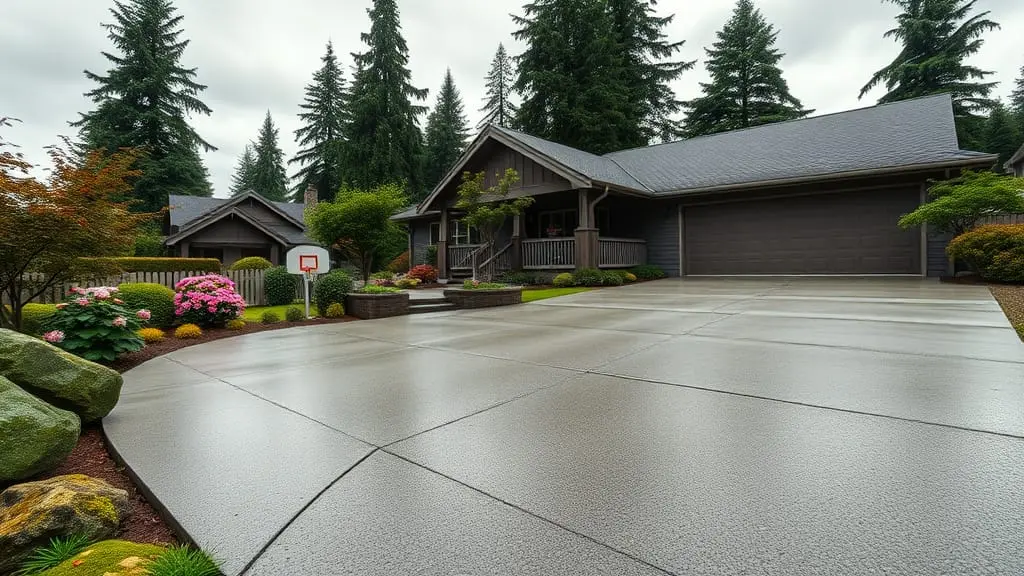
You walk out to your driveway or step onto your patio and the evidence is impossible to ignore: surface scaling that makes the concrete look like it is shedding skin, a network of cracks that has spread over the years, discoloration from decades of Bellingham weather, and maybe a section that has sunk noticeably lower than the rest. The concrete is clearly past its prime, but does it need to be torn out and replaced entirely, or can it be resurfaced and given another decade or two of useful life?
This is one of the most common questions we hear from homeowners across Whatcom County. The answer is not always obvious, and choosing wrong in either direction costs money. Resurfacing concrete that actually needs replacement wastes your investment when the overlay fails within a few years. Replacing concrete that could have been successfully resurfaced means spending $8,000-$15,000 when $2,000-$5,000 would have solved the problem. As concrete resurfacing specialists who have evaluated thousands of aging slabs throughout Bellingham, we have developed a systematic approach to making this decision correctly.
Understanding Concrete Resurfacing
Concrete resurfacing is the process of applying a new surface layer over existing concrete. Rather than demolishing and removing the old slab, you use it as a base and bond a new wear surface on top. When conditions are right, resurfacing delivers a like-new appearance and renewed performance at 30-50% of the cost of full replacement.
Types of Concrete Resurfacing Systems
Not all resurfacing is the same. The system used depends on the condition of the existing concrete, the desired finished appearance, and the intended use.
- Polymer-modified overlay (1/4 to 1/2 inch thick): A cement-based coating modified with polymers for superior adhesion and flexibility. This is the most common resurfacing system for driveways, patios, and walkways in Bellingham. It can be broom-finished for a standard concrete appearance, stamped for a decorative look, or textured with knockdown or spray-applied patterns. Cost: $3-$7 per square foot installed.
- Micro-topping (1/16 to 1/8 inch thick): An ultra-thin polymer cement coating that provides a fresh surface without adding significant thickness. Best for interior floors, garage slabs, and surfaces with only minor cosmetic damage. Not recommended for exterior use in Bellingham without a protective sealer because the thin layer is vulnerable to freeze-thaw damage. Cost: $2-$5 per square foot installed.
- Self-leveling overlay (1/4 to 1 inch thick): A high-flow cementitious material that creates a perfectly flat surface. Used primarily for interior applications or as a base for subsequent coatings. Not suitable for exterior use in our climate without additional surfacing. Cost: $3-$6 per square foot installed.
- Concrete overlay with stamping (3/8 to 3/4 inch thick): A thicker overlay that is stamped with texture mats to replicate the appearance of stone, brick, slate, or other materials. This is an increasingly popular option for homeowners in Fairhaven, Edgemoor, and the Lettered Streets who want to upgrade an aging patio's appearance without the cost and disruption of full replacement. Cost: $6-$12 per square foot installed.
Damage Assessment: The Five-Point Decision Criteria
We evaluate five specific criteria when recommending resurfacing versus replacement. All five must favor resurfacing for us to recommend it with confidence. If even one criterion falls into the replacement category, the overlay's long-term success is compromised.
1. Structural Integrity of the Existing Slab
Resurfacing candidate: The slab is structurally sound. It supports weight without flexing. There is no rocking or movement when you walk across it or drive on it. The base beneath the slab is stable.
Replacement required: The slab flexes underfoot or under vehicle weight. Sections rock when stepped on. You can hear hollow sounds when tapping the surface with a hammer, indicating voids beneath. The slab has lost its structural function as a load-bearing surface. We encounter this frequently on older properties in York, Columbia, and Samish where the original base preparation was inadequate or has eroded over decades.
2. Crack Width and Pattern
Resurfacing candidate: Cracks are hairline to 1/8 inch wide, stable (not actively growing), and limited in number. These cracks can be filled with flexible sealant before overlaying, and the resurfacing system will bridge them successfully.
Replacement required: Cracks exceed 1/4 inch in width, are actively widening (check by marking them and measuring over several months), or form a dense pattern across most of the surface. Wide, active cracks indicate ongoing structural movement that will telegraph through any overlay within one to two seasons. Properties in areas with significant glacial till like South Hill and Alabama Hill are particularly susceptible to this type of cracking from soil movement and freeze-thaw cycling.
3. Vertical Displacement and Settlement
Resurfacing candidate: All sections of the slab are within 1/4 inch of level relative to adjacent sections. Minor settlement can be addressed with slab jacking (mudjacking or polyurethane foam injection) before resurfacing.
Replacement required: Settlement exceeds 1/2 inch between adjacent panels, or the slab has tilted significantly from its original grade. Settlement this severe indicates subgrade failure that resurfacing cannot address. The overlay will be poured to an uneven thickness, with thin areas that crack and thick areas that add unnecessary weight. We see severe settlement on driveways throughout Bellingham where tree roots have decomposed beneath the slab or where fill soil was never properly compacted during original construction.
4. Surface Condition
Resurfacing candidate: Surface scaling is limited to the top 1/4 inch, with aggregate still firmly embedded. The concrete rings solidly when struck with a hammer. Discoloration and staining are cosmetic, not structural. This describes the majority of 15-30 year old concrete we evaluate in Bellingham.
Replacement required: Surface deterioration extends beyond the top 1/2 inch. Aggregate is loose and can be pried out by hand. Large areas of spalling reveal crumbling concrete underneath. The surface is so deteriorated that a proper bond between the overlay and the substrate cannot be achieved. Concrete in this condition has typically endured decades of freeze-thaw damage without sealing or maintenance. We see it frequently on 40-plus year old driveways in Sunnyland, Geneva, and Birchwood.
5. Drainage and Grade
Resurfacing candidate: The existing slab drains properly, directing water away from structures. Adding 1/4 to 3/4 inch of overlay material will not create problems with door thresholds, garage entries, or adjacent surfaces.
Replacement required: The slab's current grade directs water toward the house, garage, or other structures. Resurfacing adds height to the surface without changing the grade, potentially worsening drainage problems. In Bellingham's wet climate, improper drainage is a deal-breaker. We would rather remove and replace a slab with corrected grade than resurface a surface that channels our 37 inches of annual rainfall toward the foundation.
The Resurfacing Process in Detail
When a slab passes all five assessment criteria, here is how we execute a resurfacing project in Bellingham:
Surface Preparation
This is the most critical step and accounts for 40-50% of the project time. The overlay must bond mechanically and chemically to the existing concrete. Poor preparation is the number one cause of overlay failure.
- Power washing: All moss, algae, dirt, oil, and loose material is removed with 3,500 PSI pressure washing. In Bellingham, this step often reveals more damage than was visible under the biological growth.
- Crack repair: All cracks are routed (widened with a saw to create a clean channel) and filled with flexible polyurethane sealant. This allows the crack to continue moving slightly beneath the overlay without telegraphing through.
- Surface profiling: The concrete surface must be roughened to create mechanical bond. We use shot blasting or grinding to achieve a profile equivalent to 60-80 grit sandpaper. Smooth, hard-troweled surfaces will not bond to an overlay without profiling.
- Priming: A bonding agent or slurry coat is applied to the prepared surface immediately before the overlay pour. This creates a chemical bridge between old and new concrete.
Overlay Application
The overlay material is mixed to manufacturer specifications and applied in one or two lifts depending on thickness. For stamped overlays, the material is spread, textured with stamps, and colored with integral pigment or color hardener, following the same techniques used for new stamped concrete installation.
Curing and Sealing
Overlay materials cure more rapidly than standard concrete, typically achieving foot traffic strength within 24 hours and vehicle traffic strength within 48-72 hours. However, in Bellingham's cool conditions during spring and fall, we extend these timelines. We protect fresh overlays from rain for a minimum of 6 hours and apply a penetrating or film-forming sealer after 7 days to protect against our climate's moisture and freeze-thaw cycles.
When Replacement Is the Only Option
Some concrete is simply beyond saving. Attempting to resurface it wastes money and delays the inevitable. Here are the situations where we always recommend full replacement:
- Severe structural failure: When more than 25% of the slab area has significant cracking, displacement, or deterioration, the economics shift decisively toward replacement. Repairing and preparing a badly damaged slab for resurfacing can cost nearly as much as demolition and new construction.
- Subgrade failure: If the soil or base material beneath the concrete has eroded, compacted unevenly, or been undermined by water, tree roots, or animal burrows, no amount of surface treatment will fix the problem. The slab must be removed, the subgrade corrected, and new concrete poured on a proper base.
- Incorrect original thickness: We occasionally discover slabs that were poured at 2-3 inches instead of the proper 4-inch minimum. These thin slabs cannot support an overlay and do not have the structural capacity to serve their intended purpose. Common in DIY projects and cut-rate installations from decades past.
- Extensive reinforcement corrosion: When rebar or wire mesh has corroded extensively, the expanding rust has cracked the concrete from within. This type of damage accelerates over time and cannot be halted by resurfacing. We see this on coastal properties in Blaine and Birch Bay where saltwater exposure has reached the embedded steel.
- Code or grade issues: If the existing slab does not meet current code requirements for thickness, reinforcement, or accessibility (ADA compliance), replacement provides the opportunity to bring the surface up to standard.
Cost Comparison: Resurfacing vs. Replacement
Here is a direct cost comparison for typical Bellingham residential projects in the 2025 market:
Resurfacing Costs
- Standard polymer overlay on driveway (600 sq ft): $1,800-$4,200 ($3-$7/sq ft)
- Stamped overlay on patio (400 sq ft): $2,400-$4,800 ($6-$12/sq ft)
- Micro-topping on garage floor (400 sq ft): $800-$2,000 ($2-$5/sq ft)
- Additional slab jacking if needed: $500-$2,000
Full Replacement Costs
- Driveway replacement (600 sq ft): $6,000-$10,800 ($10-$18/sq ft including demolition)
- Patio replacement (400 sq ft): $3,600-$6,400 ($9-$16/sq ft including demolition)
- Sidewalk replacement (200 sq ft): $1,600-$2,800 ($8-$14/sq ft including demolition)
The demolition and hauling component of replacement adds $2-$4 per square foot to the total cost. A 600-square-foot driveway replacement generates approximately 10 cubic yards of concrete debris weighing nearly 15 tons, requiring multiple dump truck loads and disposal fees at Whatcom County transfer stations.
Lifespan Expectations in Bellingham's Climate
How long can you expect each option to last in our specific conditions?
- Polymer overlay (properly sealed and maintained): 10-15 years. Resealing every 3-5 years extends the upper end of this range. Properties in Cordata and Barkley Village with good drainage and sun exposure tend toward the 15-year end. Heavily shaded properties in Sehome and the Lettered Streets lean toward 10 years due to moisture retention and biological growth pressure.
- Stamped overlay: 8-12 years. The textured surface traps moisture more than a smooth overlay, which accelerates wear in our climate. Regular sealing is critical to reaching the 12-year mark.
- Micro-topping (exterior): 5-8 years with diligent sealing. We generally do not recommend micro-toppings for exterior use in Bellingham unless the surface is well protected from direct rain exposure.
- Full replacement with proper construction: 25-40 years. Air-entrained, properly reinforced, and adequately thick new concrete poured on a properly prepared base is the gold standard. With periodic sealing, it should serve a Bellingham homeowner for a generation.
Making the Right Decision for Your Property
The decision between resurfacing and replacement ultimately comes down to three questions:
Is the existing slab structurally sound? If yes, resurfacing is likely viable. If no, replacement is necessary regardless of surface condition.
Will the resurfacing investment deliver at least 10 years of service? If the existing concrete is marginal, you may get only 5-7 years from an overlay. At that point, the cost per year of service may actually favor full replacement.
Are there drainage, grade, or code issues that need correction? Resurfacing cannot change the fundamental slope or elevation of a slab. If water is flowing the wrong direction, replacement is the opportunity to fix it properly.
We offer free on-site assessments throughout Bellingham and Whatcom County, from Ferndale and Lynden to Blaine and Everson. Our evaluation includes all five assessment criteria, an honest recommendation, and a detailed cost estimate for the recommended approach. We would rather tell you your concrete can be resurfaced and save you money than sell you a replacement you do not need.
Ready to get started? Contact us today for a free estimate — we serve all of Bellingham and Whatcom County.