
One of the most common questions we hear from Bellingham homeowners is: "Do I need a permit for this?" The answer depends on what you're building, where your property is located, and how much impervious surface you're adding. Permitting may not be the most exciting part of a concrete project, but understanding the requirements upfront prevents costly delays, fines, and complications if you ever sell your home.
We've navigated Bellingham's permitting process for hundreds of residential concrete projects — from simple sidewalk replacements in Sunnyland to major slab installations in Sudden Valley. This guide covers everything Whatcom County homeowners need to know about concrete permits, including when they're required, what they cost, how long they take, and what happens if you skip them.
When Do You Need a Permit for Concrete Work in Bellingham?
The City of Bellingham and Whatcom County have different rules governing when permits are required for concrete projects. Understanding which jurisdiction applies to your property is the first step.
City of Bellingham Requirements
Within Bellingham city limits — covering neighborhoods like Fairhaven, Sehome, the Lettered Streets, Cordata, Birchwood, and South Hill — permits are generally required for:
- New concrete driveways or driveway expansions: Any new impervious surface in the right-of-way or connecting to the street requires a permit
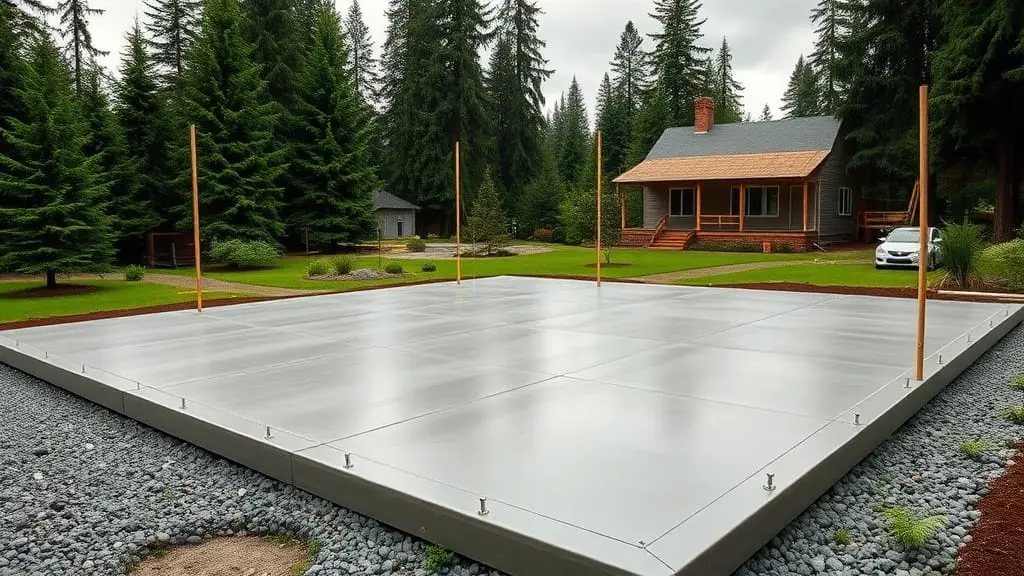
- Slabs and foundations: Concrete slabs for garages, shops, accessory dwelling units, or additions require building permits
- Retaining walls over 4 feet: Any retaining wall exceeding 4 feet in height (measured from the bottom of the footing to the top of the wall) requires a building permit and potentially engineered drawings
- Projects increasing impervious surface area: If your project adds impervious surface beyond your lot's allowable coverage, you'll need to address stormwater management — which triggers additional review
- Work in the public right-of-way: Sidewalk replacement, curb cuts, and driveway approaches on city property require a right-of-way permit
- Projects near critical areas: Properties adjacent to streams, wetlands, steep slopes, or within the Lake Whatcom watershed face additional environmental review
Common Projects That Typically Don't Require a Permit
- Replacing an existing patio or walkway in the same footprint: If you're removing a 200-square-foot patio and pouring a new one in the same location and dimensions, this generally doesn't trigger a permit because you're not adding impervious surface
- Minor concrete repairs: Crack sealing, surface patching, and small-area repairs typically don't require permits
- Concrete sealing and resurfacing: Applying sealers or resurfacing overlays to existing concrete is maintenance, not new construction
However, always verify with the City of Bellingham Planning and Community Development department before assuming your project is exempt. Rules change, and the specific characteristics of your property — lot coverage, location near critical areas, HOA covenants — can alter requirements.
Whatcom County Requirements
Properties outside Bellingham city limits but within Whatcom County — including Ferndale, Lynden, Blaine, Birch Bay, Everson, Sumas, and unincorporated areas like Sudden Valley — fall under Whatcom County's jurisdiction. County permitting requirements are similar in principle but differ in specifics:
- Retaining walls over 4 feet require a building permit with engineered plans
- New foundations and structural slabs require permits
- Impervious surface limits may be more or less restrictive depending on zoning and proximity to water features
- Properties in flood zones (common near the Nooksack River in Ferndale and Everson) face additional review requirements
Bellingham's Impervious Surface Regulations
This is where Bellingham permitting gets particularly important for concrete projects. The city enforces strict limits on how much of your lot can be covered with impervious surfaces — materials that don't allow water to soak into the ground. Concrete, asphalt, buildings, and even compacted gravel all count toward this limit.
How Impervious Surface Limits Work
In most residential zones within Bellingham, impervious surface coverage is limited to approximately 35-50% of the total lot area, depending on the specific zoning designation. For a typical 7,000-square-foot lot in Happy Valley or Columbia, that might mean a maximum of 2,450-3,500 square feet of total impervious coverage — including your house, garage, driveway, walkways, and patio.
For properties near or at their impervious surface limit, adding a new 400-square-foot patio could push you over the threshold. When that happens, the city requires stormwater mitigation — which can mean installing a rain garden, a drywells system, or using pervious concrete instead of standard concrete.
Strategies for Staying Within Limits
- Pervious concrete: Qualifies as a reduced-impact surface and may not count toward impervious coverage limits at the same rate as standard concrete
- Remove and replace: Removing an existing impervious surface (like an old asphalt pad) before adding new concrete keeps your net coverage neutral
- Rain gardens and bioswales: On-site stormwater management features can offset the impact of additional impervious surface
- Permeable pavers: An alternative that allows water infiltration while providing a hardscape surface
We regularly help homeowners in Sehome, York, and Samish — neighborhoods with older, denser development — navigate impervious surface limits. These properties often have limited room for additional coverage, making strategic planning essential before any concrete project begins.
The Permit Application Process
If your project requires a permit, here's what to expect when working through the City of Bellingham's process.
Step-by-Step Process
- Step 1 — Pre-application research: Determine your property's zoning, existing impervious surface coverage, and any critical area designations. This information is available through the city's online GIS mapping tools or by visiting the Planning and Community Development counter.
- Step 2 — Prepare application materials: Most residential concrete permits require a site plan showing the proposed work, property boundaries, existing structures, setbacks, and drainage. More complex projects (retaining walls over 4 feet, structural slabs) require engineered drawings stamped by a licensed professional engineer.
- Step 3 — Submit application and fees: Submit your completed application to the city. Residential concrete permit fees typically range from $200 to $800 depending on project valuation. Stormwater review adds an additional fee if triggered.
- Step 4 — Plan review: The city reviews your application for code compliance. Simple projects (driveway replacements, small patios) may be reviewed within 2-4 weeks. Complex projects requiring stormwater review or environmental assessment can take 6-12 weeks.
- Step 5 — Permit issuance: Once approved, you receive a permit that must be posted on-site during construction. Work can begin only after the permit is issued.
- Step 6 — Inspections: The city may require inspections at various stages — typically before the pour (to verify subgrade, forming, and reinforcement) and sometimes after completion. Schedule inspections through the city's building inspection department.
Permit Costs
Bellingham permit fees are calculated based on project valuation. Here are typical ranges for common concrete projects:
- Driveway replacement or new driveway: $250-500 (building permit) plus $100-300 (right-of-way permit if applicable)
- Patio or slab: $200-400
- Retaining wall (over 4 feet): $300-700 plus $500-2,000 for required engineering drawings
- Foundation work: $400-800 depending on scope
- Stormwater review (if triggered): $200-500 additional
What Happens If You Skip the Permit?
We understand the temptation. Permits cost money, take time, and add bureaucratic complexity to your project. But skipping required permits creates risks that far outweigh the short-term savings. Here's what can happen:
Immediate Consequences
- Stop-work orders: If a city inspector notices unpermitted construction, they can issue a stop-work order that halts your project immediately — even mid-pour. You'll then need to apply for a retroactive permit at potentially higher fees.
- Fines and penalties: The City of Bellingham can impose fines for unpermitted work. These vary but can range from hundreds to thousands of dollars for repeat violations.
- Required removal: In severe cases — particularly impervious surface violations or work in critical areas — the city can require you to remove the unpermitted concrete at your expense.
Long-Term Consequences
- Problems selling your home: Title searches and home inspections often reveal unpermitted work. Buyers may demand the work be permitted retroactively (which can be expensive and may not be approved) or reduce their offer price to account for the risk.
- Insurance complications: If unpermitted work contributes to a loss (say, a retaining wall failure that damages your foundation), your homeowner's insurance may deny the claim.
- Neighbor disputes: Unpermitted work that affects drainage, lot lines, or views can trigger complaints from neighbors. The city investigates these complaints, and unpermitted work discovered through complaints faces heightened scrutiny.
We've been called to properties in Edgemoor and Boulevard Park where homeowners hired unlicensed operators to pour concrete without permits. When problems arose — settling driveways, retaining walls leaning — the homeowners had no warranty, no recourse, and faced additional permitting costs to correct the work legally. The $300-500 they saved on the permit cost them $10,000+ in the end.
How Professional Contractors Handle Permitting
A reputable concrete contractor should manage the permitting process for you — or at minimum, guide you through it clearly. Here's what to expect from a professional operation:
- Pre-project assessment: Before quoting your project, the contractor should assess whether permits are needed and factor permit costs and timeline into the estimate
- Application preparation: The contractor prepares or helps prepare the site plan, application materials, and any required engineering documents
- Permit fee transparency: Permit fees should be itemized in your estimate so you know exactly what you're paying for
- Inspection coordination: The contractor schedules required inspections and ensures the work is ready for inspection at each stage
- Documentation: Upon project completion, you receive copies of the approved permit, passed inspections, and any final sign-offs
If a contractor tells you "we don't need a permit for this" without explaining why, or suggests doing the work without a permit to save money, treat that as a serious red flag. They're either uninformed about local codes or willing to put your property at legal risk to win the job.
Special Considerations for Bellingham Properties
Several factors unique to Bellingham can affect your permitting requirements beyond standard building codes:
- Lake Whatcom Watershed: Properties in Silver Beach, Sudden Valley, and other areas draining to Lake Whatcom face enhanced stormwater and impervious surface restrictions to protect the city's drinking water supply
- Shoreline Management Act: Properties within 200 feet of marine shorelines (relevant in Edgemoor, Boulevard Park, Birch Bay, and Blaine) may require shoreline permits for concrete work
- Historic overlay districts: Parts of Fairhaven fall under historic preservation guidelines that can affect visible exterior concrete work
- Critical areas: Steep slopes (common on South Hill and Alabama Hill), stream corridors, and wetland buffers trigger environmental review for any ground disturbance
- HOA requirements: Neighborhoods in Cordata and Barkley Village may have architectural review boards with their own approval process that runs parallel to city permitting
Planning Ahead: Building Permits Into Your Project Timeline
The most common mistake homeowners make with permitting isn't skipping it — it's not accounting for the time it takes. If you want your new patio finished by Memorial Day, you can't start the permit process in April. Build these timelines into your planning:
- Simple residential permits: 2-4 weeks for review and approval
- Projects requiring stormwater review: 4-8 weeks
- Projects in critical areas or watershed zones: 6-12 weeks
- Projects requiring engineered drawings: Add 2-4 weeks for engineering preparation before submitting
Starting the permit process early — even before finalizing your contractor selection — gives you the most flexibility. We recommend beginning permit discussions at least 2-3 months before your desired construction start date, especially if your property has any of the special considerations mentioned above.
Permits exist to protect you, your neighbors, and the community. When done right, the permitting process confirms that your concrete project meets the structural, drainage, and environmental standards that keep Bellingham livable for everyone. The small investment in time and fees pays for itself through code-compliant work that stands up to inspection, performs reliably in our demanding climate, and adds documented value to your property.
Ready to get started? Contact us today for a free estimate — we serve all of Bellingham and Whatcom County.