
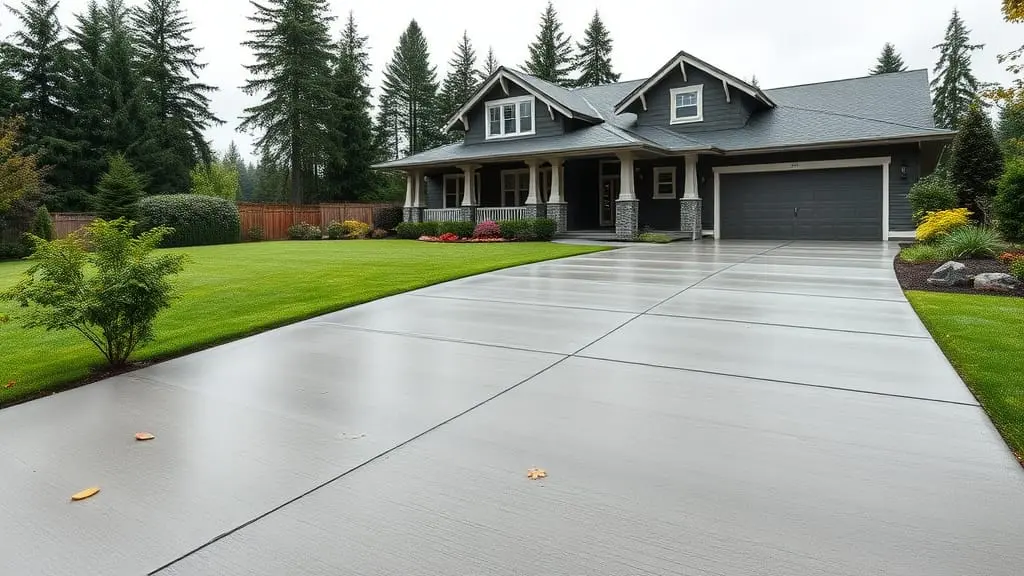
Winter driveway maintenance in Bellingham requires a different approach than what homeowners in snowbelt regions need. While we don't typically face the heavy snowfalls common east of the Cascades, our marine climate creates its own unique challenges: frequent freeze-thaw cycles, persistent dampness from Bellingham Bay, black ice formation on our hillside streets, and that green coating of moss that seems to appear overnight on any concrete surface.
After three decades maintaining concrete driveways throughout Whatcom County—from the steep slopes of South Hill to the relatively flat terrain of Barkley Village—we've learned what works in our specific climate. The key is prevention and timing: proper fall preparation prevents most winter problems, while a few strategic interventions during the wet season keep your driveway safe and functional.
Understanding Bellingham's Winter Conditions
Our winter weather patterns from November through March create specific stress points for concrete driveways. Unlike Eastern Washington's cold, dry winters or Western Oregon's milder temperatures, Bellingham sits in a unique zone where several damaging factors converge.
Average winter temperatures hover between 35-45°F during the day, dropping to 28-35°F on clear nights. This creates frequent freeze-thaw cycles—water penetrates concrete during wet days (and we have many), then expands as it freezes overnight, then thaws and contracts the next day. This repeated expansion and contraction causes concrete deterioration called "spalling," where the surface layer flakes or pops off.
We receive the majority of our 37 inches of annual rainfall during winter months. November through January typically see 4-5 inches per month, keeping concrete surfaces continuously damp. This persistent moisture accelerates several deterioration processes and makes moss and algae growth nearly inevitable without preventive treatment.
Bellingham's topography compounds these issues. Properties in South Hill, Sunnyland, Happy Valley, and parts of the Lettered Streets have sloped driveways where water flow, ice formation, and winter traction become safety concerns. Meanwhile, flatter areas in Cordata, Barkley, and the waterfront neighborhoods face different challenges with standing water and drainage.
Month-by-Month Maintenance Calendar for Whatcom County
The most effective driveway maintenance follows Bellingham's seasonal patterns. Here's what our concrete maintenance specialists recommend throughout the year.
October: Pre-Winter Preparation
This is your critical preparation month. Work done now prevents the majority of winter problems.
Deep cleaning: Power wash your driveway to remove all organic material, oil stains, and dirt. This isn't just cosmetic—organic material traps moisture against the concrete surface and creates spots where freeze-thaw damage begins. Pay special attention to areas under trees and along edges where debris accumulates. For homes in shaded areas like the Samish neighborhood or wooded parts of Birchwood, this cleaning is essential before moss treatment.
Crack assessment and repair: Inspect every inch of your driveway for cracks. Anything wider than 1/8 inch needs sealing before winter. Water infiltrating through cracks will freeze, expand, and turn hairline cracks into significant damage by spring. We use flexible polyurethane or epoxy-based crack fillers that can accommodate the slight movement concrete experiences during freeze-thaw cycles. DIY crack fillers are available at local hardware stores, but proper surface preparation (cleaning and drying) is critical for adhesion.
Moss and algae treatment: Apply preventive treatments now before winter growth begins. Bellingham's damp winters create perfect moss-growing conditions. Products containing zinc sulfate or copper sulfate work well for prevention. For established moss, we use oxygen bleach solutions (gentler on surrounding landscape than chlorine bleach) followed by scrubbing. This is particularly important on north-facing driveways or those with tree coverage.
Drainage evaluation: Walk your driveway during a rainstorm and identify where water pools or flows incorrectly. Water should flow off the driveway, not stand in puddles. Standing water during freeze events creates hazardous ice patches and accelerates concrete damage. If you have drainage problems, October is the time to address them—once winter rains begin, fixing drainage issues becomes much more difficult.
November: Sealing Deadline
November is your last opportunity for concrete sealing before winter. Sealers need at least 48 hours of dry weather to cure properly, and such windows become rare after Thanksgiving.
Why sealing matters in Bellingham: Quality penetrating sealers don't just sit on the surface—they penetrate into the concrete and create a hydrophobic barrier that repels water. This dramatically reduces freeze-thaw damage by preventing water absorption. Sealers also resist oil stains, make moss removal easier, and enhance the concrete's appearance.
Sealing requirements: The concrete must be completely dry (difficult in November, so watch weather forecasts carefully), clean, and above 50°F for application. You need 48-72 hours of dry weather—before AND after application. This is why October is actually preferable if possible. We typically use penetrating silane/siloxane sealers for Bellingham driveways, as they're breathable (allowing interior moisture to escape) while repelling exterior water.
Professional vs. DIY sealing: Homeowners can apply sealers, but proper application is critical. Too much creates a slippery surface, too little provides inadequate protection, and uneven application creates blotchy appearance. Our team pressure-sprays sealers at precise rates for uniform coverage. For sloped driveways common in South Hill and Sunnyland, proper application technique prevents product runoff before it cures.
If November weather doesn't cooperate, postpone sealing until spring rather than rushing application in poor conditions. A poorly applied sealer can cause more problems than no sealer at all.
December-February: Active Winter Care
During our wettest months, maintenance shifts from prevention to active management.
Regular debris removal: Sweep or blow leaves, needles, and other organic debris off your driveway weekly. Organic material creates a constantly damp layer against concrete—exactly what you want to avoid. This is especially important after wind storms, which are common during Bellingham's winter months.
Standing water management: After heavy rains, squeegee or sweep standing water off your driveway, particularly in areas where it tends to pool. This reduces freeze risk and moss growth. If you consistently have standing water in the same locations, mark these spots for drainage improvements in spring.
Ice and snow response: We typically see 3-6 snow events per winter in Bellingham, usually light (1-4 inches). Our bigger concern is black ice formation on clear, calm nights, particularly on shaded or north-facing driveways. More on this in the next section.
Moss spot-treatment: If moss appears despite fall prevention efforts, spot-treat immediately. Winter moss grows quickly in our climate and becomes much harder to remove once established. A spray bottle with diluted moss-killer solution handles small patches easily.
Monitor for damage: Check your driveway after any hard freeze event (temperatures below 25°F). Look for new cracks, spalling, or surface scaling. Document with photos. Most winter damage can't be repaired until spring, but knowing what needs fixing helps you plan.
March: Spring Assessment and Repair Planning
As winter rains taper off (though we typically still receive 2-3 inches in March), assess what damage occurred and plan repairs.
Comprehensive inspection: Document all cracks, spalling, staining, and drainage problems. Compare to your pre-winter photos if you took them. This reveals which areas are most vulnerable and need priority attention.
Deep cleaning: Power wash thoroughly to remove winter grime, moss that established during winter, and any de-icing residue. This prepares the surface for repairs and sealing.
Schedule repairs: March and April are when our concrete driveway repair team books up for the season. Schedule crack repairs, surface restoration, or replacement sections early. Most repairs require several days of dry weather, so April through September is the ideal window, with July-August being the most reliable weather.
Plan improvements: If winter revealed drainage problems, moss-prone areas, or structural issues, spring is the time to plan solutions. Drainage improvements, partial replacement, or application of decorative overlays can transform problematic driveways.
The De-Icing Salt Problem in Pacific Northwest Concrete
This deserves special attention because the relationship between de-icing products and concrete damage is particularly severe in Bellingham's climate—and commonly misunderstood.
Traditional rock salt (sodium chloride) and calcium chloride ice melters accelerate concrete deterioration through several mechanisms. First, they increase the number of freeze-thaw cycles concrete experiences. Salt lowers water's freezing point, so salted moisture stays liquid at temperatures where plain water would freeze solid. This means the concrete experiences more freeze-thaw cycles (28-32°F is the most damaging range) than it would without salt.
Second, salt solutions penetrate deeper into concrete than plain water. When this saturated concrete finally does freeze (below about 20°F for salted water), the ice formation occurs deeper in the concrete structure, causing more severe internal damage called "scaling"—the surface layer literally scales off like fish scales.
Third, salt accelerates corrosion of any steel reinforcement in concrete (common in driveways with control joints and in stamped or decorative concrete). This creates internal pressure as rust occupies more volume than steel, cracking concrete from within.
Fourth—and particularly relevant in Bellingham—salt-laden runoff damages landscape plants, contaminates groundwater, and eventually flows into Bellingham Bay. Our marine environment and frequent rainfall mean salt spreads quickly beyond the driveway where it was applied.
Better alternatives for Bellingham driveways:
- Sand or cat litter: Provides traction without chemical damage. Use generously on sloped driveways. Sweep up and reuse after ice melts. This is our first recommendation for most situations.
- Calcium magnesium acetate (CMA): Non-corrosive, less harmful to concrete and plants, biodegradable. More expensive than salt but far less damaging. Available at some Bellingham garden centers and online.
- Beet juice or cheese brine products: Some commercial products use organic compounds that are less corrosive. These are increasingly popular in environmentally-conscious markets like Bellingham.
- Urea (carbonyl diamide): Less corrosive than salt but can damage vegetation and is less effective below 25°F. Use sparingly if at all.
If you must use traditional de-icers: Use the minimum effective amount (more doesn't melt faster), sweep up residue once ice melts, rinse driveway thoroughly with water as soon as temperatures moderate, and never use on concrete less than one year old (new concrete needs a full season to cure before salt exposure).
For most Bellingham winter days, strategic use of sand for traction combined with careful shoveling is sufficient. We rarely experience the sustained hard freezes that make chemical de-icers necessary.
Moss Prevention Strategies Specific to Our Climate
Moss is perhaps the most persistent nuisance for Bellingham driveways. Our combination of moisture, mild temperatures, and shade from evergreen trees creates ideal moss-growing conditions. Left unchecked, moss makes surfaces slippery (a hazard on sloped driveways), retains moisture against concrete (accelerating deterioration), and becomes progressively harder to remove as it establishes deeper root structures.
Prevention strategies:
Maximize sun exposure: Trim tree branches that shade your driveway. Every additional hour of direct sunlight dramatically reduces moss growth. This is particularly important for driveways on the north side of homes or under mature cedars and firs common in established neighborhoods.
Improve air circulation: Prune shrubs and vegetation near driveway edges. Good airflow helps surfaces dry between rain events, making them less hospitable to moss.
Eliminate standing water: Moss thrives where water pools. Fix drainage issues that create consistently damp spots. This might involve mudjacking (lifting settled concrete), creating drainage channels, or installing French drains to intercept water before it reaches the driveway.
Apply preventive treatments: Annual application of moss-prevention products creates an inhospitable surface. Zinc sulfate strips are particularly effective—they slowly release zinc compounds as rain washes over them. Install these along driveway ridges or high points where water runs off. This is the same technology used for moss prevention on roofs and works equally well on concrete.
Maintain sealers: Sealed concrete is less porous, giving moss less to grip. Maintain sealer every 2-3 years on driveways, more frequently on heavily shaded ones.
Regular cleaning: Quarterly power washing or brushing with oxygen bleach solution prevents moss from establishing. This is far easier than removing well-established moss. For homeowners in heavily wooded areas (Birchwood, parts of Sudden Valley, wooded sections of South Hill), quarterly cleaning may be necessary.
Addressing established moss: For existing moss, treat with moss killer, let it die (turns brown/yellow after 1-2 weeks), then power wash or scrub with a stiff brush. Repeat if necessary. Oxygen bleach (sodium percarbonate) is gentler on surrounding plants than chlorine bleach and works well for moss removal. Never use a wire brush or aggressive scraping, as this damages the concrete surface and creates more texture for future moss to grab.
How Bellingham's Terrain Affects Winter Driveway Maintenance
Topography dramatically influences what maintenance strategies work best for your specific driveway.
Hillside Properties (South Hill, Sunnyland, Happy Valley, Parts of Lettered Streets)
Sloped driveways face unique challenges:
Ice formation: Even slight slopes become treacherous with ice. Black ice forms on clear, calm nights when temperatures drop below freezing but no precipitation falls—moisture condensing from air or draining from above freezes into a nearly invisible, extremely slippery layer. South-facing driveways that get afternoon sun may melt slightly, then refreeze as black ice overnight. North-facing driveways in shade may stay icy for days.
Water flow: Sloped driveways naturally shed water, which is good for preventing standing water but means you need careful edge management. Water running off driveway edges can erode soil, create muddy areas, and undermine driveway support. Consider channel drains at the driveway bottom to capture and direct runoff.
Traction materials: Sand or cat litter is essential for sloped driveways. Keep a bucket near your garage and apply liberally before attempting to drive on ice. Application at the top of the slope (where you'll need traction to start) and steepest sections is most critical.
Sealer selection: Some sealers can create slippery surfaces when wet—exactly what you don't want on a slope. We use penetrating sealers (rather than topical/film-forming types) on sloped driveways. Adding slip-resistant additives (fine aggregate mixed into sealer) provides texture for traction.
Flat and Low-Lying Properties (Cordata, Barkley, Waterfront, North End)
Flatter terrain creates different challenges:
Standing water: Without natural slope, water pools in any low spots. These become both hazards (ice forms here first) and maintenance problems (moss grows, concrete stays saturated). Proper drainage design is critical. Our team often retrofits drainage solutions on flat driveways that were poorly designed initially.
Freeze damage: Standing water freezes solid and remains frozen longer than moving water or damp surfaces. This creates prolonged freeze-thaw stress. The priority is eliminating standing water through mudjacking, grinding, or drainage improvements.
Moss growth: Flat driveways in shaded areas become moss farms. Aggressive prevention is necessary—regular cleaning, preventive treatments, and sealing.
When to Schedule Spring Repairs
Not all winter damage requires immediate repair, but knowing what's urgent versus what can wait until ideal conditions helps you plan effectively.
Repair immediately (even in winter if possible):
- Structural cracks showing vertical separation or heaving (indicates foundation or subbase problems)
- Trip hazards from lifted sections (safety issue)
- Rapidly expanding cracks (indicates active problem)
- Severe spalling exposing aggregate or rebar (accelerates further damage)
Repair in spring when weather permits:
- Hairline to moderate cracks (under 1/4 inch) that aren't growing rapidly
- Surface scaling and spalling that's cosmetic rather than structural
- Settled sections that aren't creating trip hazards
- Staining and discoloration
Plan for next season:
- Chronic drainage problems that can't be easily fixed
- Worn surfaces considering decorative overlay or resurfacing
- Driveways approaching end of life (20-30 years old with multiple problems)
Most concrete repairs require sustained temperatures above 50°F and dry conditions for at least 48 hours. In Bellingham, this means April through October is the realistic repair window, with July-September being ideal. Our driveway repair specialists typically book spring appointments starting in February, so early planning ensures you get scheduled when weather permits work to begin.
Local Sources for Concrete-Safe Traction Materials
Being prepared for winter conditions means having materials on hand before you need them. Here's what works and where to find it locally:
Coarse sand: Available at landscape supply yards throughout Bellingham. Buy a few 50-lb bags in October and store in your garage. Sand provides excellent traction, doesn't damage concrete, and is environmentally neutral. After ice melts, sweep it up and reuse.
Cat litter (non-clumping): Available at any grocery or pet supply store. The clay variety provides good traction. More expensive than sand but convenient to store in small spaces.
Wood ash: If you have a wood stove or fireplace, save your ash. It provides modest traction and contains minerals that slightly lower water's freezing point without the corrosive effects of salt. Apply sparingly—too much creates a messy paste.
Chicken grit or poultry scratch: Available at farm supply stores like Tractor Supply or local feed stores. The granite grit provides excellent traction and is relatively inexpensive.
Commercial ice-melt alternatives: Some Bellingham garden centers and hardware stores carry CMA (calcium magnesium acetate) and other concrete-safe alternatives. These are worth seeking out for areas where you need actual ice melting rather than just traction.
As a general rule, keep at least 100 pounds of traction material on hand if you have a sloped driveway. For flat driveways, 25-50 pounds is typically sufficient for a typical Bellingham winter.
Professional Maintenance Services
While many maintenance tasks are DIY-friendly, professional services ensure optimal driveway longevity, particularly for preventive treatments that require specialized equipment.
Our maintenance packages include: pressure washing with commercial-grade equipment that removes organic growth without damaging concrete surfaces, professional-grade sealer application with even coverage and optimal curing conditions, crack repair using commercial materials with better longevity than consumer products, drainage assessment and improvements to address root causes of standing water, and moss prevention treatments including zinc sulfate strip installation.
For homeowners throughout Whatcom County—from Sudden Valley to the waterfront, from Birchwood to Fairhaven—we offer seasonal maintenance programs that handle all preventive care on a schedule optimized for our climate. Fall preparation and spring assessment visits ensure your driveway receives attention at the times that matter most.
Winter driveway maintenance in Bellingham doesn't require daily attention, but it does require seasonal awareness and a few strategic interventions. Protect your investment with proper fall preparation, avoid corrosive de-icing salts, manage moss growth proactively, and address damage promptly each spring. Following these practices, your concrete driveway can provide decades of reliable service despite the challenges our Pacific Northwest climate presents.
Ready to get started? Contact us today for a free estimate — we serve all of Bellingham and Whatcom County.