
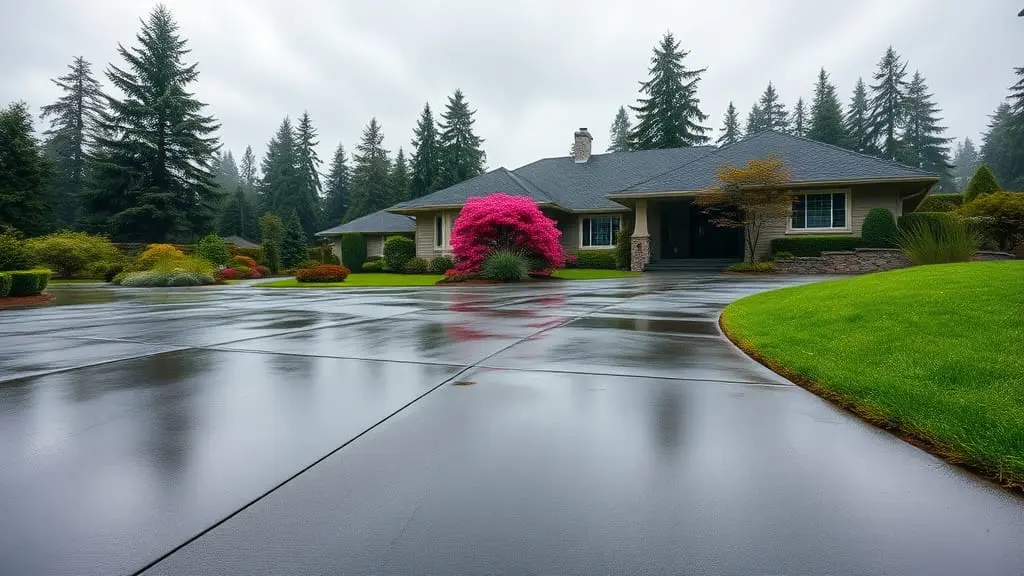
Concrete is one of the most durable building materials on the planet, but in Whatcom County it faces a relentless opponent: our marine climate. With 37 inches of annual rainfall, freeze-thaw cycles through our 35-45°F winters, and a wet season stretching from October through April, even well-installed concrete needs consistent attention to reach its full 30- to 50-year lifespan. Skip a year of maintenance and you could be looking at spalling, cracking, or staining that cuts that lifespan in half.
We have maintained, repaired, and replaced concrete across every Bellingham neighborhood—from the century-old walkways of the Lettered Streets to modern stamped patios in Cordata. The pattern we see is unmistakable: homeowners who follow a seasonal maintenance routine spend a fraction of what those who neglect their surfaces pay in emergency repairs. This checklist distills our decades of local experience into a practical, month-by-month guide for every concrete surface on your property.
Spring: Inspection and Damage Assessment (March - May)
Spring is the most important season for concrete maintenance in Whatcom County. Winter has done its worst—now is the time to find and address the damage before it compounds. We recommend walking every concrete surface on your property during a dry stretch in late March or early April, notepad in hand.
March: Post-Winter Walkthrough
- Inspect for new cracks: Look for hairline cracks, spalling (surface flaking), and any evidence of heaving or settling. Pay special attention to joints and edges where water pools. Homes on South Hill and Alabama Hill should check sloped driveways where runoff concentrates at the base.
- Check for frost damage: Freeze-thaw cycles cause pop-outs and surface scaling. Run your hand across the surface—if it feels rough or gritty where it was once smooth, the surface layer has begun to deteriorate.
- Examine expansion joints: The flexible material in control joints can degrade over winter. Gaps allow water infiltration that accelerates sub-base erosion. Press on the joint filler—if it is hard, crumbling, or missing entirely, plan to reseal.
- Assess drainage paths: Walk your property during or just after rain. Standing water on or against concrete is the single biggest threat to longevity. Puddling along driveways or against foundations needs to be corrected immediately.
April - May: Spring Cleaning and Minor Repairs
- Power wash all surfaces: Remove the accumulated grime, moss, and algae from winter. In shaded areas common in Sehome and Samish, biological growth can be heavy by spring. Use a 3,000 PSI pressure washer with a 25-degree tip, keeping the nozzle 8-12 inches from the surface. A fan tip prevents etching.
- Remove moss and algae: After power washing, apply a moss killer formulated for concrete. Avoid bleach-heavy solutions that can discolor stamped or decorative concrete. Oxygen-based cleaners are effective and surface-safe.
- Fill hairline cracks: Cracks under 1/4 inch can be sealed with a flexible concrete caulk or crack filler. Clean the crack thoroughly first—debris prevents adhesion. For cracks wider than 1/4 inch, or cracks that have shifted vertically, call a professional. These may indicate structural movement.
- Reseal expansion joints: Remove old, deteriorated joint filler with a flat screwdriver and wire brush. Apply self-leveling polyurethane sealant rated for exterior use. This is especially critical for properties in Birchwood and Silver Beach where high water tables increase hydrostatic pressure against slabs.
Estimated spring maintenance cost: $150-$400 for DIY cleaning supplies, crack filler, and joint sealant. Professional power washing runs $200-$500 depending on total square footage. Professional crack repair averages $300-$800 for a typical driveway.
Summer: Sealing and Protection (June - August)
Bellingham's brief dry season is your window for the single most impactful maintenance task: sealing. Concrete sealers require dry conditions for proper adhesion and curing—typically 48 hours without rain before and after application. Our July and August weather provides the most reliable dry stretches, though some years late June works well too.
When and How to Seal
- Timing: Seal when the forecast shows at least three consecutive dry days with temperatures between 50-90°F. Surface temperature matters—test with a thermometer. Early morning application avoids direct sun that can cause sealers to dry too quickly and bubble.
- Product selection: For Whatcom County's climate, we recommend penetrating silane/siloxane sealers for driveways and slabs. These soak into the concrete rather than forming a surface film, providing water repellency without changing appearance or creating a slippery surface. For decorative or stamped concrete, acrylic sealers enhance color but require reapplication every 2-3 years.
- Application: Clean the surface thoroughly and allow it to dry completely—at least 24 hours after washing. Apply with a pump sprayer in thin, even coats. Two thin coats outperform one heavy coat every time. Allow 4-6 hours between coats.
- Coverage: Plan for 200-300 square feet per gallon for penetrating sealers. A two-car driveway (approximately 400-600 sq ft) typically requires 2-3 gallons at $30-$50 per gallon.
Additional Summer Tasks
- Stain removal: Oil stains from vehicles, rust stains from furniture, and organic stains from leaf litter are easiest to remove in warm, dry conditions. Poultice-type stain removers work best on set-in oil stains—common on Edgemoor and Fairhaven driveways where mature trees drop sap.
- Inspect retaining walls: Summer is ideal for examining retaining walls for lean, bulging, or weep hole blockage. Vegetation growth can mask structural issues. Clear all plants from wall faces and check for movement.
- Address drainage issues identified in spring: Regrading, adding drain channels, or extending downspouts should be completed during dry weather when soil is workable and concrete can cure properly.
Estimated summer maintenance cost: $100-$250 for DIY sealing materials. Professional sealing runs $0.50-$1.50 per square foot—typically $300-$900 for a complete driveway and walkway treatment. Stain removal products cost $20-$60.
Fall: Preparation for Winter (September - November)
As the rains return in October, your goal shifts from improvement to protection. Everything you do in fall is about preventing water from getting into and under your concrete before freeze-thaw cycles begin.
September: Final Inspection and Corrections
- Verify sealer effectiveness: Splash water on sealed surfaces. If it beads up, the sealer is performing. If it soaks in, you may need to reapply before the wet season—though application windows become unreliable after mid-September in Whatcom County.
- Clear debris from joints and edges: Leaf litter trapped in expansion joints and along slab edges holds moisture against concrete. Properties in Happy Valley and York with mature deciduous trees need thorough clearing as leaves begin to fall.
- Trim vegetation: Cut back shrubs and ground cover that contact concrete surfaces. Plant material traps moisture and promotes biological growth. Maintain at least a 3-inch gap between landscaping and concrete edges.
October - November: Winter-Proofing
- Check and clear gutters and downspouts: Overflowing gutters dump concentrated water onto driveways, walkways, and against foundations. A single clogged downspout can deposit hundreds of gallons of water onto a slab during a November storm. This is especially critical for properties in Geneva and Columbia where older homes may have undersized drainage systems.
- Verify positive drainage: Walk the property during a rainstorm. Water should flow away from all concrete surfaces and never pool against foundation walls. Settling can change drainage patterns over time—what worked last year may not work this year.
- Apply moss preventative: Zinc sulfate or copper-based moss prevention products applied in October can significantly reduce winter moss growth. Sprinkle dry zinc sulfate granules along areas prone to moss—typically north-facing surfaces and shaded zones.
- Protect vulnerable surfaces: New concrete poured within the last year is especially vulnerable to its first winter. Consider applying an additional coat of sealer if not already done in summer. Properties in Ferndale and Lynden, where temperatures occasionally dip below freezing for extended periods, should be particularly diligent.
- Store deicing supplies: Purchase calcium magnesium acetate (CMA) or sand for winter traction. Never use sodium chloride (rock salt) or calcium chloride on concrete—they cause surface scaling and spalling.
Estimated fall maintenance cost: $50-$150 for moss preventative, clearing supplies, and safe deicing products.
Winter: Monitoring and Safe Practices (December - February)
Winter is about vigilance and gentle treatment. Heavy maintenance is off the table—cold, wet conditions prevent sealing, patching, or any work requiring dry curing. Focus on preventing damage through careful practices.
Safe Snow and Ice Management
- Use safe deicers only: Calcium magnesium acetate (CMA) is the safest option for concrete. Sand provides traction without any chemical risk. Rock salt is the worst offender—it accelerates freeze-thaw damage and can cause surface spalling within a single winter on newer concrete. We see salt damage every spring on properties in Sudden Valley and Birch Bay where homeowners used the wrong products.
- Shovel promptly: Remove snow before it compacts into ice. Use a plastic-edged shovel to avoid scratching sealed surfaces. On stamped concrete, metal shovels can chip the textured surface.
- Avoid piling snow against structures: Snow melt against foundation walls, garage slabs, and retaining walls creates sustained moisture exposure. Push snow away from all concrete structures.
Winter Monitoring Tasks
- Watch for new cracks after hard freezes: After any freeze event below 28°F, walk your concrete surfaces and note any new cracking. Do not attempt repairs in winter—document them for spring attention.
- Monitor basement and crawlspace moisture: Increased water intrusion during winter storms can signal foundation waterproofing failure. Check for new water stains, efflorescence (white mineral deposits), or dampness along foundation walls.
- Clear ice dams at garage door transitions: Water that freezes at the threshold between a garage slab and driveway can heave the joint and create tripping hazards. Gentle CMA application prevents this buildup.
- Keep drains clear: Channel drains and catch basins can clog with debris during winter storms. Check them monthly and clear any blockages to prevent water from backing up onto concrete surfaces.
Estimated winter maintenance cost: $30-$80 for deicing products and replacement shovel blades over the season.
Surface-Specific Annual Checklists
Different concrete surfaces have different maintenance priorities. Here is a quick-reference guide for the most common surfaces on Whatcom County properties.
Driveways
- Spring: Inspect for cracks, clean oil stains, power wash, fill cracks
- Summer: Seal entire surface, address drainage issues
- Fall: Clear edges, verify sealer, stock safe deicers
- Winter: Shovel promptly, use CMA only, monitor for new cracks
- Annual budget: $200-$600 DIY; $500-$1,500 professional
Patios, Walkways, and Foundations
- Patios: Spring moss removal and power washing, summer sealing (acrylic for decorative, penetrating for standard), fall leaf clearing and moss preventative. Annual budget: $150-$500 DIY; $400-$1,200 professional.
- Sidewalks: Spring trip-hazard inspection, summer sealing, fall vegetation clearing, winter traction priority. Annual budget: $75-$200 DIY; $200-$500 professional.
- Foundations: Spring crack and efflorescence checks, summer waterproofing repairs, fall gutter verification, winter moisture monitoring. Annual budget: $100-$300 DIY; professional waterproofing $2,000-$8,000 if needed.
When DIY Maintenance Is Not Enough
This checklist covers routine maintenance that most homeowners can handle. However, some situations require professional evaluation. Call a concrete contractor if you observe any of the following:
- Cracks wider than 1/4 inch or cracks that are growing
- Vertical displacement where one side of a crack is higher than the other
- Slab settling or sinking creating uneven surfaces or water pooling
- Widespread surface spalling beyond minor flaking
- Water intrusion through foundation walls or basement floor
- Retaining wall movement—leaning, bulging, or cracking
- Surfaces beyond repair where removal and replacement may be more cost-effective than continued patching
We provide free assessments throughout Whatcom County. Our inspections identify root causes—not just symptoms—so repairs address the actual problem. Whether your Sunnyland bungalow needs a driveway reseal or your Blaine waterfront home has foundation concerns, honest evaluation comes first.
The Bottom Line: Maintenance Pays for Itself
A complete annual maintenance program for all concrete surfaces on a typical Bellingham property costs $400-$1,000 per year when handled by a professional, or $200-$500 in materials if you do it yourself. Compare that to the cost of premature replacement: $8-$15 per square foot for a basic slab, $15-$30+ for decorative work. A 600-square-foot driveway replacement runs $5,000-$9,000. A decade of diligent maintenance costs a fraction of that—and extends your concrete's life by 10-20 years.
Whatcom County's climate is demanding, but it is also predictable. You know the rain is coming in October. You know freeze-thaw cycles will hit between December and February. You know moss will grow on every north-facing surface. By following this seasonal checklist, you work with our climate rather than being surprised by it—and your concrete will show the difference for decades.
Ready to get started? Contact us today for a free estimate — we serve all of Bellingham and Whatcom County.